Skip to content

How to Prevent Forklift Accidents: A Practical Guide for Warehouse Managers
Forklift accidents rarely come from a single bad decision — they come from small gaps in layout, training, inspection, and visibility stacking up until one shift they line up at the same time. This guide walks through exactly where those gaps usually form and how to close them, section by section.
Every warehouse manager has heard some version of the same statistic: forklifts are involved in tens of thousands of workplace injuries every year, and a meaningful share of those are fatal. What's less often explained is why — and more importantly, what actually moves the needle once you already run daily checks and hold a monthly toolbox talk. This guide is built around one question: if you manage a warehouse floor, what should you actually change this month to reduce forklift accidents, not just document that you thought about them?
1. Why Forklift Accidents Keep Happening
Most warehouses already have a safety policy, a training program, and a forklift checklist taped to the wall. So why do incidents keep happening anyway? Because a policy on paper and a floor in practice are two different things. Forklift accidents tend to happen at the seams — the moment a picker steps out from an end-of-aisle rack the same second a truck is turning in, or the split second an operator relies on a mirror that's angled two degrees off from where it should be.
None of that shows up on an audit checklist. It shows up in the daily rhythm of the floor: how aisles are marked, how fast operators actually travel versus the posted limit, whether near-misses get reported or shrugged off, and whether the operator has any warning system beyond their own eyes and a horn.
2. The Leading Causes of Forklift Accidents, Ranked
Not every cause carries equal weight. Understanding which ones are driving injuries — not just incidents — tells you where to spend your first dollar and your first hour of training time.
| Cause | Why It Happens | Typical Severity |
|---|---|---|
| Struck-by pedestrian incidents | Blind intersections, no separated walkways, pedestrians stepping into travel lanes | High — most reported fatalities |
| Tip-overs | Overloaded or off-center loads, turning too fast, uneven or wet floor surfaces | High — severe injury, extended downtime |
| Falling loads | Improperly stacked pallets, exceeding rated load center, unsecured loads at height | Medium–High — injury and product loss |
| Forklift-to-forklift collisions | Shared intersections, blind corners near racking, no right-of-way convention | Medium — equipment damage, occasional injury |
| Dock and staging incidents | Trailer creep, poor lighting, congestion during loading/unloading | Medium — injury during dock transitions |
| Running off the dock or platform | Missing wheel chocks, no dock lock, operator misjudging edge distance | High — severe fall injury |
Struck-by incidents and tip-overs consistently account for the most severe outcomes, which is why Sections 5 and 7 of this guide carry more detail than the rest — that's where the highest-leverage fixes live.
3. What a Forklift Accident Actually Costs
The injury or the damaged rack is only the visible part. A single forklift incident sets off a chain of secondary costs that's easy to underestimate when you're building the case for safety spending internally:
- Operational downtime while the area is cleared, investigated, and the incident is documented — often a full aisle or dock door out of service.
- Equipment and product damage, including racking that may need engineering re-certification after a strike.
- Regulatory exposure — an inspection, a citation, or closer scrutiny across the rest of the site.
- Workers' comp and insurance impact that outlasts the immediate repair cost by years, not months.
- Team morale — a visible incident makes every operator on that floor more anxious, which can paradoxically increase errors rather than reduce them.
Weighed against that chain of costs, the price of the controls that prevent it — better markings, a training refresher, a pedestrian detection system — is almost always the cheaper side of the ledger. If you haven't scored your own facility's exposure yet, our warehouse risk assessment framework walks through a practical 5-step process for doing that.
4. The Five-Layer Prevention Framework
No single control prevents forklift accidents on its own — mirrors help but rely on attention, training helps but fades over time, and technology helps but isn't a substitute for a trained operator. The facilities with the lowest incident rates combine five layers so that when one fails, another catches it.
Warehouse Layout & Traffic Design
Marked lanes, managed blind corners, and separated pedestrian paths that reduce how often people and trucks occupy the same space unexpectedly. Section 7.
Pre-Shift Inspection
A non-negotiable, documented check before every shift, with a clear out-of-service rule for anything that fails. Section 6.
Operator Training & Certification
Initial certification plus scheduled refreshers — not training that stops the day someone passes their first test. Section 8.
Active Detection Technology
Systems that catch the split-second a pedestrian steps around a rack or a truck approaches an intersection too fast. Section 9.
Reporting & Continuous Improvement
A near-miss log that actually gets reviewed, so the same blind corner doesn't keep almost causing the same accident. Section 10.
5. Preventing Forklift–Pedestrian Accidents
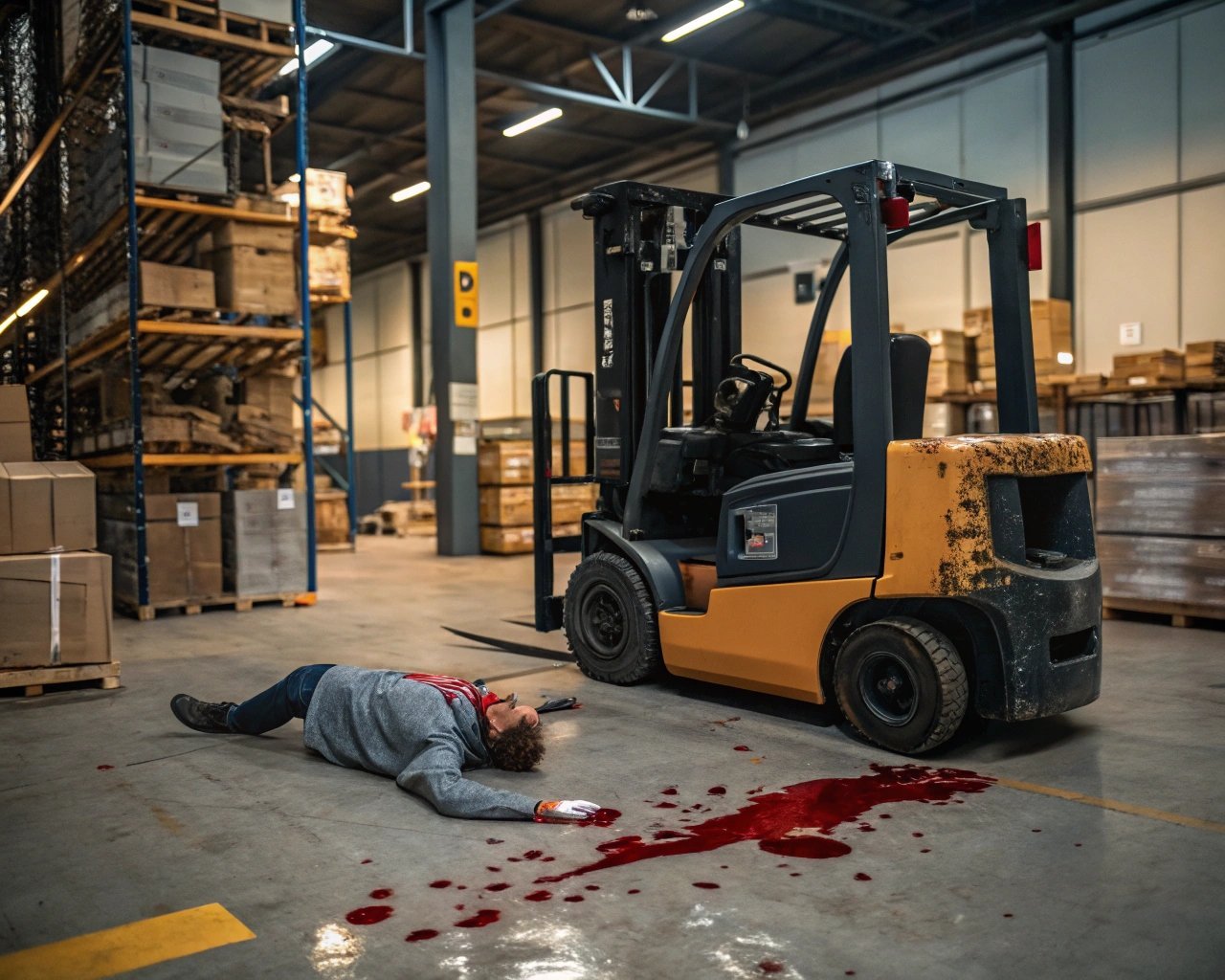
Struck-by incidents cause the most severe outcomes in almost every warehouse safety report, and they're rarely a rule-following problem. An operator can be certified, alert, and driving at a safe speed and still not see someone who steps out of a cross-aisle at the wrong second. Reducing this risk means working three angles at once, not picking one:
- Separate the paths physically wherever you can. Painted lanes, floor markings, and barriers between forklift routes and walkways cut down the number of moments where a person and a truck share the same square footage.
- Treat every blind corner as a known hazard, not a surprise. Convex mirrors help at low speed, but they only work if both parties happen to be looking at the right moment.
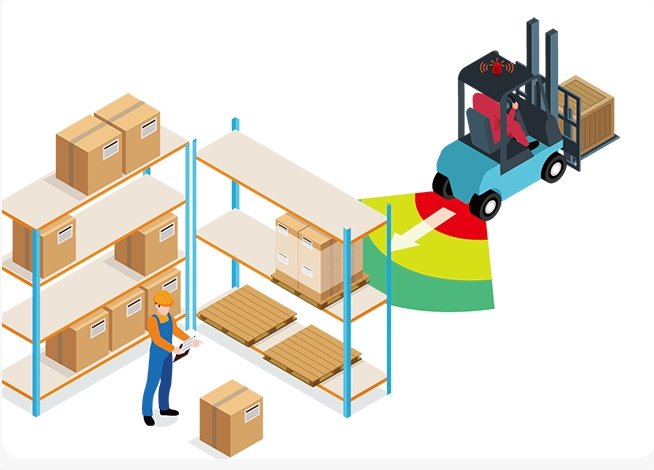
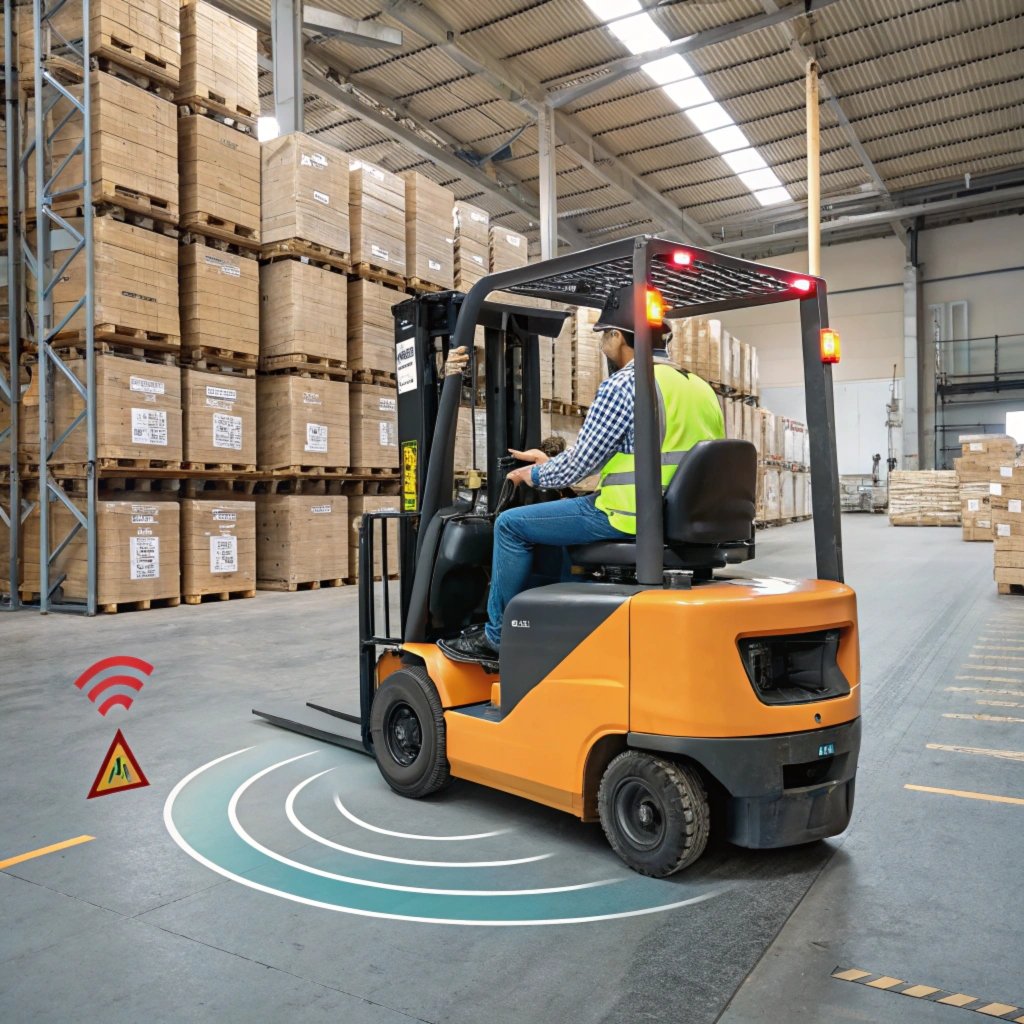
- Give the operator an active warning, not just a passive aid. This is where most warehouses see the single biggest improvement — a system that alerts the operator the instant a pedestrian enters a blind zone, instead of relying on the operator spotting them first.
It's also worth learning to tell a near-miss apart from an actual accident when you're building out your prevention program. Near-misses are your early warning system, and treating them as noise is one of the most common ways a warehouse misses a pattern before it becomes an injury — see our breakdown of forklift near-miss vs. forklift accident reporting for how to build that habit into your team.
6. Pre-Shift Inspection Checklist
A documented inspection before every shift catches mechanical problems before they turn into incidents, and it creates a paper trail that matters if an investigation ever happens. Beyond the standard OEM checklist, a few items deserve extra attention on a busy warehouse floor:
- Horn, backup alarm, and any fitted camera or pedestrian-alert system — these carry more weight in a warehouse with narrow aisles than almost anywhere else.
- Tires and forks for visible damage, especially on floors that mix smooth concrete with dock plates, expansion joints, or debris near receiving.
- Mirrors and any blind-spot camera monitor, checked for cleanliness and correct alignment before the shift starts — not after a near-miss.
- Load charts and data plate legibility, particularly on trucks shared across shifts or moved between different attachment setups.
- Brakes and steering response, tested at low speed before the truck is loaded and sent into active aisles.
Any defect that affects safe operation should take the truck out of service immediately. A verbal "it's probably fine" is one of the most common ways a known issue turns into a documented incident.
7. Warehouse Layout & Traffic Design
Layout is often the single biggest lever a warehouse has, because most incidents happen at the same handful of predictable intersection points, shift after shift. A few targeted changes go a long way even if you can't redesign the whole floor:
- Mark every crossing point between a forklift route and a walkway with floor tape, hatching, or raised markers — not just the main aisles, but every access point into a picking or staging zone.
- Walk the floor deliberately looking for blind corners rather than reacting after a near-miss — flag every point where sightlines drop under roughly 10–15 feet.
- Keep staged pallets out of natural forklift turning radii wherever possible; a truck making a tight turn around staged material has far less room to react to someone appearing unexpectedly.
- Treat loading docks as their own risk zone — poor lighting, trailer creep, and the transition between dock and open floor account for a disproportionate share of incidents relative to how much space they cover.
- Set and enforce a consistent right-of-way rule at every intersection so operators aren't guessing who yields when two routes cross.
8. Operator Training That Actually Sticks
Most warehouses already run initial certification. Where programs break down is what happens after that first pass — training that stops at hire tends to fade exactly when complacency sets in, usually somewhere between six months and a year in, once the routes start to feel routine.
- Site-specific orientation for every operator, including experienced hires transferring from another facility — a different warehouse's blind corners and traffic patterns aren't intuitive on day one.
- Scheduled refresher training, not just training triggered by an incident — waiting for something to go wrong before retraining keeps the whole program reactive.
- Immediate retraining after any near-miss, observed unsafe behavior, or a switch to a different truck class or attachment.
- Fatigue and attention awareness built into refreshers — a tired operator is statistically more likely to be involved in a struck-by incident, which is why some warehouses now pair refresher training with a driver fatigue monitoring system on longer or overnight shifts.
9. Where Technology Closes the Gaps Training Can't
Training and layout changes reduce risk, but neither one fully compensates for the split-second nature of a blind-corner encounter. This is the gap safety technology is built to close — not as a replacement for training, but as the layer that catches what a well-trained, attentive operator still can't physically see in time.
- Pedestrian detection gives an active alert the moment a person enters a blind zone or intersection, instead of relying on the operator spotting them first.
- Forklift-to-forklift proximity warning reduces collisions at shared intersections and staging points where multiple trucks converge on a predictable schedule — see our proximity warning system overview.
- Camera systems extend the operator's field of view around racking and reversing blind spots that mirrors alone don't fully cover — our comparison of forklift cameras vs. mirrors breaks down how the two compare in practice.
- Speed limiting keeps trucks inside a safe travel speed automatically in high-traffic zones, cutting stopping distance right at the intersections where it matters most — see our forklift speed limiter page for how this works on the ground.
- Recorded-event footage turns every near-miss into usable data — instead of relying on memory, you can review exactly what happened, retrain the right operator, and fix the specific layout issue that caused it.
None of this replaces a trained, alert operator — but a warehouse that pairs solid training with an active forklift anti-collision system is working with two independent layers of protection instead of one, which is exactly what keeps a single missed glance from becoming an injury.
Reducing Forklift Accidents in Your Warehouse?
We design the AI pedestrian detection, camera, and speed-control systems that give your operators an extra layer of protection your layout and training alone can't provide.
Talk to a Forklift Safety Specialist10. Building a Reporting Culture, Not Just a Reporting Form
A near-miss log only helps if someone actually reads it. The warehouses that consistently reduce incident rates year over year tend to do three things differently:
- Make reporting fast and blame-free. If reporting a near-miss feels like inviting a write-up, operators stop reporting — and you lose your earliest warning signal.
- Review the log on a fixed schedule, not just after something serious happens. A monthly pattern review usually surfaces the same one or two locations well before an injury does.
- Close the loop visibly. When operators can see that reporting a blind corner led to a mirror, a marking change, or a technology install, they keep reporting. When nothing visibly changes, they stop.
This is the layer most warehouses underinvest in, largely because it doesn't show up as a line item the way a new camera system does — but it's often the cheapest fix available, since it mostly costs attention rather than budget.
11. Common Mistakes Warehouses Make
- Treating layout as fixed because it's always been that way — even small marking and barrier changes at high-traffic intersections meaningfully cut risk.
- Logging near-misses informally, or not at all — without a pattern to look at, the same blind corner keeps almost causing the same incident until it finally does.
- Letting training lapse after initial certification — complacency, not lack of skill, is what tends to creep in on repetitive routes.
- Relying on mirrors alone at high-traffic blind corners — they help, but they depend on both parties looking at the right moment.
- Mixing forklift and pedestrian foot traffic through the same dock access point without a separated walkway or staggered schedule.
- Assuming a "quiet" floor is a safe one — the absence of a recent incident isn't the same as the absence of risk; it often just means the near-misses haven't been counted yet.
12. Frequently Asked Questions
Tap a question to expand the answer — tap again to collapse it.