Skip to content

Forklift Camera vs Mirrors: Which One Actually Stops Blind-Spot Accidents?
Convex mirrors have been the default for decades — but they only work if an operator looks at the right one, at the right moment, at the right angle. Here's what mirrors can and can't do, how camera-based systems close the gap, and how to decide what your fleet actually needs.
Walk into almost any warehouse and you'll find the same setup: a forklift, a set of dome or flat mirrors bolted at the aisle intersections, and an operator trusting both. It's cheap, it's familiar, and it's been "good enough" for fifty years. But near-miss reports keep telling the same story — the load was fine, the aisle was clear on the mirror, and the forklift still clipped a pallet rack or came within inches of a pedestrian who simply wasn't where the mirror could show them.
This isn't an anti-mirror article. Mirrors are cheap, they need no power, and they still earn their place on a forklift. The real question warehouse managers should be asking isn't "mirrors or cameras" — it's where mirrors run out of physics, and whether a camera-based anti-collision system is worth adding at those exact points.
📋 What This Guide Covers
- 1. What Forklift Mirrors Actually Do
- 2. What a Forklift Camera System Sees Instead
- 3. Mirrors vs Cameras: Head-to-Head Comparison
- 4. The Blind Spot Math Mirrors Can't Solve
- 5. Reaction Time: Habit vs Automatic Alert
- 6. Real Cost: Mirrors vs Camera Systems
- 7. Where Mirrors Still Earn Their Place
- 8. Three Warehouse Scenarios Where Mirrors Fail
- 9. How a Camera-Based Anti-Collision System Works
- 10. Choosing the Right Setup for Your Fleet
- 11. FAQs
1. What Forklift Mirrors Actually Do
A convex mirror does one job: it bends a wide field of view into a curved surface so an operator can glance at a fixed point — usually a blind aisle intersection — and see a compressed image of what's approaching. That's genuinely useful at low-traffic corners where the geometry is simple and consistent.
But a mirror only helps if three things line up every single time: the operator looks at it, looks at the right moment, and correctly judges distance and speed from a curved, reversed, often dusty or fogged reflection. Convex mirrors are known to compress depth perception — objects appear farther away and smaller than they really are, which is exactly the wrong distortion to have when a pedestrian is closing in on a blind corner.
A mirror is a fixed, passive surface. It doesn't alert anyone — it only shows an image to someone who is already looking in the right direction. If the operator is checking a load, glancing at a lift height indicator, or simply looking straight ahead through an intersection, the mirror's information never reaches them.
2. What a Forklift Camera System Sees Instead
A camera-based forklift anti-collision system replaces "an operator hoping to catch a reflection" with a continuously active sensor. Wide-angle or AI-powered cameras mount at the rear, sides, or mast of the truck and feed a live image — or, on AI-enabled systems, a processed pedestrian-detection alert — directly to a display inside the cab.
The meaningful difference isn't just "a bigger picture." It's that modern camera systems can run AI-based human detection on that video feed, meaning the system itself watches for a person entering the danger zone and triggers an audible or visual alert — instead of relying on the operator to notice, interpret, and react to a mirror image on their own.
🪞 Mirror-Only Setup
- Passive — shows an image, doesn't alert anyone
- Requires the operator to look at the exact moment of risk
- Curved surface compresses distance and speed judgment
- Fogs, dust, vibration, and misalignment degrade it over time
- No record of what happened before a near miss
📷 Camera-Based System
- Active — can trigger an alert without operator input
- Continuous coverage, not dependent on a glance timed correctly
- True-perspective or AI-processed image, less distance distortion
- Some models add recording for incident review and coaching
- Can be paired with pedestrian AI detection for automatic warnings
3. Mirrors vs Cameras: Head-to-Head Comparison
| Factor | Convex Mirror | Camera-Based System |
|---|---|---|
| Requires operator to look at exact moment | ✕ Yes, always | ✓ Reduced with AI alerts |
| Works in low light / at night | ✕ Degrades sharply | ✓ IR / low-light models available |
| Distance & speed accuracy | Distorted by curvature | True or near-true perspective |
| Can trigger an automatic alert | ✕ No | ✓ With AI detection models |
| Coverage at reversing / rear blind zone | Limited, single fixed angle | Dedicated rear/side camera feed |
| Incident review / footage available | ✕ None | ✓ On recorder-equipped models |
| Upfront cost | Very low | Moderate, scales with features |
| Maintenance | Occasional realignment/cleaning | Periodic lens cleaning, firmware checks |
| Best used | Simple, low-traffic fixed corners | Blind reversing, pedestrian-heavy zones, high-traffic aisles |
4. The Blind Spot Math Mirrors Can't Solve
A standard counterbalance forklift has three structural blind zones that no single mirror placement fully resolves: directly behind the mast when carrying a tall or wide load, the overhead reach zone when forks are raised, and the rear counterweight swing radius when turning in a tight aisle. Each of these needs a different viewing angle at a different moment — which is exactly why a single fixed mirror can only ever cover one of them well.
Multiplying mirrors to cover every zone creates a different problem: operator overload. Once a truck has three, four, or five mirrors positioned around a facility, the operator has to remember which one applies to which movement, and check it in the two or three seconds before the truck enters that zone. In practice, that's a lot to ask of someone who is also watching the load, the forks, and the aisle ahead.
Most forklift-to-pedestrian near misses happen at intersections and during reversing — precisely the two movements where the operator's attention is already split between the mirror, the load, and the direction of travel. A system that watches the blind zone continuously and alerts on its own removes the "did they check the mirror in time" variable entirely.
5. Reaction Time: Mirror Habit vs Automatic Alert
With a mirror, the full safety chain depends on the operator: notice the mirror exists → look at it → interpret the curved image → judge distance and speed → decide to slow or stop → act. Miss any one link — especially under time pressure, fatigue, or a repetitive route the operator has driven hundreds of times — and the chain breaks.
An AI camera-based system shortens that chain. The camera continuously watches the zone, the onboard processor flags a person or obstacle entering it, and the alert — audible beep, on-screen warning, sometimes an automatic speed reduction on integrated systems — reaches the operator without requiring them to remember to look. That shift, from "operator must notice" to "system notifies operator," is the single biggest safety difference between the two approaches.
Not Sure Where Your Blind Spots Actually Are?
We help fleet and warehouse managers map their forklift blind zones and match the right camera, AI detection, or alert system to each one — no guesswork, no over-buying.
6. Real Cost: Mirrors vs Camera Systems
Mirrors win on sticker price — a convex mirror and mounting bracket is a small, one-time hardware cost with no power draw. But that comparison only tells half the story. The real cost of a blind-spot system isn't the hardware, it's what happens when the system fails to prevent an incident: downtime, damaged racking or product, workers' compensation claims, insurance premium increases, and in serious cases, OSHA citations or litigation.
Camera-based systems cost more upfront and typically require an install (usually a few hours per truck) plus occasional lens cleaning or firmware updates. For fleets running multiple shifts through pedestrian-heavy zones, that cost is usually weighed against a single prevented incident — which, once you include downtime and liability exposure, commonly outweighs several years of camera system costs on its own.
Comparing "mirror price" to "camera price" as if they solve the same problem isn't a fair comparison. A mirror covers one fixed viewing angle; a camera-based system with AI detection can cover a moving danger zone and alert without operator action. Price the systems against the risk they actually reduce, not against each other feature-for-feature.
7. Where Mirrors Still Earn Their Place
None of this makes mirrors obsolete. In low-traffic areas, simple T-intersections, or facilities on a tight budget, a well-placed, well-maintained mirror still adds a genuine layer of visibility at near-zero cost. Many safety-mature warehouses run both: mirrors at simple, low-risk corners, and camera-based systems at the handful of zones where near misses actually cluster — main aisle intersections, loading dock reversing zones, and areas with regular pedestrian foot traffic.
Think of it less as "replace mirrors with cameras" and more as "reserve cameras for the blind zones mirrors were never going to solve." That's usually a shorter, more affordable list than fleet managers expect — often just the three or four highest-traffic points in a facility.
8. Three Warehouse Scenarios Where Mirrors Fail
Scenario 1: The Blind Reverse Near the Loading Dock
An operator reverses out of a dock bay with a raised load blocking the rear view. The mirror covering that zone is angled for forward-facing cross traffic, not a pedestrian walking directly behind the counterweight. By the time the operator checks the correct mirror, the person is already in the truck's path.
Scenario 2: The Rushed Aisle Intersection
During a peak shift, an operator running a familiar route stops checking the corner mirror out of habit — they "know" the aisle is usually clear. A pedestrian steps around a rack corner exactly when the operator isn't looking. This is one of the most commonly cited patterns in forklift near-miss reports.
Scenario 3: Low Light and a Fogged Mirror
Early morning shift, cold warehouse, condensation on the mirror surface. The reflected image is blurred enough that the operator can't reliably judge whether the aisle is clear, but proceeds anyway because stopping at every corner to manually wipe a mirror isn't realistic on a tight schedule.
None of these are "bad operator" stories. They're "the tool ran out of physics" stories — a passive, fixed-angle mirror simply cannot cover a moving blind zone under every lighting and traffic condition, no matter how careful the operator is.

AI Camera-Based Forklift Anti-Collision System
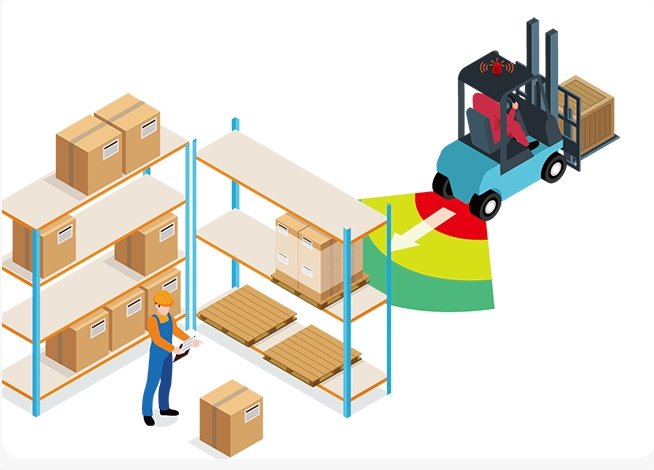
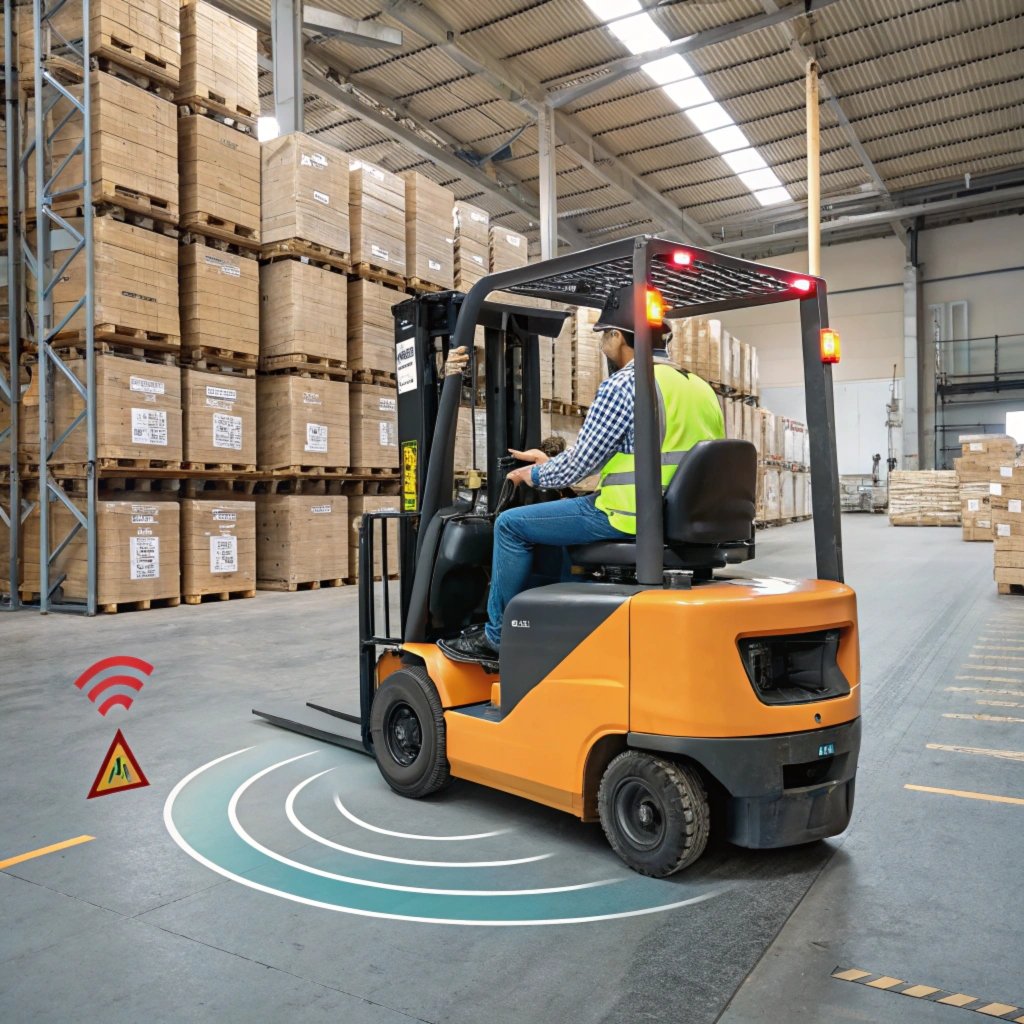
This is the kind of system fleets add at the blind zones mirrors can't cover — an AI camera watches for pedestrians and obstacles in real time and triggers an audible or visual alert automatically, without the operator needing to check a mirror at the exact right second.
See how the camera-based system works →9. How a Camera-Based Anti-Collision System Works
At a basic level, a forklift camera system is a wide-angle lens feeding a cab-mounted display — useful, but still something the operator has to glance at. AI-enabled systems go a step further: onboard processing analyzes the video feed in real time, identifies people or obstacles entering a defined danger zone, and fires an alert without requiring the operator to actively watch the screen.
The short video below walks through the physical components of a camera-based system — the camera units, the in-cab display, and how the detection zone is set up on the truck.
Camera-based forklift anti-collision system — component overview
10. Choosing the Right Setup for Your Fleet
There's no single right answer for every facility — the correct mix depends on traffic patterns, pedestrian density, and where your near misses actually happen. A few practical starting questions:
- Where do near misses actually cluster? Pull the last 6–12 months of incident and near-miss reports before buying anything — the data usually points to two or three specific zones, not the whole facility.
- Is the risk from other forklifts, pedestrians, or fixed objects? Pedestrian-heavy zones benefit most from AI human-detection cameras; forklift-to-forklift risk is often better handled with proximity/UWB systems layered alongside cameras.
- What's your lighting and dust environment? Facilities with variable lighting or heavy dust should prioritize camera models rated for those conditions over basic mirror upgrades.
- Do you need incident footage? If insurance, training, or liability documentation matters to your operation, recorder-equipped camera systems add a benefit mirrors simply cannot provide.
For most warehouses, the practical answer is layered: keep mirrors at simple, low-traffic corners, and add camera-based detection at the handful of high-risk zones — reversing areas, dock intersections, and pedestrian crossings — where mirror physics runs out.
11. Frequently Asked Questions
Tap a question to expand the answer — tap again to collapse it.
Not necessarily. Mirrors still work well at simple, low-traffic corners with predictable sightlines. The stronger approach is layering — keep mirrors where they're genuinely effective, and add camera-based detection at the specific zones where near misses actually happen, such as reversing areas and pedestrian-heavy intersections.
No. Core detection and alerting on most forklift camera-based anti-collision systems runs on the truck itself, processing the video feed locally and triggering the alert without needing an internet connection. Some fleet-management add-ons for footage review or reporting may use connectivity, but basic collision alerting does not depend on it.
A basic backup camera just displays a live image — the operator still has to watch the screen and interpret it. An AI-enabled camera system analyzes that same feed in real time, detects people or obstacles entering a defined danger zone, and triggers an automatic alert, which works even in the moments the operator isn't looking at the display.
Convex mirrors are curved to fit a wider field of view into a small surface. That curvature compresses the image, which makes objects appear farther away and smaller than they actually are — a known distortion that makes quick distance and speed judgments unreliable, especially for a fast-moving pedestrian or forklift.
Most counterbalance forklifts have at least three structural blind zones: behind the mast when carrying a tall or wide load, the overhead area when forks are raised, and the rear swing radius created by the counterweight during turns. Each requires a different viewing angle, which is why a single mirror rarely covers all of them.
Most camera-based systems are designed as retrofit kits and can be installed on existing forklifts, typically within a few hours per truck, without modifying the truck's core hydraulics or drivetrain. Exact install time depends on the number of camera units and whether AI detection hardware is included.
Stop Guessing Where the Blind Spots Are
We design AI camera-based anti-collision systems specifically for the zones mirrors can't cover — reversing paths, pedestrian crossings, and high-traffic intersections. Tell us about your facility and we'll recommend the right setup.