Skip to content

Manufacturing Forklift Safety: A Complete Guide to Preventing Accidents on the Plant Floor
Manufacturing floors put forklifts and people closer together than almost any other work environment — narrow aisles, staged materials, machine operators stepping in and out of production cells, and forklifts running the same routes dozens of times a shift. This guide breaks down why that combination is so accident-prone, the specific causes worth fixing first, and a practical safety program you can start applying this week.

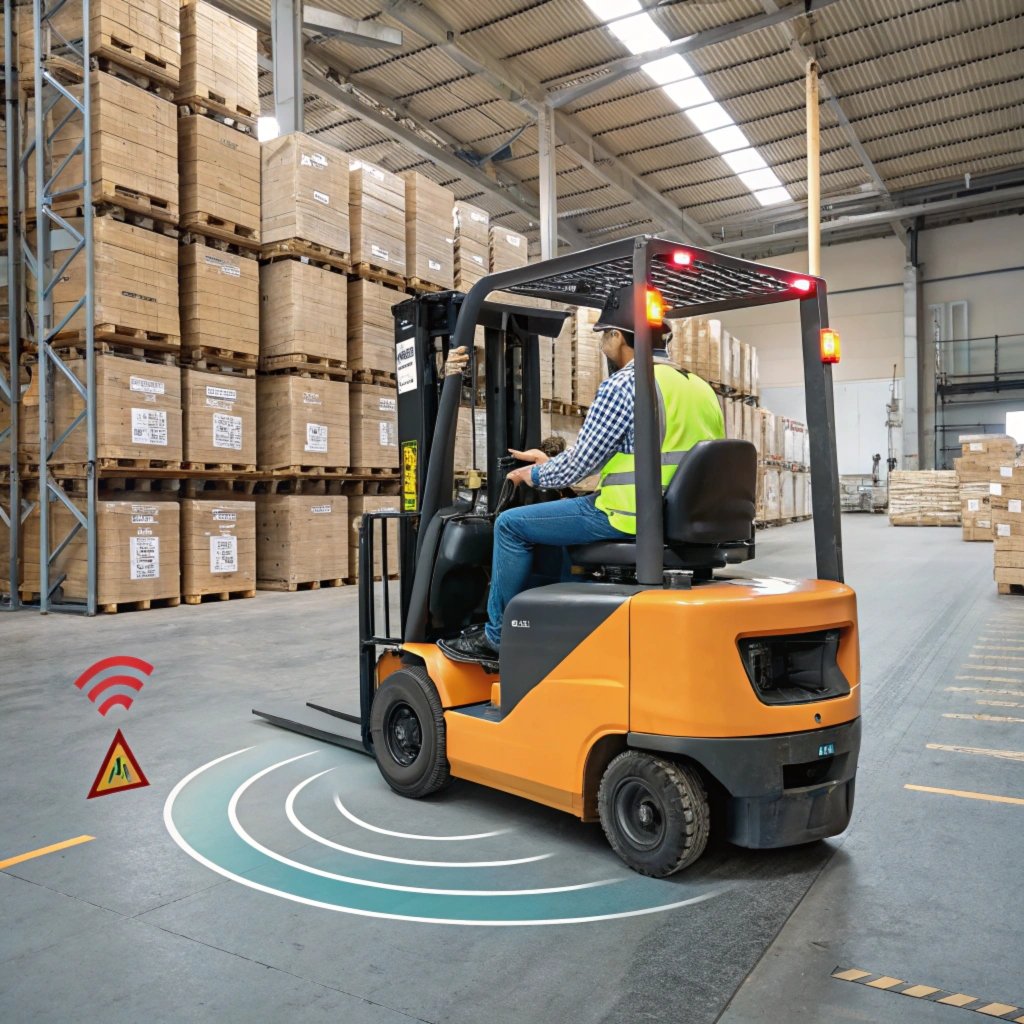
A forklift sharing floor space with production staff — the exact scenario most manufacturing forklift injuries come from.
Warehouses are built around forklift traffic; manufacturing plants aren't. A distribution center can dedicate wide, marked lanes to lift trucks because moving pallets is the whole job. A manufacturing floor has to fit that same forklift traffic around assembly lines, staging racks, machine operators, and maintenance crews who are focused on the task in front of them — not on watching for a truck backing out of a blind aisle. That mismatch between forklift routes and human attention is where most manufacturing forklift accidents start.
This guide is written for plant managers, EHS coordinators, and operations leads who need a straightforward, practical answer to one question: what actually reduces forklift accidents in a manufacturing environment, and where should you start?
📋 Table of Contents
- 1. Why Manufacturing Floors Carry Different Forklift Risk Than Warehouses
- 2. The Leading Causes of Forklift Accidents in Manufacturing
- 3. The Real Cost of a Forklift Accident
- 4. The Four Pillars of a Manufacturing Forklift Safety Program
- 5. Reducing Forklift–Pedestrian Accidents on the Plant Floor
- 6. Pre-Shift Inspection: What Manufacturing Operators Should Check
- 7. Facility Layout: Aisles, Blind Corners, and Staging Areas
- 8. Operator Training That Actually Sticks
- 9. Where Safety Technology Closes the Gaps Training Can't
- 10. Common Mistakes Manufacturing Sites Make
- 11. FAQs
1. Why Manufacturing Floors Carry Different Forklift Risk Than Warehouses
In a pure warehouse, forklift traffic and pedestrian traffic can usually be separated by design — dedicated aisles, caged walkways, and racking laid out specifically for lift truck movement. Manufacturing floors rarely have that luxury. Production lines dictate the layout, not forklift efficiency, which means trucks are often routed through the same open floor space where operators, technicians, and quality staff are working.
Three factors make this combination higher-risk than a typical distribution warehouse:
- Shared, unmarked space. Staging areas, WIP racks, and machine cells frequently sit right beside forklift travel paths with no physical separation.
- Task-focused pedestrians. Production and assembly workers are concentrating on their station, not scanning for approaching forklifts — attention that a warehouse picker walking an aisle is more likely to have free.
- Repetitive, predictable routes that breed complacency. Operators running the same forklift route to the same staging rack dozens of times a shift are the ones most likely to stop treating a blind corner as blind.
Manufacturing forklift safety isn't primarily a "better driver" problem — it's a layout and attention problem. The operators aren't reckless; they're navigating a floor plan that was never designed around forklift movement in the first place.
The short clip below illustrates exactly this dynamic — forklifts, workers, materials, and equipment all sharing the same busy floor space, where visibility, traffic flow, and operator awareness make the difference between a routine shift and a serious incident.
Why manufacturing forklift safety should be a priority in busy industrial environments — visibility, traffic management, and consistent safety practices.
2. The Leading Causes of Forklift Accidents in Manufacturing
Across manufacturing environments, a small number of root causes account for most incidents. Understanding which one is driving your near-misses tells you exactly where to focus first.
| Cause | Why It Happens on Manufacturing Floors | Typical Outcome |
|---|---|---|
| Struck-by pedestrian incidents | Blind corners near production cells, no separated walkways, workers stepping backward out of a station | Serious injury, most reported forklift fatalities |
| Forklift-to-forklift collisions | Multiple trucks running staging routes through the same intersection points | Equipment damage, product loss, occasional injury |
| Tip-overs | Overloaded or off-center loads, turning too fast near machine bays, uneven floor transitions | Severe injury, extended downtime |
| Load drops / struck-by falling material | Improperly secured loads, lifting above rated capacity for the load center | Property damage, injury to nearby staff |
| Dock and staging area incidents | Trailer creep, poor lighting, congestion at loading/unloading points | Injury during transition between dock and floor |
Notice that the first two rows — pedestrian strikes and forklift-to-forklift collisions — both come down to one thing: an operator or a pedestrian not seeing the other party in time. That single failure mode is responsible for a disproportionate share of manufacturing forklift incidents, which is exactly why the pedestrian-safety section below carries the most weight in this guide.
3. The Real Cost of a Forklift Accident
The injury is the immediate cost, but it's rarely the only one. A single forklift incident on a manufacturing floor typically triggers a chain of secondary costs that plant managers often underestimate when building the case for a safety investment:
- Line downtime while the area is cleared, investigated, and the incident is documented.
- Equipment damage to the forklift, racking, or the product itself.
- Regulatory exposure — an inspection, citation, or increased scrutiny on the rest of the facility.
- Insurance premium impact that outlasts the immediate repair cost by years.
- Workforce trust — a visible near-miss or incident makes every operator on that floor more anxious, which paradoxically often increases errors rather than reducing them.
Compare that to the cost of the controls that prevent it — layout changes, training refreshers, or a pedestrian detection system — and the safety investment case usually makes itself. For a deeper look at how to score and prioritize these risks systematically, see our warehouse risk assessment framework.
4. The Four Pillars of a Manufacturing Forklift Safety Program
A safety program that actually reduces incidents on a manufacturing floor rests on four pillars working together — remove any one and the others carry more weight than they can handle.
Pillar 1 — Operator Training & Certification
Formal, documented initial training plus scheduled refreshers and retraining after any near-miss or incident. Covered in detail in Section 8.
Pillar 2 — Pre-Shift Equipment Inspection
A documented, non-negotiable check before every shift, with a clear out-of-service process for anything that fails. Covered in Section 6.
Pillar 3 — Facility & Traffic Design
Physical layout choices — aisle marking, blind-corner mitigation, staging area placement — that reduce how often a forklift and a pedestrian occupy the same space unexpectedly. Covered in Section 7.
Pillar 4 — Active Detection & Monitoring Technology
Systems that catch what training and layout alone can't — the split-second a pedestrian steps around a rack corner, or a truck approaches an intersection too fast. Covered in Section 9.
5. Reducing Forklift–Pedestrian Accidents on the Plant Floor
Struck-by incidents are the most severe outcome in manufacturing forklift safety, and they're almost always a visibility and timing problem, not a rule-following problem. An operator can be fully certified, alert, and driving at a safe speed, and still not see a worker who steps backward out of a machine cell at the exact wrong moment. Reducing this risk means attacking it from three angles at once:
- Separate the paths where you physically can. Painted lanes, floor markings, and physical barriers between forklift routes and walkways cut down the number of moments where a truck and a pedestrian share the same square footage.
- Fix the blind corners you can't design away. Convex mirrors help at low speed, but they rely on both parties looking at the right moment — they don't compensate for a distracted pedestrian or an operator focused on a tight turn.
- Give the operator an active warning, not just a passive aid. This is where most manufacturing sites see the biggest single improvement: a system that alerts the operator the instant a pedestrian enters a blind zone, rather than relying on the operator to spot them first.
Mirrors require both the operator and the pedestrian to be looking at the right place at the right time — and manufacturing pedestrians are frequently focused on a task, not the aisle. An active pedestrian detection system closes that gap by alerting the operator directly, regardless of where the pedestrian is looking.
It's also worth distinguishing a near-miss from an actual accident when you're building your prevention program — the near-misses are your early warning system, and treating them as noise is one of the most common ways manufacturing sites miss a pattern before it becomes an injury. See our breakdown of forklift near-miss vs. forklift accident reporting for how to build that habit into your team.
6. Pre-Shift Inspection: What Manufacturing Operators Should Check
A documented pre-operation inspection at the start of every shift catches mechanical issues before they become incidents — and creates a paper trail that matters if an investigation ever happens. On a manufacturing floor specifically, a few items deserve extra attention beyond the standard checklist:
- Horn, backup alarm, and any fitted camera or pedestrian-alert system — these are doing more work on a manufacturing floor than in an open warehouse, so a failure here matters more.
- Tires and forks for damage, since manufacturing floors often mix smooth concrete with metal plating, expansion joints, or debris near production lines.
- Mirrors and any blind-spot camera monitors, checked for cleanliness and correct alignment before the shift starts, not after a near-miss.
- Load charts and data plate legibility, especially on trucks that get shared across multiple production areas with different attachment setups.
- Brakes and steering response tested at low speed before the truck is loaded and moved into the production floor.
Any defect affecting safe operation should take the truck out of service immediately — a verbal "it's probably fine" is one of the most common ways a known issue turns into a documented incident.
7. Facility Layout: Aisles, Blind Corners, and Staging Areas
Because manufacturing layouts are built around production flow first, safety usually has to be retrofitted onto an existing floor plan rather than designed in from scratch. That's still worth doing — a few targeted layout changes go a long way even on a floor you can't fully redesign:
- Mark every point where a forklift route crosses a walkway with floor tape, hatching, or raised markers — not just at the main aisles, but at every access point to a production cell.
- Identify blind corners methodically rather than reacting after a near-miss — walk the floor with both an operator and a pedestrian's perspective and flag every point where sightlines are under roughly 10–15 feet.
- Keep staging and WIP racks out of natural forklift turning radii wherever possible, since a truck making a tight turn around staged material has far less room to react to a pedestrian appearing unexpectedly.
- Treat loading docks as a distinct risk zone — poor lighting, trailer creep, and the transition between dock and open floor account for a disproportionate share of incidents relative to how much floor space they cover.
You don't need to redesign the whole floor at once. List every point where a forklift route crosses a walkway or another forklift route, rank them by traffic volume, and fix the top five first — that's usually where the majority of near-misses are already happening.
8. Operator Training That Actually Sticks
Most manufacturing sites already run initial certification training. Where programs break down is in what happens after that first certification — training that stops at hire tends to fade exactly when complacency sets in, which is usually six months to a year in, once the routes feel routine.
- Site-specific orientation for every operator, including experienced hires transferring from another facility — a different plant's blind corners and traffic patterns aren't intuitive on day one.
- Scheduled refresher training, not just training triggered by an incident — waiting for something to go wrong before retraining means the lesson is always reactive.
- Immediate retraining after any near-miss, observed unsafe behavior, or a switch to a different truck class or attachment.
- Fatigue and attention awareness built into refresher sessions — a tired or distracted operator is statistically more likely to be involved in a struck-by incident, which is why some manufacturing sites now pair training with a driver fatigue monitoring system on longer shifts.
9. Where Safety Technology Closes the Gaps Training Can't
Training and layout changes reduce risk, but neither one can fully compensate for the split-second nature of a blind-corner encounter. This is the gap safety technology is built to close — not as a replacement for training, but as the layer that catches what a well-trained, attentive operator still can't physically see in time.
- Pedestrian detection gives an active alert the moment a person enters a blind zone or intersection, rather than relying on the operator spotting them first.
- Forklift-to-forklift proximity warning reduces collisions at shared intersections and staging points where multiple trucks converge on a predictable schedule.
- Camera systems extend the operator's field of view around racking, machine cells, and reversing blind spots that mirrors alone don't fully cover — see our comparison of forklift cameras vs. mirrors for how the two compare in practice.
- Speed limiting keeps trucks inside a safe travel speed automatically in high-traffic zones, cutting stopping distance at exactly the intersections where it matters most.
- Recorded-event footage turns every near-miss into usable data — instead of relying on memory, you can review exactly what happened, retrain the right operator, and fix the specific layout issue that caused it.
None of this replaces a trained, alert operator — but a manufacturing floor that pairs solid training with active detection technology is working with two independent layers of protection instead of one, which is exactly what keeps a single missed glance from becoming an injury.
Reducing Forklift Accidents on Your Manufacturing Floor?
We design the AI pedestrian detection, camera, and speed-control systems that give your operators an extra layer of protection your layout and training alone can't provide.
Talk to a Forklift Safety Specialist10. Common Mistakes Manufacturing Sites Make
- Treating the layout as fixed because production dictated it — even small marking and barrier changes at high-traffic intersections meaningfully cut risk.
- Logging near-misses informally, or not at all — without a pattern to look at, the same blind corner keeps almost causing the same incident until it finally does.
- Letting training lapse after initial certification — complacency, not lack of skill, is what tends to creep in over time on repetitive routes.
- Relying on mirrors alone at high-traffic blind corners — they help, but they depend on both parties looking at the right moment.
- Mixing forklift and pedestrian foot traffic through the same loading dock access point without a separated walkway or staggered schedule.
- Assuming a "quiet" floor means a safe one — the absence of a recent incident isn't the same as the absence of risk; it often just means the near-misses haven't been counted yet.
11. Frequently Asked Questions
Tap a question to expand the answer — tap again to collapse it.
The leading causes are struck-by pedestrian incidents at blind corners, forklift-to-forklift collisions at shared intersections, tip-overs from overloaded or off-center loads, and incidents at loading docks. Pedestrian strikes tend to carry the most severe outcomes because manufacturing floors mix forklift traffic with task-focused workers who aren't watching for approaching trucks.
The most effective approach combines physical separation of forklift and pedestrian paths where possible, addressing blind corners with mirrors and clear sightlines, and adding an active pedestrian detection system that alerts the operator directly rather than relying on either party spotting the other first.
Beyond initial certification, operators should receive scheduled refresher training at intervals set by the facility's own risk assessment, plus immediate retraining after any near-miss, observed unsafe operation, or a change to a different truck class or attachment. Waiting for an incident before retraining means the safety program is always reactive rather than preventive.
Layout is often the biggest lever a manufacturing site has, because most incidents happen at predictable intersection points where forklift routes cross walkways or staging areas. Marking these crossings, fixing blind corners, and keeping staged material out of forklift turning radii reduces the number of moments where a truck and a pedestrian unexpectedly share the same space.
Training and layout changes reduce risk significantly, but neither fully compensates for the split-second timing of a blind-corner encounter. Active detection technology — pedestrian alerts, proximity warnings, cameras, and speed limiting — adds an independent layer of protection that catches what even a well-trained, attentive operator can't always see in time.
Log it formally rather than treating it as a non-event, identify the specific location and contributing factor, and address that factor directly — whether that's a layout fix, a retraining session, or a technology gap. Near-misses are the clearest early warning a facility gets before a minor incident becomes a serious one.