Skip to content

Forklift Safety Standards UAE: OSHAD, Dubai Municipality & Federal Compliance Explained
What UAE law actually requires for forklift operations — federal rules, emirate-level frameworks, operator licensing, inspection cycles, and where pedestrian protection fits in.
A forklift accident in a UAE warehouse or port doesn't just trigger an insurance claim — it can trigger a Federal Decree-Law No. 33 of 2021 investigation, an OSHAD-SF or Dubai Municipality audit, and in serious cases, personal liability for the site manager. Yet many facility managers in Dubai, Abu Dhabi, Sharjah, and the northern emirates are still operating on assumptions rather than the actual text of the regulation. This guide lays out where UAE forklift safety rules come from, what each emirate's authority actually enforces, and what a compliant operation looks like in practice — from licensing to lifting equipment inspection to pedestrian segregation.
📋 Table of Contents
- 1. The UAE Regulatory Framework at a Glance
- 2. Federal Baseline: Decree-Law No. 33 of 2021
- 3. Abu Dhabi: OSHAD-SF Requirements
- 4. Dubai Municipality & Free Zone Rules
- 5. Sharjah, RAK & the Northern Emirates
- 6. Forklift Operator Licensing in the UAE
- 7. Lifting Equipment Inspection Requirements
- 8. Pedestrian Safety & Warehouse Traffic Rules
- 9. PPE & Site-Level Controls
- 10. Violations, Fines & Liability
- 11. Where Anti-Collision Technology Fits In
- 12. UAE Forklift Compliance Checklist
- 13. FAQs
1. The UAE Regulatory Framework at a Glance
Unlike single-authority markets, UAE forklift safety compliance sits on three layers stacked on top of each other. Getting this hierarchy wrong is the single most common reason facilities fail an audit — a policy written for one emirate often doesn't transfer to the next.
- Federal layer: Federal Decree-Law No. 33 of 2021 on the Regulation of Labour Relations sets the minimum duty of care every employer in the country must meet, enforced by the Ministry of Human Resources and Emiratisation (MOHRE).
- Emirate layer: Each emirate runs its own occupational safety system on top of the federal law. Abu Dhabi uses the OSHAD Safety Framework (OSHAD-SF), administered by the Abu Dhabi Public Health Centre. Dubai uses Dubai Municipality's HSEMS framework and Local Orders.
- Free zone layer: Zones such as JAFZA, DMCC, KIZAD, and ADGM often issue their own HSE community guidelines and inspection regimes on top of emirate rules, particularly for high-throughput logistics and port operations.
A company running forklifts in both a Dubai warehouse and an Abu Dhabi distribution center is not covered by one policy. OSHAD-SF and Dubai Municipality maintain separate audit checklists, separate documentation formats, and separate inspection cadences — a fleet safety program has to satisfy both, not just the stricter of the two.
2. Federal Baseline: Decree-Law No. 33 of 2021
Federal Decree-Law No. 33 of 2021 replaced the older Federal Law No. 8 of 1980 as the UAE's core labour statute, and Article 13 places the duty of care squarely on the employer: assess occupational hazards, define protective measures, and provide safe equipment and safe systems of work. For forklift operations, that translates into three baseline obligations that apply everywhere in the country, regardless of emirate or free zone:
- Documented risk assessment for every material handling activity involving powered industrial trucks.
- Competent, trained operators — informal "on-the-job" familiarity is not sufficient documentation in an audit.
- Equipment maintained in safe, serviceable condition, with records available on request.
Penalties for breaches of federal occupational safety obligations range widely — from AED 5,000 for a documentation gap up to AED 1,000,000 for serious or repeated violations, multiplied per affected worker in some cases. Emirate-level authorities layer their own fine schedules and stop-work powers on top of this federal baseline.

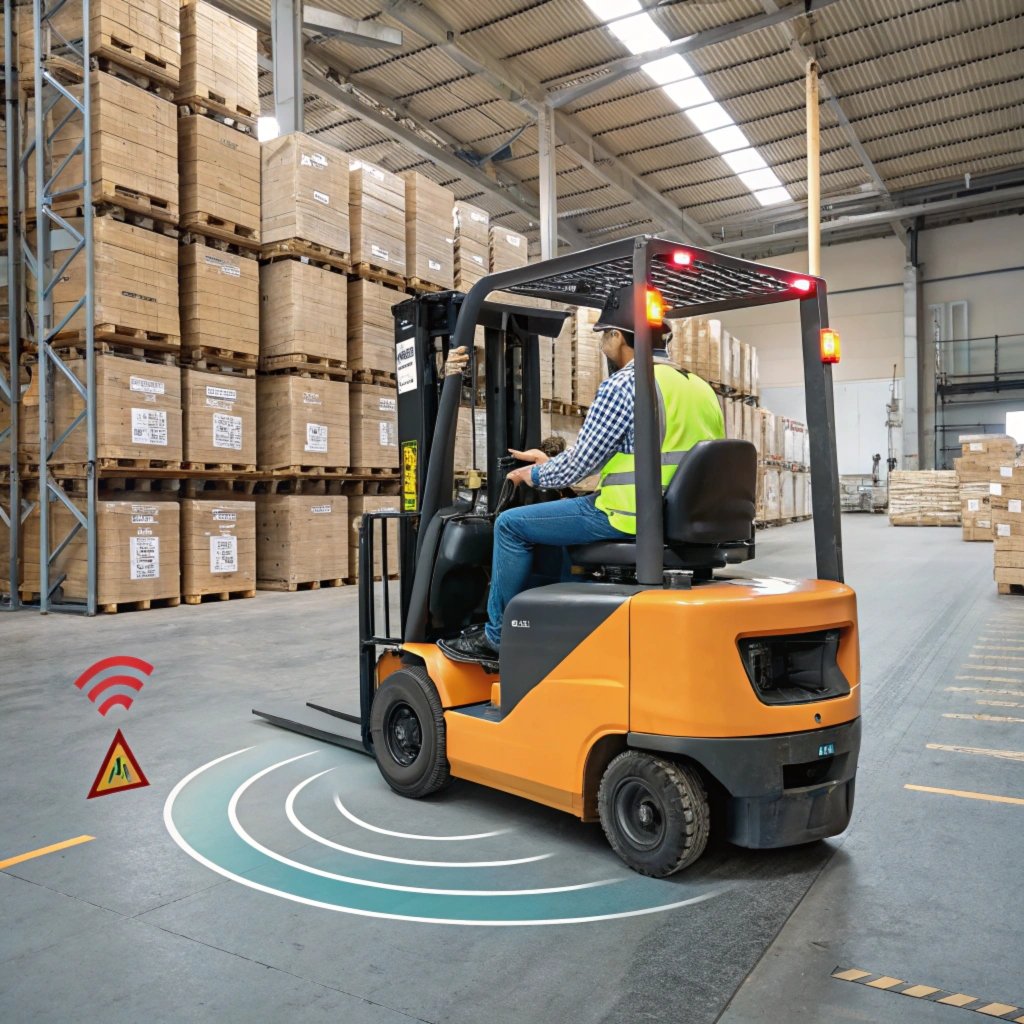
A compliant UAE warehouse floor: certified operator, correct PPE, marked pedestrian walkway, and physical segregation between forklift lanes and foot traffic.
3. Abu Dhabi: OSHAD-SF Requirements
Abu Dhabi runs the most structured system in the country. OSHAD-SF is organized into numbered "Mechanisms" — system elements that each define documentation, competence, and management expectations for a specific area of workplace safety, and the framework was updated in 2025–2026 to align more closely with ISO 45001:2018. For any employer with 30 or more workers, implementation of the full OSHAD-SF management system is mandatory, not optional.
For forklift and material handling equipment (MHE) specifically, OSHAD-SF inspectors typically look for:
- A documented risk assessment specific to MHE operations, updated when the layout, load type, or equipment changes.
- Evidence of a management-of-change process — so a new forklift model, a new racking layout, or a new attachment doesn't get deployed without re-assessment.
- Worker participation and training records that can be traced back to the specific operator and specific equipment.
- Recognition of technological safety aids — OSHAD-SF explicitly treats cameras, proximity sensors, and monitoring systems as valid, auditable compliance evidence, not just "nice to have" extras.
4. Dubai Municipality & Free Zone Rules
Dubai Municipality (DM) enforces its own HSEMS framework and a set of Local Orders that sit alongside the UAE Fire and Life Safety Code. Where OSHAD-SF is built around structured Mechanisms, DM's approach leans more heavily on its Construction Safety Code and sector-specific technical guidelines, with fire, electrical, and mechanical safety folded into the same inspection visit as MHE and forklift operations.
Free zones complicate this further. JAFZA, DMCC, Dubai Airport Free Zone, and similar zones typically issue their own HSE community guidelines layered on top of DM's framework — meaning a logistics operator inside JAFZA may face a stricter or differently-documented inspection than an identical operation just outside the zone boundary. DIFC and ADGM, by contrast, operate under separate common-law employment frameworks with their own reporting obligations.
"We're compliant in our free zone, so we're covered everywhere in the emirate." Free zone HSE guidelines typically add requirements on top of Dubai Municipality's baseline — they rarely replace it, and moving equipment or staff outside the zone boundary can put you back under DM's direct jurisdiction.
5. Sharjah, RAK & the Northern Emirates
Sharjah, Ras Al Khaimah, Ajman, Fujairah, and Umm Al Quwain each maintain their own arrangements rather than adopting Abu Dhabi's or Dubai's frameworks wholesale. In practice, the RAKEZ HS&E Construction Regulations are the most detailed published example, setting minimum safety standards for lifting and material handling operations across the Ras Al Khaimah Economic Zone. Facilities in the northern emirates should treat the federal Decree-Law as the non-negotiable floor and confirm current emirate-specific or free-zone-specific requirements directly with the relevant municipality, since these frameworks are updated more frequently — and with less centralized publication — than Abu Dhabi's or Dubai's.
6. Forklift Operator Licensing in the UAE
Unlike jurisdictions where forklift certification is purely an internal company matter, the UAE treats forklift operation as a licensed driving activity, issued through the RTA (in Dubai) or the equivalent traffic authority in other emirates — separate from, and in addition to, workplace-level competency training.
- Light forklift license: Minimum age 20, requires a valid Emirates ID, medical fitness certificate, and an electronic eye test, followed by mandatory theory classes and a road test through an RTA-approved training center.
- Heavy forklift license: Typically requires an existing light forklift or heavy machinery license as a prerequisite, plus additional practical assessment on larger-capacity trucks.
- Site-specific / company certification: Holding an RTA license does not remove the employer's separate OSHAD-SF or DM obligation to provide hands-on, model-specific training and demonstrate operator proficiency before assigning someone to a particular truck.
This two-tier structure — a government-issued driving license plus employer-level operational certification — is a distinctive feature of UAE compliance and one of the most frequently missed items when multinational operators apply a policy template built for a country where forklift certification is purely internal.
7. Lifting Equipment Inspection Requirements
Third-party inspection of lifting equipment — including forklifts — is treated as mandatory across the major regulatory bodies, not optional best practice. OSHAD, Dubai Municipality, and MOHRE all recognize periodic third-party inspection as the primary mechanism for demonstrating that equipment remains in safe, serviceable condition, and inspectors accredited under recognized schemes (such as ENAS) check for issues that aren't visible during routine daily checks — fatigue cracks, corrosion, worn components, and hidden overload damage.
Operating with an expired or missing third-party inspection certificate can trigger an immediate stop-work order from OSHAD, Dubai Municipality, or Ministry inspectors, fines that commonly start at AED 50,000 per violation, and — in the event of an injury — potential criminal exposure for the site manager or HSE officer personally. Insurance policies are frequently void from the outset if an incident occurs on uninspected equipment.
8. Pedestrian Safety & Warehouse Traffic Rules
Pedestrian-forklift interaction is one of the highest-frequency incident categories across UAE ports, logistics hubs, and manufacturing sites — a risk driven by 24/7 mixed-traffic operations and, in many facilities, a highly multilingual workforce where a shared visual safety language matters more than verbal instruction. Regulators expect this risk to be controlled structurally, not just through operator caution:
- Physical segregation — marked, and where possible barriered, pedestrian walkways separate from forklift travel lanes.
- Visual warning systems — blue spotlights, arc lights, and flashing beacons that give pedestrians advance warning before a forklift enters a blind corner or intersection, a requirement inspectors assess for real-world effectiveness, not just presence.
- Right-of-way rules at intersections — documented and posted, particularly in high-density zones like ports and cross-dock facilities.
- Explosion-proof protocols at fuel terminals and hazardous storage sites, where standard camera and lighting equipment isn't rated for the environment.
If your site includes hazardous storage or fuel-handling areas, it's worth reviewing our breakdown of explosion-proof forklift camera systems, since standard equipment typically cannot be deployed in those zones without additional certification.
9. PPE & Site-Level Controls
PPE requirements flow from the same federal duty-of-care obligation and are then made specific by each emirate's technical guidelines. For forklift operations, the baseline generally expected across UAE sites includes:
- High-visibility vests or coveralls for both operators and any personnel working on foot near MHE traffic.
- Hard hats in racking, loading dock, and overhead-hazard areas.
- Safety footwear rated for the specific site (steel toe as a minimum in most warehouse and port environments).
- Heat-stress controls during summer months — UAE-specific requirements around hydration breaks and outdoor work scheduling apply to outdoor forklift operations at ports and construction sites.
10. Violations, Fines & Liability
The financial exposure for non-compliance is significant and layered — a single incident can trigger federal, emirate, and criminal consequences simultaneously.
| Violation Type | Typical Consequence | Enforced By |
|---|---|---|
| Missing/expired lifting equipment inspection | Stop-work order; fines from AED 50,000+ | OSHAD / Dubai Municipality / MOHRE inspectors |
| General occupational safety breach | AED 5,000 – AED 1,000,000 per offense, multiplied per affected worker | MOHRE (federal) |
| Non-compliant contractor safety practices (Dubai) | Fines up to AED 200,000; license suspension up to 1 year | Dubai Municipality (Law No. 7 of 2025) |
| Injury/fatality linked to uncertified equipment or untrained operator | Civil liability, license revocation, potential criminal prosecution of managers | UAE Penal Law / relevant emirate authority |
The pattern across all four rows is consistent: documentation and demonstrable controls are what separates a manageable finding from a stop-work order. Facilities that can show a risk assessment, valid inspection certificates, licensed operators, and objective evidence of pedestrian protection measures are in a fundamentally different position than one relying on "we've never had an incident."
11. Where Anti-Collision Technology Fits In
Regulators in the UAE don't currently mandate a specific brand or model of forklift safety technology nationwide, but OSHAD-SF and Dubai Municipality both explicitly recognize cameras, proximity sensors, and monitoring systems as legitimate, auditable evidence of hazard control — which matters directly when an inspector is deciding whether your pedestrian segregation and blind-spot controls are adequate on paper versus adequate in practice.
In multilingual, high-density UAE facilities, technology closes gaps that signage and training alone can't:
- A forklift pedestrian safety system detects people near the truck automatically, regardless of whether the pedestrian saw or understood a posted warning sign.
- A proximity warning system using UWB tags gives forklift-to-forklift alerts in the blind intersections common at ports and cross-dock facilities.
- AI-camera anti-collision systems provide the kind of objective, logged detection event that turns "we have a safety program" into evidence an OSHAD or DM auditor can actually verify.
- A forklift speed limiter supports the traffic management rules increasingly expected in yard and dock areas.
- A driver fatigue monitoring system addresses the extended-shift risk common on 24/7 UAE logistics operations.
Building a UAE-Compliant Forklift Safety Program?
We design and supply AI-powered anti-collision, pedestrian detection, and proximity warning systems built for high-throughput ports, warehouses, and industrial sites across the UAE.
Talk to a Safety Specialist12. UAE Forklift Compliance Checklist
- Documented risk assessment for every forklift/MHE activity, reviewed on any change to layout, load, or equipment.
- Operators hold both a valid RTA (or equivalent) forklift driving license and employer-issued, model-specific certification.
- Current third-party lifting equipment inspection certificate for every truck in the fleet.
- Marked and, where possible, physically segregated pedestrian walkways separate from forklift travel routes.
- Visual warning devices (blue spotlights, arc lights, beacons) fitted and verified for real-world visibility, not just presence.
- PPE program covering hi-vis, footwear, head protection, and heat-stress controls for outdoor operations.
- Emirate-specific and, where applicable, free-zone-specific documentation maintained separately — not a single generic policy.
- Incident reporting and management-of-change procedures documented and accessible on request.
Comparing UAE requirements to other markets? See how our Malaysia DOSH forklift safety guide and SafeWork Australia forklift rules handle pedestrian segregation and licensing differently.
13. Frequently Asked Questions
Tap a question to expand the answer — tap again to collapse it.
No. Federal Decree-Law No. 33 of 2021 sets the minimum baseline nationwide, but each emirate adds its own framework on top — OSHAD-SF in Abu Dhabi, Dubai Municipality's HSEMS and Local Orders in Dubai, and separate arrangements in Sharjah, RAK, and the other northern emirates. Free zones can add a further layer again.
Not as a blanket national mandate, but OSHAD-SF and Dubai Municipality both explicitly recognize cameras, proximity sensors, and monitoring systems as valid compliance evidence for hazard control, and requirements are becoming more common in ports, oil terminals, and high-density logistics zones. Whether a specific system is required for your site depends on your emirate, sector, and risk assessment.
Generally no for the light forklift category — a home-country license is not accepted, and operators must complete UAE-based theory and practical training through an RTA-approved center. Operators who already hold a UAE-issued heavy forklift or heavy machinery license may be eligible for a direct test rather than the full course.
Exact intervals depend on the equipment type, usage intensity, and the specific emirate's requirements, so operators should confirm the applicable schedule with an ENAS-accredited inspection body. What's consistent across OSHAD, Dubai Municipality, and MOHRE is that periodic third-party inspection is treated as mandatory, not discretionary, and a lapsed certificate can trigger an immediate stop-work order.
Article 13 of Federal Decree-Law No. 33 of 2021 places the primary duty of care on the employer. In practice, if an injury results from non-compliant equipment or an untrained operator, liability can extend personally to the site manager, company director, or HSE officer, alongside company-level fines and potential license or contract consequences.
Not automatically. Free zones such as JAFZA or DMCC typically add their own HSE community guidelines on top of the host emirate's framework — they don't replace it. Equipment or staff moving outside the free zone boundary generally falls back under the direct jurisdiction of Dubai Municipality or the relevant emirate authority.