Skip to content

Saudi Arabia Warehouse Forklift Safety Regulations: GOSI, SASO & MHRSD Rules Explained
What does the Kingdom actually require for forklift operation, licensing, and pedestrian safety in warehouses, ports, and industrial sites — and how do you build a compliant, accident-free operation around it?

Saudi Arabia's warehousing sector is expanding fast — driven by Vision 2030 logistics hubs, NEOM, the Red Sea Project, and growing e-commerce distribution around Riyadh, Jeddah, and Dammam. More warehouses and more forklifts on the floor means the Kingdom's occupational safety framework matters more than ever, yet it's scattered across several authorities and rarely explained in one place. This guide pulls the actual forklift-specific requirements from Saudi Arabia's official OSH standards, explains who enforces what, and shows where anti-collision and pedestrian detection technology fits into a compliant operation.
📋 Table of Contents
- 1. Who Regulates Forklift Safety in Saudi Arabia?
- 2. GOSI's Basic OSH Standards: The Core Forklift Rules
- 3. Operator Licensing & Training Requirements
- 4. Load Handling, Speed & Stability Rules
- 5. Warehouse Storage Rules That Affect Forklift Movement
- 6. Pedestrian Safety & Right-of-Way Requirements
- 7. Common Compliance Gaps in Saudi Warehouses
- 8. How Anti-Collision Technology Supports GOSI Compliance
- 9. Forklift Safety Compliance Checklist
- 10. Inspections & Enforcement
- 11. FAQs
1. Who Regulates Forklift Safety in Saudi Arabia?
Unlike single-agency systems such as OSHA in the US or HSE in the UK, forklift and warehouse safety in the Kingdom sits across several bodies, each covering a different layer of the same operation. Understanding which one governs which part of your forklift program is the first step to actually being compliant, rather than just assuming international standards automatically apply.
GOSI
The General Organization for Social Insurance publishes the Basic Standards for Occupational Safety & Health (OSH), which include a dedicated section on forklift operation — licensing, load limits, warning devices, and daily checks.
MHRSD
The Ministry of Human Resources and Social Development enforces the Saudi Labor Law's occupational health and safety articles, runs workplace inspections, and can issue violations against employers who fail to protect workers.
SASO
The Saudi Standards, Metrology and Quality Organization sets technical conformity requirements for machinery — including forklifts imported or sold in the Kingdom — through the SABER conformity assessment platform.
Civil Defense & TVTC
General Directorate of Civil Defense governs warehouse fire safety and egress requirements that intersect with forklift storage layouts, while the Technical and Vocational Training Corporation accredits operator training programs.
A lot of Saudi forklift training providers reference OSHA 29 CFR 1910.178 and ANSI/ITSDF B56.1 alongside local rules. These US standards aren't legally binding in the Kingdom, but many multinational operators, contractors on ARAMCO or SABIC sites, and third-party trainers use them as a practical baseline layered on top of — not instead of — the GOSI and MHRSD requirements below.
2. GOSI's Basic OSH Standards: The Core Forklift Rules
GOSI's Basic Standards for Occupational Safety & Health is the closest thing Saudi Arabia has to a single reference document for forklift operation, and it devotes a specific section to "Forklifts" inside its broader chapter on lifting equipment and mechanical works. Here is what it actually requires, in plain English:
- The forklift driver must hold a valid license within the Kingdom of Saudi Arabia — a general driving license is not treated as sufficient on its own by most sites.
- The driver must be medically fit and in good health before being assigned to forklift duties.
- The driver must have received safety training specific to forklift operation, not just general induction training.
- The speed limit posted within the work area must be followed at all times.
- The forklift must be operated strictly according to the manufacturer's instructions.
- Lifted loads must never exceed the rated lifting capacity set by the manufacturer.
- Forklifts must be checked and inspected regularly, not just at purchase or annually.
- Every forklift must be equipped with a seat belt, fire extinguisher, and warning lights.
- The forklift must sound an audible alarm while reversing.
- Forklifts must be fitted with side mirrors to support the operator's field of view.
- A preliminary check of warning lights, the reverse alarm, and the fire extinguisher must be carried out before the forklift is used each shift.
- Any malfunction must be reported to responsible personnel immediately — the forklift should not stay in service until it's addressed.
- Supervisors and safety officials must stop forklift work if conditions become unsafe or during bad weather.
- Loads must be carried low and stable — fork height should sit roughly 15–25 cm above the ground while traveling, to avoid tipping or falling loads.
- When loading, the driver should reverse into position so their view of the load remains clear throughout the lift.
- A forklift must never be left running unattended.
- No one may ride on any part of the forklift unless it has a seat specifically designated for a passenger.
- Workers must keep all parts of their body clear of the forklift's moving parts at all times.
Almost every GOSI forklift requirement falls into one of three buckets: who's allowed to drive (license, health, training), what the forklift itself must have (mirrors, alarm, extinguisher, warning lights), and how the load is carried (capacity, height, stability). If you're auditing your own site, checking against those three buckets is a fast way to spot gaps.
3. Operator Licensing & Training Requirements
Because GOSI's standard explicitly requires a valid Saudi license and forklift-specific safety training — not just general competence — most compliant sites build their operator program around three layers:
1. A valid Saudi driving license
This is the baseline GOSI requirement. Expatriate operators typically need to convert or hold a recognized Saudi license before being placed on forklift duties, in addition to any employer-issued internal authorization.
2. TVTC-recognized or accredited forklift operator training
Many employers route operators through Technical and Vocational Training Corporation-accredited programs or private training providers (often funded through HRDF/Hadaf schemes) that cover pre-operation inspection, load charts, stability principles, and hands-on evaluation — closely mirroring the classroom-plus-practical structure used internationally.
3. Site-specific and refresher training
A certificate from a training provider doesn't automatically make someone competent on your specific mast type, racking layout, or attachment. Sites operating under ARAMCO, SABIC, or major EPC contractor safety programs typically layer site induction and periodic refresher assessments on top of the base certification — and GOSI's broader OSH standard reinforces this by requiring ongoing supervision and performance monitoring, not a one-time sign-off.
Training gets operators certified. Technology keeps them safe on the days a checklist can't catch.
4. Load Handling, Speed & Stability Rules
Beyond the forklift-specific section, GOSI's standards for heavy equipment in general apply to forklifts as well, since a forklift is legally treated as a category of powered industrial truck. Several of these general rules matter just as much day-to-day as the forklift-specific list above:
- Equipment must be maintained on an ongoing basis and confirmed fit for the work being performed — not just kept "running."
- Only operators who have been trained and demonstrated the ability to use the equipment may operate it.
- The posted speed limit and marked pedestrian paths must be adhered to while working.
- Pedestrians must always be given right of way — this is stated explicitly, not left to site discretion.
- Operators' hands, arms, and legs must stay inside the cockpit while the machine is moving.
- All directions must be checked before starting to move and at every crossing or intersection.
- Speed must be reduced and horns sounded at intersections and blind corners.
If your heaviest or bulkiest loads regularly push close to your fleet's rated capacity, it's worth understanding exactly how load center and lift height change what a forklift can safely carry — our guide to reading forklift capacity ratings correctly breaks this down before you find out the hard way on a Saudi warehouse floor.
5. Warehouse Storage Rules That Affect Forklift Movement
GOSI's storage and warehousing provisions weren't written only with forklifts in mind, but they directly shape how safely a forklift can move once product is on the racks. Two requirements matter most for warehouse layout planning:
- Stored materials must be stacked so they never obstruct forklifts, handling equipment, or emergency access — a blocked aisle isn't just inefficient, it's a documented compliance failure.
- The height of stored materials must not exceed 3 meters unless a proper racking system is in use, specifically to control tip-over and falling-load risk in aisles forklifts travel through.
In practice, most Saudi warehouse safety violations we hear about aren't dramatic accidents — they're blocked emergency exits, pallets stacked past 3 m without racking, or aisles narrowed by seasonal overstock. These are the details a GOSI or MHRSD inspector checks first, precisely because they're the easiest to fix and the easiest to ignore.
6. Pedestrian Safety & Right-of-Way Requirements
Forklift-to-pedestrian incidents are consistently among the most serious warehouse accidents worldwide, and Saudi Arabia's standards address this in two ways: procedural rules for how forklifts move around people, and — where a site can't fully separate people from powered equipment — a requirement for a trained spotter.
What the standard requires
- Pedestrians have right of way in every documented scenario — the forklift yields, not the other way around.
- Heavy equipment operators must be provided with an assistant to direct movement and warn of danger where visibility or site conditions demand it — effectively a formal spotter requirement.
- Workers must stay away from the edges of platforms, stands, and raised floors where forklifts and lifting equipment operate.
- Standing or walking underneath a raised load or crane path is never allowed, a principle that extends naturally to forklift forks and mast zones.
Why "a spotter" isn't always enough
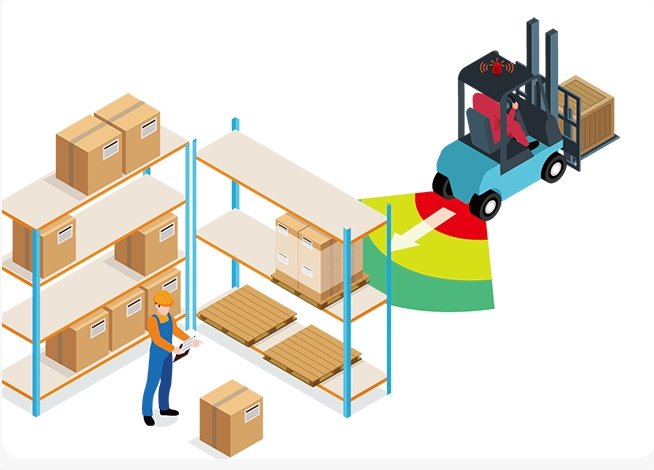
A human spotter is exactly what the regulation asks for — but a spotter can only watch one blind spot at a time, gets fatigued over a 10-12 hour shift in Gulf heat, and can't see through racking or around a warehouse corner. This is precisely the gap that pedestrian detection and anti-collision systems are designed to close: they don't replace the human element the standard requires, they extend it to every blind spot, every shift, without the fatigue curve.
If your warehouse has racking taller than eye level, cross-aisle intersections, or shared forklift/pedestrian walkways — the exact conditions GOSI's rules on right-of-way and intersection warning are written for — that's usually the clearest sign a camera-based or radar-based detection layer will pay for itself long before an incident does.
7. Common Compliance Gaps in Saudi Warehouses
Across warehouses, ports, and industrial sites in the Kingdom, the same handful of compliance gaps tend to show up again and again:
- Treating a general Saudi driving license as sufficient — without forklift-specific training documented on file.
- Skipping the daily pre-use check of warning lights, reverse alarm, and fire extinguisher, especially on night shifts.
- Leaving forklifts running and unattended during short breaks or handovers.
- Stacking pallets above 3 m without a racking system to save floor space during peak season.
- Allowing riders on forklifts that have no designated passenger seat, particularly for "quick trips" across the floor.
- Relying on a single spotter to cover multiple aisles or intersections at once.
- Not reporting minor malfunctions — a flickering warning light or a weak reverse alarm — until they fail completely.
8. How Anti-Collision Technology Supports GOSI Compliance
We don't sell forklifts, and we're not a licensing body — we build the detection and warning systems that help Saudi warehouses meet the intent behind GOSI's and MHRSD's rules, every shift, without relying on a checklist alone. A few direct connections between the regulation and the technology:
| Regulatory requirement | How a safety system supports it |
|---|---|
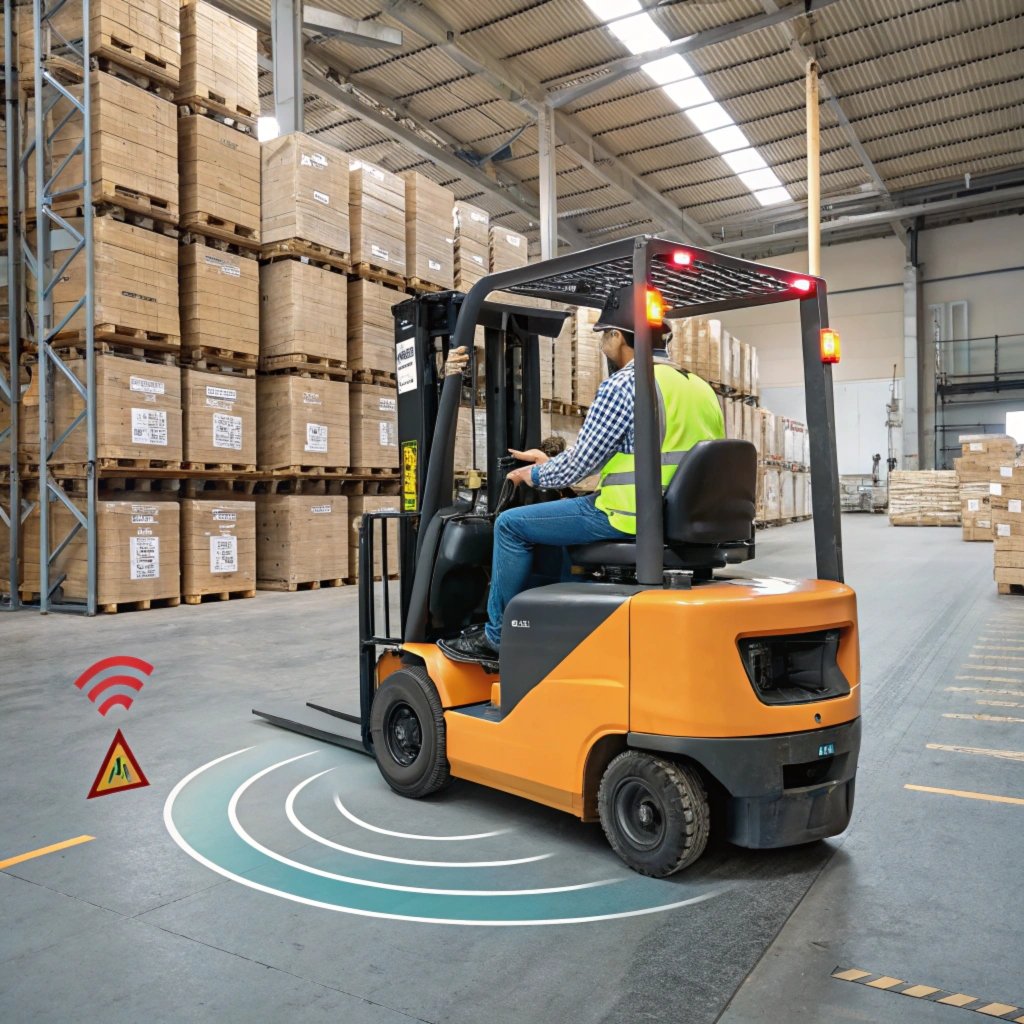
| Audible alarm while reversing | Camera-based reverse alarm systems pair the required beep with a live rear view, closing the gap a mirror alone leaves. |
| Pedestrian right-of-way at all times | AI pedestrian detection systems flag a person in the danger zone before the operator's eyes do, especially around blind corners and racking. |
| Assistant/spotter for heavy equipment | UWB proximity warning systems with wearable tags extend spotter-level awareness to every forklift on the floor simultaneously. |
| Posted speed limits within work areas | A forklift speed limiter enforces the zone limit automatically instead of depending on operator discipline alone. |
| Loads must not exceed rated capacity | An on-board weighing scale gives the operator a real weight reading before the forks ever leave the ground. |
Build the Safety Layer GOSI's Rules Point To
From pedestrian detection to speed limiting and reverse alarms, we help Saudi warehouses, ports, and logistics sites turn compliance requirements into everyday protection.
9. Forklift Safety Compliance Checklist
A quick self-audit against the requirements covered above:
- Every operator holds a valid Saudi license and documented forklift-specific training.
- Medical fitness for forklift duty is confirmed and refreshed periodically.
- Every forklift has a working seat belt, fire extinguisher, warning lights, side mirrors, and reverse alarm.
- Pre-shift checks are logged, not just performed informally.
- Speed limits are posted and visible in every zone forklifts travel through.
- Rated capacity charts are accessible to operators, not just filed in an office.
- No stored materials exceed 3 m without a racking system.
- Aisles and emergency access routes stay clear of stock at all times.
- Pedestrian walkways are marked and physically separated where possible.
- Blind intersections have either a spotter, a mirror, or a detection system covering them.
10. Inspections & Enforcement
MHRSD conducts workplace inspections as part of its broader labor law enforcement mandate, and GOSI's OSH standards are increasingly referenced as the technical benchmark inspectors check facilities against. Non-compliance can affect far more than a single audit finding — it can factor into insurance claims through GOSI's occupational hazard branch following a workplace injury, contractor eligibility on major industrial and Vision 2030-linked projects, and site access approval for contractors working under ARAMCO, SABIC, or similar corporate safety programs. Documented training records, inspection logs, and maintenance history are usually the first things requested when an inspection or an incident review happens — treating them as a live operational habit, not paperwork to assemble after the fact, is the difference that shows up during an actual audit.
11. Frequently Asked Questions
Tap a question to expand the answer — tap again to collapse it.
Is a general Saudi driving license enough to operate a forklift?
No. GOSI's Basic OSH Standards require a valid Saudi license as a baseline, but they also separately require forklift-specific safety training. Most compliant employers treat both as mandatory, non-substitutable requirements, and keep training records on file to prove it.
What safety equipment must every forklift in Saudi Arabia have?
At minimum: a seat belt, a fire extinguisher, warning lights, side mirrors, and an audible alarm that sounds while reversing. These must be checked before the forklift is used each shift, and any malfunction has to be reported and addressed before the truck goes back into service.
How high can materials be stacked in a Saudi warehouse?
GOSI's storage provisions cap stacked material height at 3 meters unless a proper racking system is used. This limit exists specifically to control tip-over risk in the aisles forklifts travel through, not just general warehouse tidiness.
Who has right of way — forklifts or pedestrians?
Pedestrians. Saudi OSH standards state explicitly that pedestrians are always given right of way around heavy equipment, including forklifts, and require an assistant or spotter where visibility conditions make that right of way hard to guarantee on its own.
Which government body actually enforces forklift safety in the Kingdom?
Enforcement is shared. MHRSD carries out workplace inspections under Saudi Labor Law, GOSI's OSH standards act as the technical reference those inspections are checked against, SASO governs the equipment's technical conformity, and Civil Defense covers fire and egress requirements that intersect with warehouse layout.
Can a forklift be left running while the operator steps away briefly?
No. GOSI's standard is explicit that a forklift must never be left running unattended, regardless of how short the break is expected to be.
Do OSHA standards apply to forklift operations in Saudi Arabia?
Not legally — OSHA is a US regulation. However, many training providers, multinational operators, and contractors on major industrial sites in the Kingdom use OSHA 29 CFR 1910.178 and ANSI/ITSDF B56.1 as a practical reference layered on top of GOSI and MHRSD's actual legal requirements, rather than as a replacement for them.
Can technology replace the spotter requirement for heavy equipment?
The standard calls for a trained assistant to direct movement and warn of danger — detection technology is best understood as extending that requirement rather than replacing it, covering blind spots and fatigue gaps a single spotter can't fully close across a large floor or a long shift.