Skip to content

Forklift Safety Guidelines Malaysia: DOSH Rules, Speed Limits & Pedestrian Safety
What DOSH (JKKP) actually expects from Malaysian warehouses and factories — operator certification, speed control, pedestrian traffic separation, and how to close the gaps before an inspector or an accident finds them first.
Malaysia doesn't have a single "Forklift Act." Instead, forklift safety obligations are stitched together from the Occupational Safety and Health Act 1994 (OSHA 1994), the Factories and Machinery Act 1967 (FMA 1967), and a series of DOSH (Jabatan Keselamatan dan Kesihatan Pekerjaan, JKKP) approved codes of practice and enforcement guidelines. For a safety manager, that means the rules are real and enforceable — but they're scattered across certification requirements, training standards, and site-level traffic management practices that aren't written down in one place.
This guide pulls those pieces together: what DOSH requires for operator certification and lifting-machinery inspection, what speed limits and pedestrian separation actually look like in a compliant Malaysian warehouse, where most operations get cited, and how AI-based anti-collision technology fits into a defensible safety program — not as a replacement for the rules, but as the layer that catches what procedure alone can't.
📋 Table of Contents
- 1. The Legal Framework: OSHA 1994, FMA 1967 & DOSH
- 2. Operator Certification Requirements
- 3. Certificate of Fitness (CF) for Forklifts
- 4. Forklift Speed Limits in Malaysian Workplaces
- 5. Pedestrian Safety & Traffic Management
- 6. Daily Inspection & Maintenance Duties
- 7. Safe Load Handling & Racking
- 8. Common Violations & Penalties
- 9. Building a DOSH-Ready Safety Program
- 10. Where Anti-Collision Technology Fits In
- 11. FAQs
1. The Legal Framework: OSHA 1994, FMA 1967 & DOSH
Every forklift safety obligation in Malaysia traces back to two statutes. The Occupational Safety and Health Act 1994 sets the general duty of care — under Section 15, employers must ensure, so far as is practicable, the safety and health of every person at work, which covers forklift operations as a standard workplace hazard. The Factories and Machinery Act 1967 goes further for powered lifting equipment specifically: a forklift is classified as lifting machinery, which brings it under certification, inspection, and competent-person requirements that ordinary equipment doesn't face.
Both Acts are enforced by the same authority: DOSH, the Department of Occupational Safety and Health — almost always referred to on the ground by its Malay acronym, JKKP (Jabatan Keselamatan dan Kesihatan Pekerjaan). JKKP approves the training providers who certify operators, issues the Certificate of Fitness for lifting machinery, and is the body that shows up during an audit or after an incident.
OSHA 1994 covers the employer's general safety duty; FMA 1967 governs the machine itself. DOSH/JKKP administers both. If your forklift program only addresses one of these — say, operator training but not machinery certification — you're compliant on paper with half the framework, not all of it.
2. Operator Certification Requirements
Malaysia does not issue a single government "forklift license" the way it issues a driving license. What it requires instead is documented, DOSH-recognised training specific to the equipment class the operator will run. A certification earned on a counterbalance forklift does not automatically extend to a reach truck, telehandler, or order picker — each equipment type needs its own training and assessment, and an operator moving between types needs a conversion course for the new class.
- Training must come from a JKKP-approved training provider, not an informal in-house handover.
- Certification is equipment-specific — counterbalance, reach truck, and rider-type powered pallet trucks each require separate assessment.
- Manual, non-powered pallet jacks fall outside formal DOSH certification, but employers should still cover safe use and load limits in basic induction.
- Employers are expected to keep certificates and a job hazard analysis on file, ready to produce during an audit.
Don't assume a transferred employee's forklift certificate covers the truck they'll actually drive on your floor. Check the equipment class on the certificate against the equipment class in your warehouse before they touch the controls — this is one of the most common gaps DOSH auditors flag.
3. Certificate of Fitness (CF) for Forklifts
Because a forklift is classified as lifting machinery under FMA 1967, it needs its own Certificate of Fitness (CF) — a document confirming the machine has been inspected and meets safety requirements, separate from whether its operator is certified. CF applications and renewals are handled through DOSH's MyKKP portal, and the certificate is tied to a specific inspection cycle, not a one-time approval.
This is not a paperwork formality. Non-renewal or lapsed certification is treated as a serious compliance failure — DOSH enforcement has moved toward significant financial penalties for lifting machinery operating without valid certification, on top of the operational risk of running equipment that hasn't been re-verified as safe.
Keep original design approvals, prior inspection reports, and maintenance logs current and accessible year-round. Scrambling to assemble this documentation only when the CF is due to expire is the most common reason renewals get delayed — and an expired CF can mean the machine is not legally permitted to operate.

4. Forklift Speed Limits in Malaysian Workplaces
Malaysia has no single statutory number posted in law for maximum forklift speed the way it does for road vehicles. What exists instead is a practicable-safety obligation under OSHA 1994 combined with DOSH guidance and industry best practice, which converges on zone-based limits rather than one blanket figure. The working standard used across Malaysian warehouses and logistics operations sets a lower ceiling wherever pedestrians are present and a higher one only in genuinely clear, open zones.
| Zone | Recommended Max Speed | Why |
|---|---|---|
| Pedestrian-shared aisles & walkways | 5 km/h | Stopping distance must stay short enough to react to a person stepping into the lane |
| Blind corners, doorways, intersections | 3–4 km/h, walking pace | No sightline until the forklift is already at the junction |
| Loading docks & ramps | 5–6 km/h | Uneven surfaces and gradient change braking behaviour |
| Open, clear warehouse zones (no pedestrian crossing) | 10 km/h | Sightlines are long enough to allow higher travel speed safely |
| Outdoor yards, container/laydown areas | 10–15 km/h, site-dependent | Depends on ground condition, cross-traffic, and yard layout |
These figures are guidance ranges, not a single fixed clause in statute — the exact ceiling that's defensible for your site depends on aisle width, pedestrian density, and floor condition, and should be set out in your own written traffic management plan rather than assumed from a table. Most 2026-model forklifts support electronic speed limiting, which lets a site enforce these ceilings mechanically instead of relying on operator discipline alone.
Signage and floor markings communicate the limit; they don't enforce it. A forklift speed limiter caps the truck's actual top speed electronically, and zone-aware systems can automatically drop the ceiling further as the forklift enters a pedestrian crossing or blind corner — closing the gap between the posted rule and what actually happens on the floor.
5. Pedestrian Safety & Traffic Management
Forklift-pedestrian incidents are consistently among the most serious workplace accidents DOSH investigates, because a loaded forklift's stopping distance and blind spots rarely match a pedestrian's instinct to just "stay alert." A defensible traffic management plan treats separation as the default, not supervision alone.
Core elements of a compliant traffic layout
- Physical separation — marked or barrier-separated pedestrian walkways distinct from forklift travel lanes, especially at high-traffic pinch points like dock doors and racking aisles.
- Defined crossing points — where paths must cross, use marked crossings with clear sightlines rather than allowing pedestrians to cut across live travel lanes anywhere.
- Right-of-way rules that are actually trained — a written rule pedestrians never hear about in induction isn't a control, it's a document.
- Blind-spot mitigation at corners and racking — convex mirrors, warning lights, or camera systems at junctions where neither party can see the other coming.
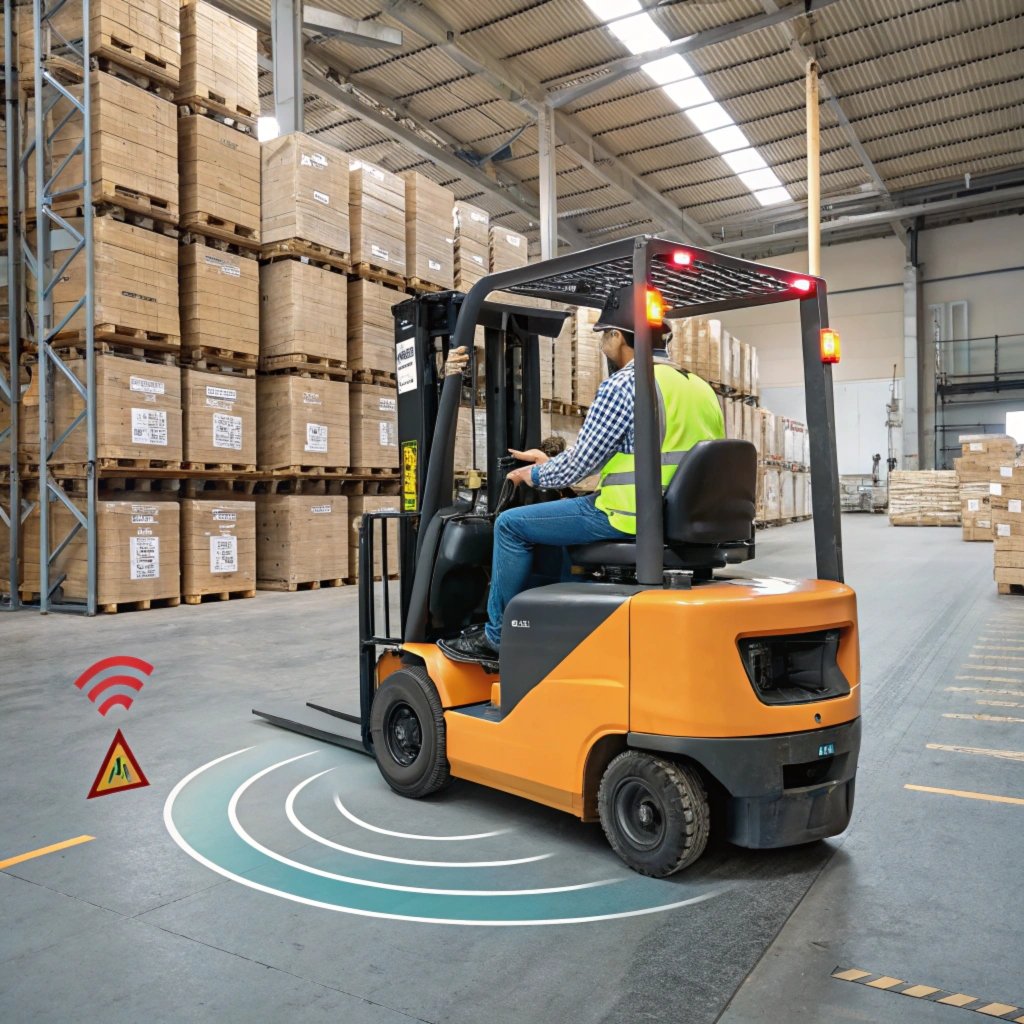
- Audible and visual warning devices — horn use at junctions, reversing alarms, and blue spot or arc lights that project a warning zone ahead of the truck before it's visible.
- High-visibility PPE for anyone on foot in active forklift zones, including visitors and contractors, not just warehouse staff.
The most common failure isn't a missing rule — it's a walkway that exists on the site plan but gets blocked by staged pallets during peak periods, forcing pedestrians back into the forklift lane. If your walkway isn't physically enforced (bollards, barriers, floor-mounted rails), assume it will get encroached on eventually.
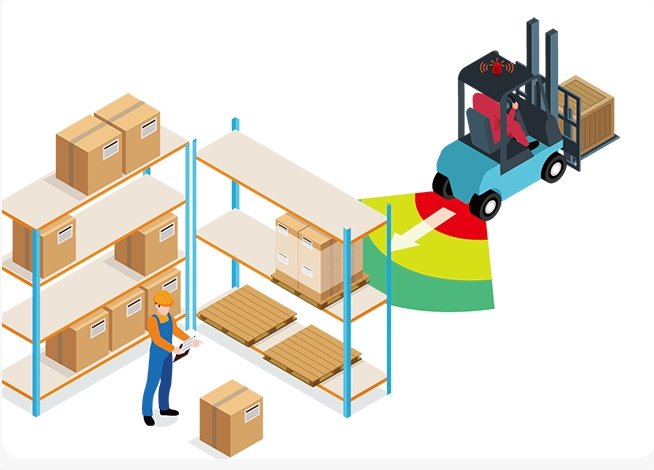
Where full physical separation isn't possible — mixed-use aisles, loading bays, cross-docking areas — pedestrian detection technology becomes the practical backstop. Systems built around UWB tag-based detection, AI camera recognition, or radar sensing can alert the operator — and in some configurations automatically slow or stop the truck — the moment a pedestrian enters the danger zone, regardless of whether either party actually sees the other.
6. Daily Inspection & Maintenance Duties
DOSH expects lifting machinery to be maintained in demonstrably safe working condition, and a pre-operation inspection checklist is treated as a mandatory safety record — not an optional courtesy — kept on file for audit purposes.
- Brakes, steering, and horn — tested functional before every shift, not assumed from the day before.
- Tyres — checked for wear, cuts, or pressure issues that affect stability.
- Forks — inspected for cracks, wear at the heel, and even alignment between the two forks.
- Mast and lift chains — lubricated, checked for stretching or rust on the links.
- Warning devices — backup alarms, lights, and horn confirmed working, not just present.
- Load capacity plate — legible and matched to the truck's current configuration, especially if attachments have been added.
End-of-shift procedure matters just as much as the start-of-shift check: forks lowered flush with the ground, directional control in neutral, parking brake engaged, and the truck parked clear of fire exits, electrical panels, and extinguishers. Any defect found during the shift should go into a logbook or tag-out system immediately — not carried over verbally to the next operator.
7. Safe Load Handling & Racking
Overloading and unstable loads remain leading causes of forklift tip-overs in Malaysian facilities, and the risk compounds as warehouses shift toward higher racking. Operators need to understand that a load's rated capacity is tied to a specific load center and lift height — lifting past roughly 6 metres, or handling a load whose center of gravity sits further out than standard, can meaningfully reduce what the truck can safely carry, even though the nameplate number hasn't changed.
- Confirm the load capacity plate is legible and matches the truck's current attachment configuration.
- Account for de-rated capacity when side-shifters, clamps, or other attachments are fitted.
- Keep loads low while traveling, and tilted back for stability — never travel with forks raised.
- Point the load uphill when carrying weight on a ramp, and point the forks downhill when running empty.
8. Common Violations & Penalties
Under the tightened enforcement posture DOSH has taken on OSHA Act amendments, the financial and legal exposure for forklift-related non-compliance has increased — penalties now extend beyond fines to include potential imprisonment for negligence that leads to a workplace accident. The most frequently cited issues in Malaysian audits tend to repeat across sites:
- Operating lifting machinery with a lapsed or unrenewed Certificate of Fitness.
- Operators running equipment classes their certification doesn't actually cover.
- No documented pre-operation inspection record, or one that's clearly filled in retroactively.
- Pedestrian walkways that exist on paper but are routinely blocked or ignored in practice.
- Missing or non-functional warning devices — alarms, lights, or horns that don't work when tested.
Failing to comply doesn't just risk a fine — it risks suspension of the equipment's authority to operate, which stops production far more expensively than the audit itself.
Higher racking and faster throughput mean less room for a preventable violation.
We don't issue certifications or renew your CF — but we build the pedestrian detection, speed control, and collision-avoidance systems that back up your written safety program with a working one.
Talk to a Safety Specialist9. Building a DOSH-Ready Safety Program
A program that survives an audit — and more importantly, prevents an incident — is built in layers rather than relying on any single control:
- Documentation first. Valid CF, current operator certificates matched to equipment class, and a live inspection logbook — accessible on request, not reconstructed after the fact.
- Written traffic management plan. Zone-based speed limits, marked pedestrian routes, and defined crossing points, trained into every operator and every floor worker, not just posted on a wall.
- Physical controls before behavioural ones. Barriers, bollards, and marked lanes reduce reliance on people remembering the rule under pressure.
- Refresher training on a schedule. A periodic competency check — and an immediate one after any near-miss — catches drift before it becomes an incident report.
- Technology as the backstop, not the whole plan. Speed limiters, pedestrian detection, and collision-avoidance systems close the gap between what the rulebook says and what happens in the three seconds before a near-miss becomes a collision.
10. Where Anti-Collision Technology Fits In
None of the above replaces DOSH certification, CF renewal, or trained operators — those are the legal foundation. What technology adds is coverage for the moments procedure alone can't reach: the blind corner where neither party sees the other, the operator whose attention lapses for two seconds, the pedestrian who steps around a pallet stack without checking.
- Forklift pedestrian safety systems — automatic alerts, and in some configurations automatic slowdown, the instant a person enters the truck's danger zone.
- Speed limiters — enforce the zone-based speed table above mechanically, instead of relying on operator memory.
- Forklift-to-forklift anti-collision systems — proximity warning between multiple trucks sharing the same aisles, especially where sightlines are poor.
- Camera-based blind-spot detection — visibility at rear and side blind spots that no amount of mirror placement fully solves.
These systems generate the kind of activity logs and alert records that also strengthen your documentation trail during a DOSH audit — evidence the safety program is active day to day, not just written down once and filed away.
11. Frequently Asked Questions
Tap a question to expand the answer — tap again to collapse it.