Skip to content
What Is the Number 1 Cause of Forklift Accidents?

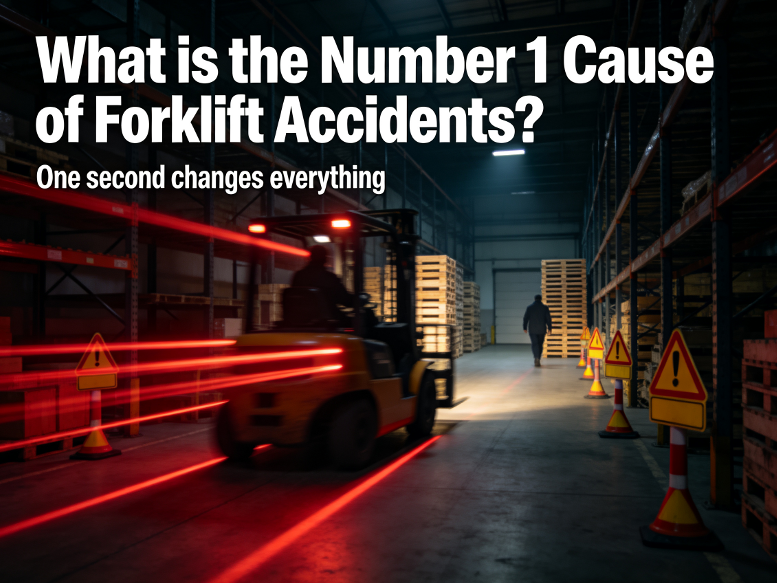
A forklift operator and a pedestrian sharing the same aisle — the exact scenario behind the leading cause of forklift fatalities.
Search "number 1 cause of forklift accidents" and you'll get two different answers depending on which report you land on: some say pedestrians struck by forklifts, others say tip-overs. Both are technically right, and the difference matters more than it looks, because it changes what you should actually fix first on your floor. This guide untangles the data, ranks every major cause, and gives you a practical framework for cutting the risk that matters most.
1. The Short Answer: Pedestrians Struck by Forklifts
Based on Bureau of Labor Statistics data that OSHA itself cites in its powered industrial truck enforcement directive, the leading cause of forklift-related work fatalities is a pedestrian being struck by the vehicle. It edges out tip-overs, falling loads, and dock incidents as the single most frequent circumstance behind a forklift death.
The number 1 cause of forklift accidents is a pedestrian being struck by the forklift — not the operator, and not the load. Most of these incidents happen at blind corners, during reversing, or in aisles where a forklift's travel path crosses a walkway with little or no warning.
That doesn't mean tip-overs are a minor issue — far from it. They're the deadliest single type of forklift accident, accounting for roughly 42% of all forklift fatalities on their own. The distinction is this: tip-over is one specific event, while "struck-by-pedestrian" covers many different scenarios (blind-corner strikes, reversing incidents, loading-dock collisions, and aisle crossings), which is exactly why it edges out tip-over as the single leading cause even though tip-over remains the single deadliest event type.
2. Why "Tip-Over" and "Pedestrian Strike" Both Get Called #1
Most of the confusion online comes down to two different ways of slicing the same accident data:
- By event type — group every fatality by what physically happened (tipped over, struck by object, fell from height, struck by vehicle). Sliced this way, tip-overs win at around 42% of fatalities, because it's one large, well-defined bucket.
- By circumstance / hazard — group every fatality by the underlying risk factor that caused it. Sliced this way, pedestrian strikes win, because they occur across many different physical settings (aisles, docks, blind corners, reversing) that don't all fall under one "event type" bucket.
For a warehouse or plant manager, the practical takeaway is the same either way: pedestrian visibility and vehicle stability are the two risks worth building your entire safety program around, because together they explain the overwhelming majority of serious forklift incidents.
If you only fix tip-over risk (speed, load balance, seat belts) but ignore pedestrian visibility, you've addressed the deadliest single event type while leaving the most common cause of forklift deaths untouched. A serious safety program budgets for both.
3. Every Leading Cause of Forklift Accidents, Ranked
Here's how the major causes stack up against each other, combining OSHA enforcement data with the incident patterns most warehouses and plants report:
| Rank | Cause | Why It's So Common | Typical Severity |
|---|---|---|---|
| #1 | Pedestrian struck by forklift | Blind corners, reversing without a spotter, no separated walkways, workers focused on a task instead of watching the aisle | Leading cause of fatalities |
| #2 | Forklift tip-over / overturn | Excess speed on turns, overloaded or off-center loads, uneven or sloped floors | Deadliest single event type (~42% of fatalities) |
| #3 | Falling loads / struck-by material | Loads exceeding rated capacity for the load center, poor securing, forks lifted too high | Serious injury, property damage |
| #4 | Falls from the forklift or an unapproved platform | Using forks (instead of an approved work platform) to lift a person, or dismounting/mounting improperly | Severe injury or fatality |
| #5 | Forklift-to-forklift collisions | Multiple trucks converging at shared intersections without visibility or right-of-way rules | Equipment damage, occasional injury |
| #6 | Loading dock incidents | Trailer creep, poor lighting, congestion during loading/unloading | Injury during dock-to-floor transition |
Notice that #1 and #5 both come down to the same underlying failure: an operator or pedestrian not seeing the other party in time. That single failure mode — poor mutual visibility — sits behind more forklift incidents than any mechanical defect ever does, which is why the rest of this guide focuses on closing that specific gap.
See how AI pedestrian detection catches what mirrors and training alone can't.
See the System4. Why Forklift-Pedestrian Accidents Keep Happening
None of this happens because operators are reckless. In most incident reports, the operator was certified, following posted speed limits, and still didn't see the pedestrian in time. That's a visibility and timing problem, not a compliance problem, and it usually comes down to a combination of these factors:
- Blind corners at racking and doorways — a forklift's mast and load block the operator's forward view at the exact moment a pedestrian is most likely to step into the aisle.
- Reversing without a clear line of sight — reversing incidents are disproportionately represented in struck-by fatalities, since the operator's attention and the pedestrian's position are both harder to track.
- Shared, unmarked floor space — many facilities route forklift traffic through the same open areas where pedestrians walk, with no painted lane, barrier, or raised curb separating the two.
- Task-focused pedestrians — a picker, technician, or line worker concentrating on their own job is statistically less likely to be watching for an approaching truck than the truck's own operator is to be watching for them.
- Noise and ambient distraction — busy floors, PA announcements, and machinery noise mean a horn alone often isn't enough warning, especially in facilities with hearing protection requirements.
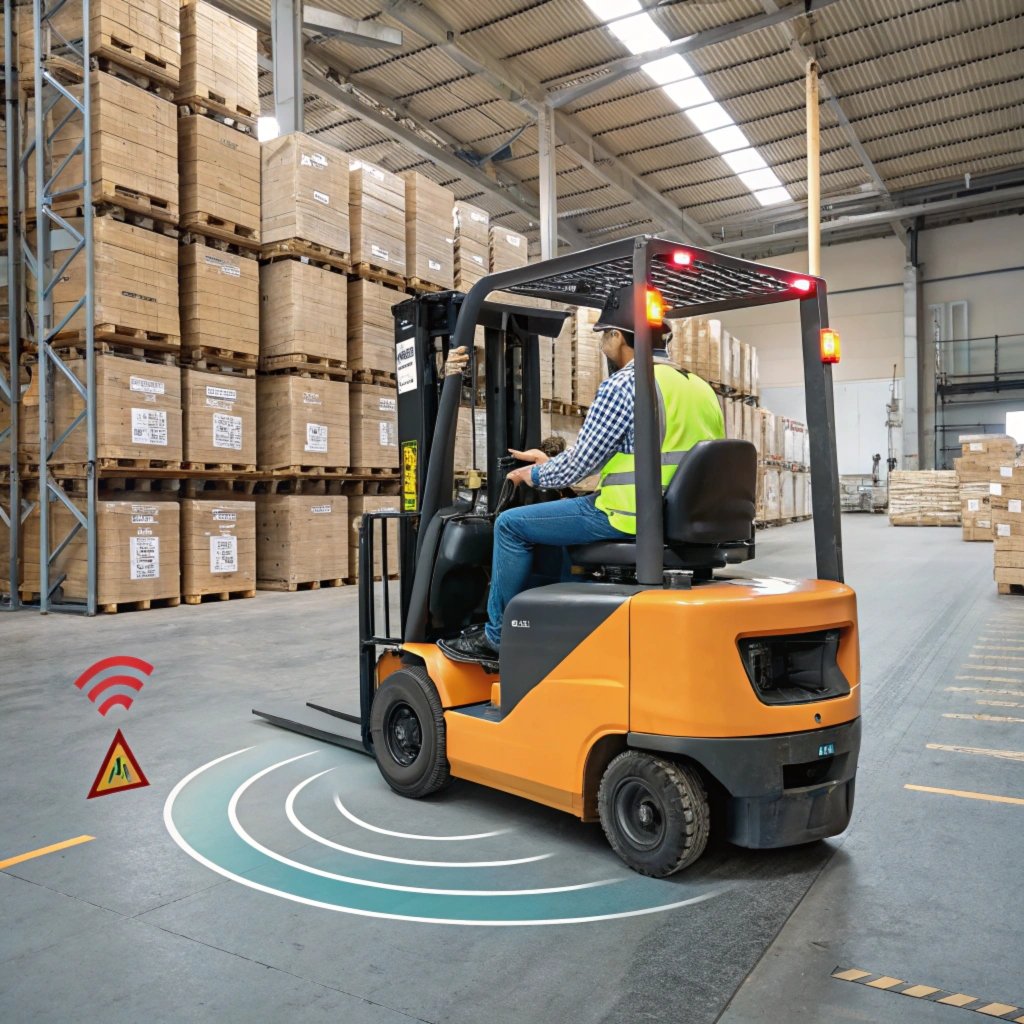
Both rely on the pedestrian and the operator looking or listening at exactly the right moment. In a busy facility, that moment is easy to miss — which is why an active pedestrian detection system that alerts the operator directly the instant someone enters a blind zone closes a gap that passive warnings simply can't.
5. What a Single Pedestrian-Strike Incident Actually Costs
The injury itself is only the first cost. A single forklift-pedestrian incident typically sets off a chain of secondary costs that are easy to underestimate when you're building the case for a safety investment:
- Downtime while the area is cleared, secured, and investigated.
- Workers' compensation claims that commonly run into the tens of thousands of dollars per serious injury.
- OSHA scrutiny — a citation, a follow-up inspection, or wider attention on the rest of the facility.
- Insurance premium increases that outlast the immediate incident by years.
- Team morale and trust — a visible near-miss or injury makes every operator on that floor more anxious, which can paradoxically increase errors rather than reduce them.
Set against that, the cost of prevention — layout fixes, refresher training, or a detection system — is usually a fraction of what one serious incident costs. If you haven't scored your own facility's risk yet, our warehouse risk assessment framework walks through how to prioritize which intersections and blind corners to fix first.
6. The 5-Layer Framework for Reducing the #1 Cause
Facilities that actually move the needle on pedestrian-strike risk don't rely on any single fix. They layer five things together, so that no single missed glance or forgotten rule turns into an injury:
Layer 1 — Separate the paths physically wherever you can
Painted lanes, floor markings, and physical barriers between forklift routes and walkways cut the number of moments where a truck and a pedestrian occupy the same square footage in the first place.
Layer 2 — Fix the blind corners you can't design away
Convex mirrors help at low speed, but they only work if both parties look at the right moment. Walk the floor and flag every point where sightlines drop under roughly 10–15 feet.
Layer 3 — Train, then retrain
Initial certification matters, but complacency tends to creep in six months to a year into a role, once routes feel routine. Scheduled refreshers, plus immediate retraining after any near-miss, keep the risk front of mind. Pairing this with a driver fatigue monitoring system on longer shifts catches the attention lapses training alone can't.
Layer 4 — Log near-misses, not just incidents
A near-miss is your earliest warning that a specific corner or route is about to produce a real injury. Treating near-misses as noise is one of the most common ways facilities miss a pattern before it becomes an incident — see our guide on forklift near-miss vs. forklift accident reporting for how to build that habit into your team.
Layer 5 — Add active detection technology
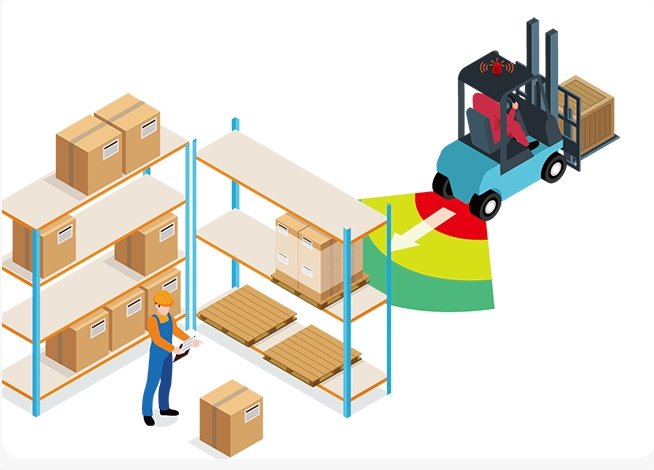
This is the layer that catches what the other four can't: the split second a pedestrian steps around a rack corner, or a truck approaches an intersection too fast. A forklift anti-collision system or proximity warning system alerts the operator directly the moment a person or another truck enters a danger zone, instead of relying on either party to spot it first.
Ready to Close the Gap Training and Layout Alone Can't?
We design the AI pedestrian detection, proximity warning, and camera systems that give your operators an active layer of protection against the number 1 cause of forklift accidents.
Talk to a Forklift Safety Specialist7. A Practical Pedestrian-Safety Checklist
Use this as a working checklist for your next floor walk — it's built around the specific risk factors behind the #1 cause, not a generic forklift safety list.
8. Common Mistakes That Keep This Risk Alive
- Treating tip-over prevention as the whole safety program — it's necessary, but it leaves the leading cause of fatalities unaddressed.
- Relying on mirrors alone at high-traffic blind corners — they help, but they depend on both parties looking at the right moment.
- Letting training lapse after initial certification — complacency, not lack of skill, is usually what creeps in on repetitive routes.
- Not logging near-misses — without a pattern to review, the same blind corner keeps almost causing the same incident until it finally does.
- Assuming a quiet floor is a safe floor — the absence of a recent incident isn't the same as the absence of risk.
9. Frequently Asked Questions
Tap a question to expand the answer — tap again to collapse it.
Based on Bureau of Labor Statistics data cited in OSHA's own enforcement directive, pedestrians being struck by a forklift is the leading cause of forklift-related work fatalities, ahead of tip-overs, falling loads, and dock incidents. Tip-overs cause the largest share of fatalities from a single event type (around 42%), but struck-by-pedestrian incidents are the single most common circumstance behind a forklift death.
Both statistics are correct, they're just answering slightly different questions. Tip-overs are the deadliest single event type, responsible for roughly 42% of forklift fatalities. Pedestrians being struck by the vehicle is the leading cause when fatalities are grouped by circumstance, since it includes many more distinct scenarios (blind corners, reversing, loading docks, and warehouse aisles) than the single tip-over category.
Pedestrian involvement varies by source and year, but struck-by-pedestrian incidents consistently rank among the top two or three causes in every major OSHA and BLS breakdown of forklift fatalities, and they carry a disproportionately high severity rate compared to other forklift incident types.
The most effective approach layers physical separation (marked lanes, barriers), facility fixes (blind-corner mirrors, better lighting), operator training and refreshers, and active detection technology that warns the operator the instant a pedestrian enters a blind zone, instead of relying on either party to spot the other first.
OSHA's Powered Industrial Trucks standard (29 CFR 1910.178) requires trained, evaluated operators, functioning horns and warning devices, and safe operating practices around pedestrians, but it does not mandate a specific detection technology. Many facilities now go beyond the minimum standard with pedestrian detection and proximity warning systems to close the gaps that training alone can't cover.
OSHA estimates that a large majority of forklift accidents are preventable through proper training, equipment inspection, and safe operating protocols. Since the leading cause is a visibility and timing failure between an operator and a pedestrian rather than reckless driving, most prevention efforts focus on closing that specific gap through layout, training, and technology.

Forklift Safety Solutions for the #1 Cause of Accidents
Forklift to Pedestrian
AI camera detection that alerts operators the instant a pedestrian enters a blind zone.
Forklift to Forklift
UWB tag-based proximity warning for high-traffic intersections and staging areas.
Forklift to Object
Millimeter-wave radar and LiDAR that detect both objects and pedestrians.