Skip to content
Forklift Cameras: The Ultimate Guide to Choosing, Placing, and Using Them Safely (2026)
A forklift camera doesn't stop an accident on its own — it gives the operator something mirrors and instinct can't: a clear, constant view into the exact spots a forklift is most likely to hit someone. This guide walks through what forklift cameras actually do, the different types on the market, where to mount them for real coverage, and how to fold them into a warehouse safety program that holds up under an audit and, more importantly, keeps people off the injury report.
1. What Is a Forklift Camera System?
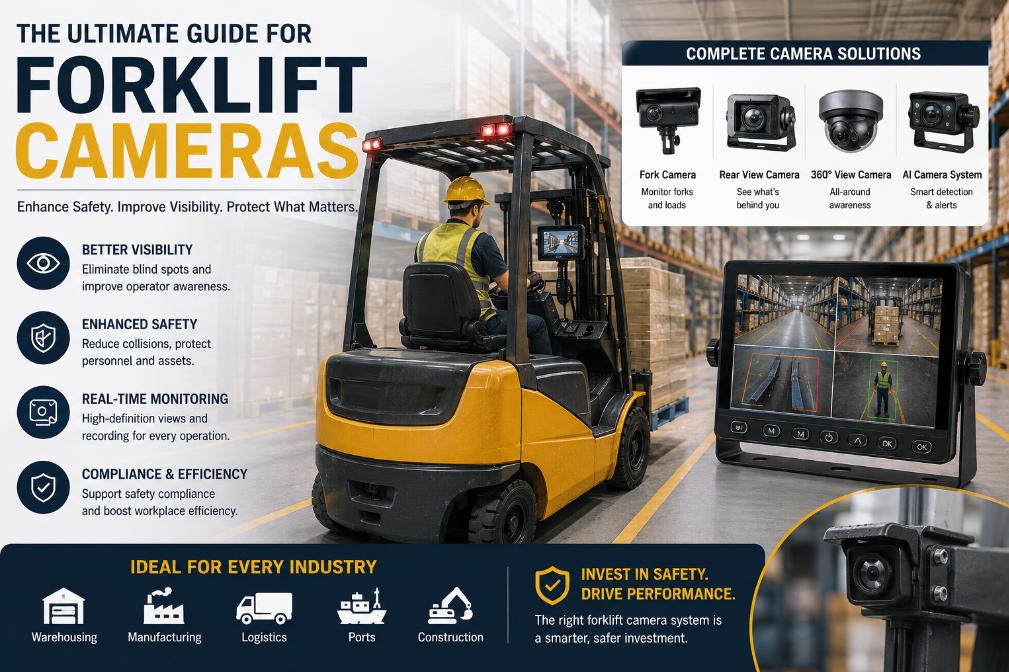
A forklift camera system is one or more cameras mounted directly on the truck — usually at the rear, the fork tips, or along the sides — feeding live video to a small monitor inside the operator's cab. Instead of relying on a quick glance over the shoulder or a convex mirror bolted to a post, the operator gets a continuous, real-time view of the exact zone the truck is about to move into.
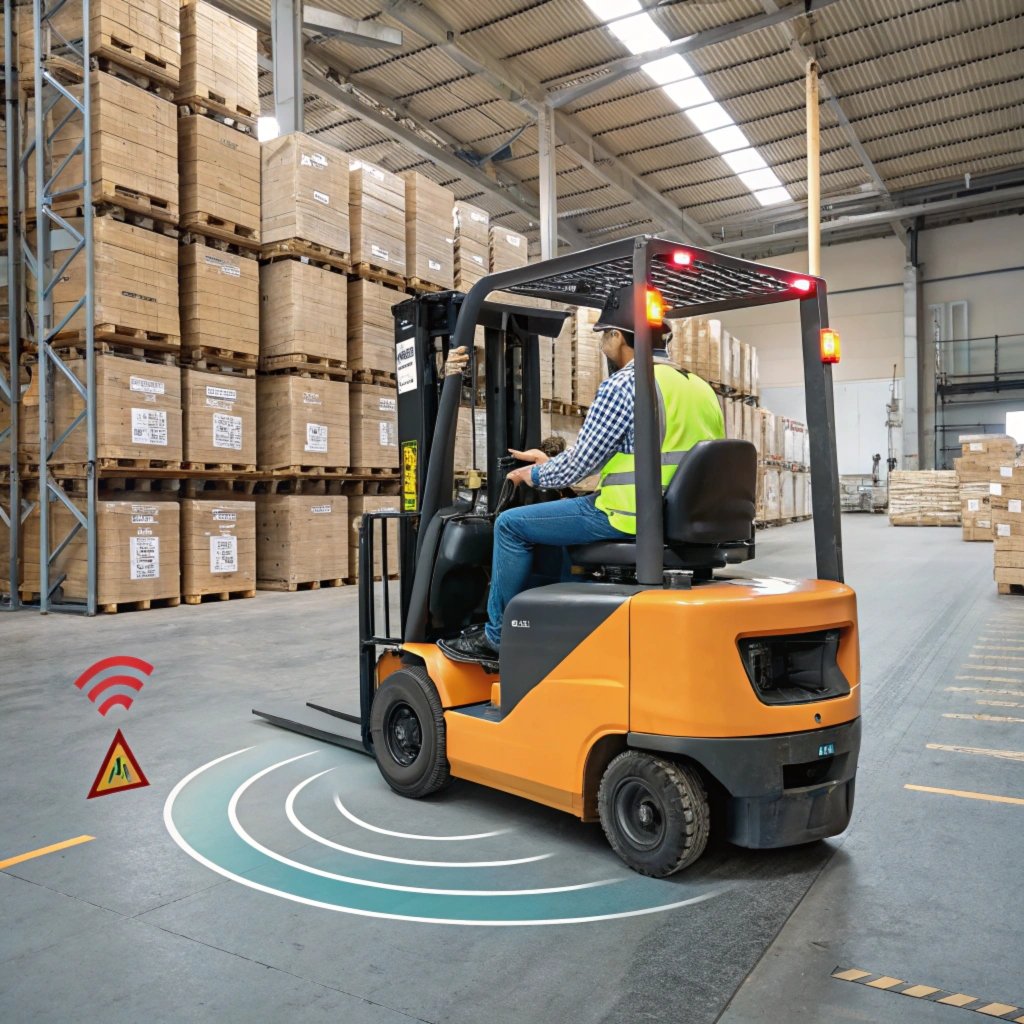
Modern systems go beyond a plain video feed. Many forklift camera systems now build in AI-based pedestrian detection, drawing a box around a person in frame and triggering an audible or visual alert the instant they step into the truck's path — turning a passive video feed into an active warning tool.
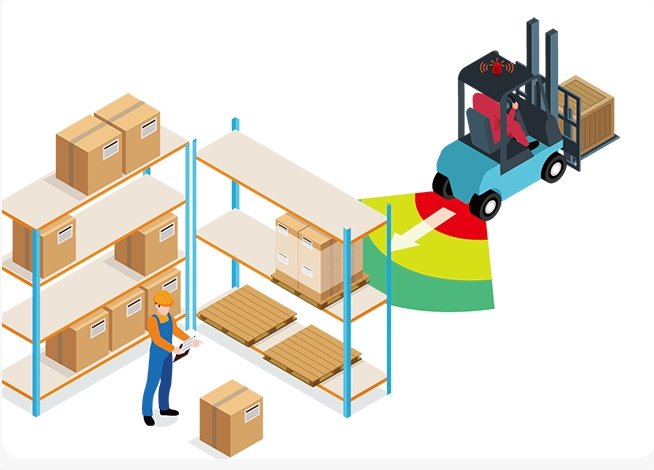
It's worth separating cameras from proximity sensor technology early, since the two get lumped together often. A camera shows the operator what's there; a sensor-based system (ultrasonic, radar, or UWB) detects a person or object and pushes an alert regardless of whether the operator is looking at a screen at that moment. We compare the two in more detail in section 4.
2. Why Forklift Blind Spots Are a Bigger Problem Than Most Managers Think
Sit in a counterbalance forklift and try to see everything around the truck at once — you can't. The mast, the overhead guard, the load itself, and the operator's own seated position all block sightlines that a pedestrian on foot has no reason to know about. A raised load in particular can blind an operator to almost everything directly in front of the truck, which is exactly the direction it's about to travel.
These aren't rare, edge-case blind spots. They're the same handful of zones every shift, every route, every day — which is precisely why they're dangerous. An operator who has driven the same aisle a hundred times starts to trust that "nobody's usually there," and that assumption is what turns a routine reverse or turn into a struck-by incident.
Forklift blind spots aren't a training failure — they're a physics and geometry problem. No amount of experience lets an operator see through a mast or around a stacked pallet. The fix has to be visibility, not vigilance alone.
3. The Main Types of Forklift Cameras
Not every forklift needs the same camera setup. The right type depends on the truck class, the blind spot you're solving for, and the environment it operates in.
| Camera Type | What It Covers | Best Suited For |
|---|---|---|
| Rear-view camera | The zone directly behind the counterweight during reversing | Counterbalance trucks doing frequent reverse travel |
| Side / blind-spot camera | The side the operator's seated position and mast obstruct | Narrow aisles, dock areas, cross-traffic intersections |
| Fork-tip / mast-mounted camera | What's directly ahead of or above a raised load | Reach trucks, order pickers, high-stack put-away work |
| 360° surround-view system | A stitched, top-down view around the entire truck | High-traffic, multi-directional aisles and cross-docks |
| AI pedestrian-detection camera | Same coverage as above, plus active on-screen and audible alerts | Sites with frequent pedestrian traffic near forklift routes |
| Explosion-proof camera | Standard camera coverage rated for hazardous atmospheres | Chemical plants, grain facilities, paint booths, refineries |
Wired systems tend to be more reliable and lower-latency but need professional installation; wireless forklift camera kits install faster and move between trucks more easily, at the cost of occasional signal interference in metal-heavy warehouses. Some setups also include a camera recorder (DVR), which stores footage locally so incidents and near-misses can be reviewed after the fact rather than relying on memory.
4. Forklift Cameras vs. Mirrors vs. Sensor-Based Systems
Each of these three tools solves a slightly different part of the visibility problem, and most well-run warehouses end up using more than one together rather than picking just one.
- Mirrors are cheap, need no power, and never go offline — but they only work if the operator remembers to check them and happens to be looking at the right angle at the right moment.
- Cameras put the blind zone directly in the operator's line of sight on a monitor, removing the need to twist around or catch a small mirror reflection — but the operator still has to glance at the screen and interpret it.
- Proximity sensor systems (ultrasonic, radar, or UWB-based) go a step further and actively alert the operator the moment a person or object is detected, without depending on where the operator happens to be looking.
We've broken this comparison down in much more depth in Forklift Camera vs. Mirrors and AI Camera vs. UWB Forklift Safety System, if you're weighing which combination fits your facility.
A camera is only as good as the operator's attention to the screen. In your highest-traffic pedestrian zones, pairing a camera with an active blind-spot detection system closes the gap a camera alone can leave open.
5. How Forklift Cameras Prevent Pedestrian Accidents
The scenario forklift cameras exist to solve is almost always the same: a pedestrian standing in a zone the operator physically cannot see from the seat, right as the truck is about to move through that exact space. It happens at blind corners, behind racking, and directly behind a reversing counterweight — and it happens fast enough that "the operator should have looked harder" isn't a fix, it's wishful thinking.

A camera closes that gap in two ways. First, it puts the blind zone on a screen the operator is already glancing at as part of a reversing or turning routine, instead of requiring a separate mental step. Second, when the camera is AI-enabled, it doesn't wait for the operator to notice the person on screen — it flags them automatically, the same way a backup camera in a car draws guide lines around an obstacle.
This matters most at the handful of predictable pressure points every warehouse has: dock doors, blind aisle intersections, and any route where a forklift regularly reverses out of a staging area. Mapping those points and confirming camera coverage at each one is one of the highest-leverage things a safety manager can do — see our warehouse risk assessment framework for a structured way to find and rank them.
Not sure which blind spots on your fleet actually need coverage?
Get a Free Blind Spot Review6. Key Features to Evaluate Before You Buy
Camera systems vary a lot in build quality and capability. These are the features worth checking before you commit to a fleet-wide rollout:
- Resolution and low-light performance. A camera that's unreadable in a dim corner of the warehouse or at dusk defeats the purpose — look for night-vision or wide dynamic range (WDR) capability.
- Monitor size, placement, and glare handling. A screen that's hard to read in direct sunlight near a dock door gets ignored fast — test it in your actual lighting conditions, not just a showroom.
- Wired vs. wireless latency. A laggy feed is worse than no camera at all when the operator is making a split-second reversing decision.
- IP rating. Warehouse floors get power-washed, forklifts get rained on during outdoor yard moves — confirm a dust and water ingress rating suited to your environment.
- Explosion-proof / hazardous-area certification if the truck operates anywhere near combustible dust, flammable vapors, or a classified zone.
- AI detection accuracy. False alerts train operators to ignore the system just as fast as missed detections do — ask for a demo in conditions close to your own facility.
- Recording and playback. A built-in DVR/recorder turns every near-miss into a coaching opportunity instead of a he-said-she-said dispute.
- Vibration and shock resistance. Forklifts vibrate constantly — consumer-grade cameras and mounts loosen or fail faster than industrial-rated ones.
7. Where to Mount Cameras: Blind Spots by Truck Type
Camera placement isn't one-size-fits-all — the blind spot that matters most depends heavily on the truck class and how it's used.
Counterbalance forklifts
The two highest-value positions are rear-facing (covering the zone behind the counterweight during reversing) and a side-mounted camera on whichever side the mast and seated position obstruct most — usually the side opposite the operator's dominant head-turn direction.
Reach trucks and order pickers
These trucks spend more time lifting than reversing, so a fork-tip or mast-mounted camera aimed at the load and the space directly ahead tends to deliver more value than a rear camera.
Narrow-aisle and very narrow-aisle (VNA) trucks
Side clearance is the main risk here — cameras mounted to show both aisle walls as the truck travels help operators catch a pedestrian who's stepped into the aisle from a cross-connector.
Yard trucks and outdoor forklifts
Wider fields of view and weatherproof, glare-resistant monitors matter more here than indoor units, since sightlines involve trailers, parked equipment, and changing outdoor light.
You don't need to outfit every truck on day one. Identify the two or three routes with the most near-misses or the tightest blind corners, get those covered first, and use what you learn to refine the rollout across the rest of the fleet.
8. Installation and Maintenance Best Practices
A camera system is only as good as its upkeep. A few practices keep it reliable instead of becoming another piece of equipment nobody trusts:
- Route cables away from moving parts — masts, chains, and hydraulic lines will chafe through a poorly routed cable within weeks.
- Add lens cleaning to the pre-shift inspection — a dirty or fogged lens is functionally the same as no camera at all, and it's the single most common reason a system stops getting used.
- Check monitor visibility at shift-start, especially for trucks that move between indoor and outdoor light throughout the day.
- Confirm mount stability periodically — constant forklift vibration works mounting brackets loose over time.
- Keep AI detection firmware current on systems that support it — detection accuracy on these systems typically improves with updates.
- Professional installation for wired, multi-camera, or AI-enabled systems is worth the cost; a poorly wired system that intermittently drops the feed is worse than the operator trusting mirrors alone.
9. Building a Camera-Based Warehouse Safety Program
A camera on the truck is a tool, not a program. The warehouses that get the most out of forklift cameras treat them as one layer in a broader safety approach, not a stand-alone fix:
- Pair cameras with operator training that specifically covers how and when to check the monitor — not just that the camera exists.
- Review recorded footage regularly, not only after an incident. Near-misses caught on camera are the earliest, cheapest warning sign a facility gets.
- Use footage to coach, not just discipline — operators who trust the system won't be reported for using it correctly are far more likely to actually rely on it.
- Layer in active detection technology at your highest-risk intersections, combining cameras with a pedestrian safety system or a speed limiter so a missed glance at the screen isn't the only line of defense.
- Tie camera checks into your existing pre-shift inspection so verifying the system works becomes routine, not an afterthought.
Reducing Blind-Spot Accidents in Your Warehouse?
We design forklift camera, AI pedestrian detection, and collision-avoidance systems that give your operators an extra layer of protection your layout and training alone can't provide.
Talk to a Forklift Safety Specialist10. Common Mistakes Warehouses Make With Forklift Cameras
- Buying one camera type for every truck class instead of matching the position to the blind spot each truck actually has.
- Mounting a camera where it blocks mast travel or a chain, forcing maintenance to remove or damage it within months.
- Skipping lens cleaning as part of the pre-shift routine, letting the system quietly stop being useful without anyone noticing.
- Positioning the monitor where glare makes it unreadable for half the shift, which trains operators to stop checking it.
- Treating cameras as a complete fix and skipping the active-detection layer at genuinely high-traffic pedestrian intersections.
- Never reviewing recorded footage until after an incident, missing the near-misses that would have flagged the problem earlier.
- Installing standard cameras in a classified hazardous area instead of an explosion-proof rated system.
11. Frequently Asked Questions
Tap a question to expand the answer — tap again to collapse it.