Skip to content

Warehouse Forklift Pedestrian Safety Systems: Complete Guide
Most forklift-pedestrian collisions don't happen because an operator was careless — they happen because a person stepped around a rack, out of a doorway, or across an aisle at the exact moment a 9,000-pound truck was passing, and neither one saw the other in time. This guide explains how warehouse forklift pedestrian safety systems close that gap, how the main detection technologies compare, and how to build them into a program that actually reduces struck-by incidents rather than just adding another sticker to the truck.
1. What Is a Forklift Pedestrian Safety System?
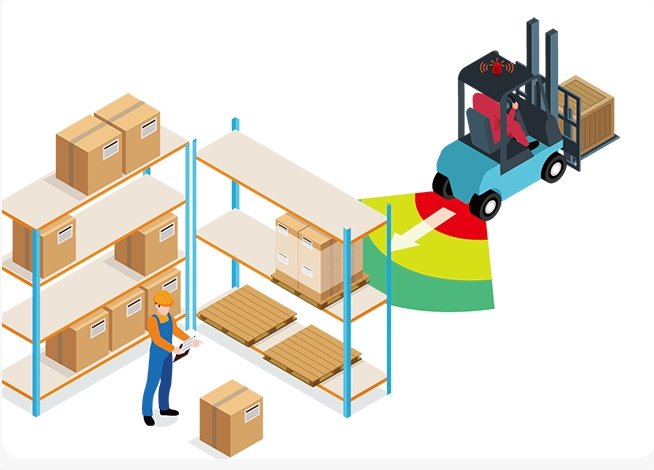
A forklift pedestrian safety system is any combination of sensors, tags, or cameras — mounted on the truck, worn by pedestrians, or fixed to the facility — that detects when a person and a forklift are converging, and then delivers a warning fast enough for one of them to react. The warning can be a light, a sound, a vibration on a wearable tag, or an automatic speed cut, depending on the technology.
The category covers a range of approaches — UWB tag-based detection, AI camera systems, millimeter-wave radar, ultrasonic sensors, and projected warning lights — and most mature forklift pedestrian safety systems combine two or more of these rather than relying on a single sensor type. What they share is the same core job: replace "the operator happened to look at the right moment" with an active, repeatable warning that doesn't depend on luck or attention.
A pedestrian safety system is different from a single safety device. A backup alarm or a convex mirror is a passive aid — it only helps if someone is already paying attention to it. A pedestrian safety system actively detects proximity and pushes a warning to the operator, the pedestrian, or both, regardless of where either party is looking.
2. Why Pedestrian Safety Systems Matter in a Warehouse
Warehouses are built around forklift traffic more than almost any other industrial environment, which sounds like it should make them safer — the aisles are wide, the routes are marked, the racking is designed for lift trucks. But that same density of forklift traffic is exactly why pedestrian exposure adds up: pickers crossing aisles, receiving staff stepping off a dock, supervisors walking a section, and drivers all sharing the same floor for an entire shift, often at the exact intersections where forklifts turn or reverse.
Industry-wide estimates commonly cited by OSHA-adjacent safety data put forklift-related workplace injuries in the tens of thousands annually in the U.S. alone, and struck-by-vehicle incidents are consistently among the most likely forklift incidents to result in a fatality rather than a recoverable injury. Unlike a tip-over or a dropped load, a pedestrian strike has essentially no margin — there is no seatbelt, no cage, no cab protecting the person on foot.
That severity gap is the real reason pedestrian detection gets its own budget line separate from general forklift safety spending: it targets the single failure mode most likely to end in a life-altering injury rather than a repair bill.
3. How Forklift–Pedestrian Collisions Actually Happen
Almost every forklift-pedestrian incident traces back to one of a small number of visibility and timing failures, repeated across different layouts:
- Blind rack corners. A pedestrian steps out from behind racking into an aisle the operator is already committed to.
- Reversing without a clear rear view. The load, mast, or overhead guard blocks the operator's sightline exactly where a person is most likely to be walking.
- Shared dock and staging zones. Foot traffic and forklift traffic cross the same doorway with no separation or staggered timing.
- Task-focused pedestrians. A picker scanning a barcode or a worker carrying a box is looking at the task, not scanning for an approaching truck.
- Predictable-route complacency. An operator running the same route dozens of times a shift stops treating a known blind corner as genuinely blind.
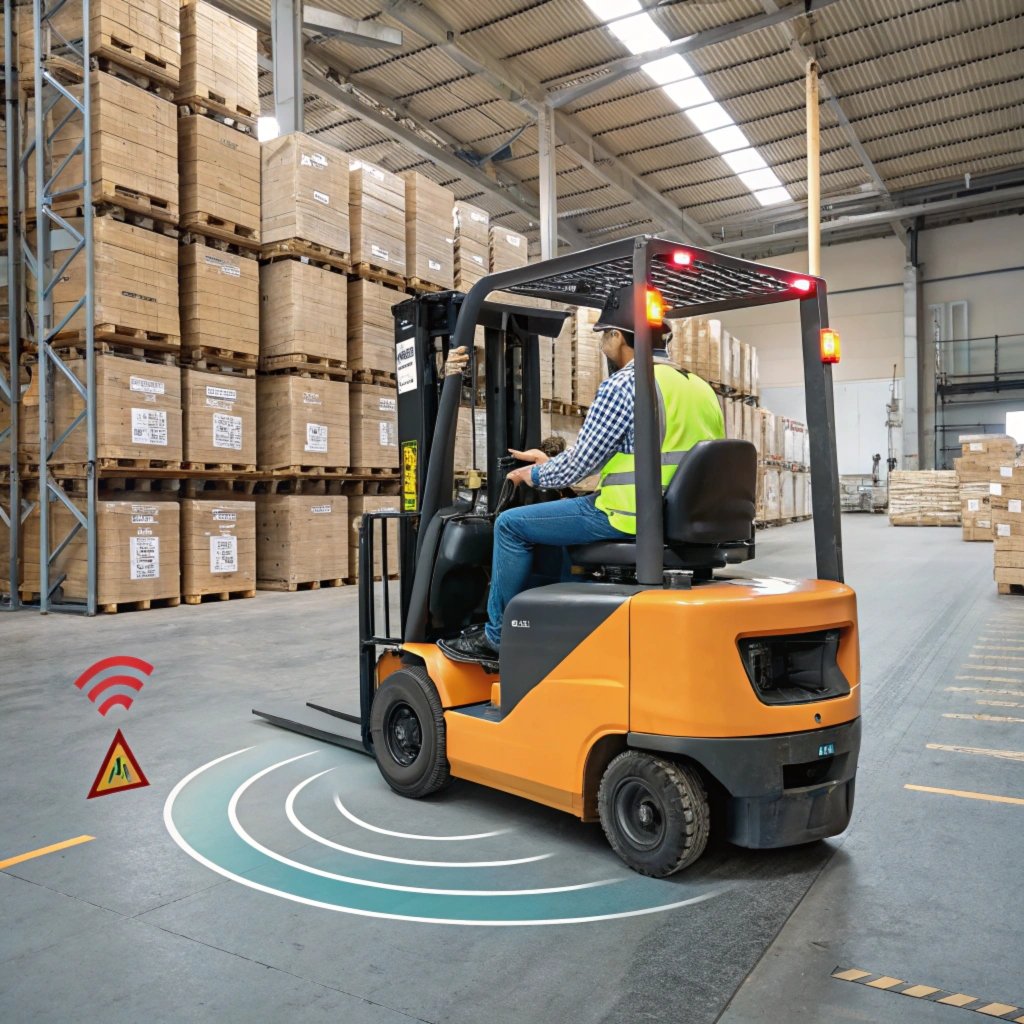
The photo below shows exactly this scenario: a pedestrian standing close to the side of a forklift, well within the truck's turning and stopping radius, but outside the operator's natural line of sight from the seat. If the operator doesn't specifically check that side before moving, this is precisely the moment a struck-by incident happens — not because anyone was reckless, but because the geometry of the cab simply didn't put that pedestrian in view.

An operator can be certified, sober, alert, and driving within the posted speed limit and still not see a pedestrian standing in a structural blind spot. This is a geometry and timing problem, not an attitude problem — which is exactly why layout controls and active detection technology, not just reminders, are what actually move the needle.
4. Types of Forklift Pedestrian Safety Systems, Compared
There is no single "best" pedestrian detection technology — each approach trades off detection range, accuracy, cost, and how much it depends on pedestrians cooperating (for example, wearing a tag). Here's how the main categories stack up:
| Technology | How It Detects | Strengths | Limitations |
|---|---|---|---|
| UWB Tag-Based | Wearable tags on pedestrians communicate with truck-mounted anchors, measuring distance through walls and racking | Non-line-of-sight detection, high accuracy, works around corners | Requires every pedestrian to carry a tag; higher upfront rollout |
| AI Camera Detection | Onboard cameras use computer vision to identify human shapes in real time, no tag required | Detects any pedestrian, including visitors and contractors; also gives the operator a live view | Line-of-sight only — can't see through racking or around blind corners |
| Millimeter-Wave Radar | Radar waves detect moving objects and estimate distance/speed regardless of lighting or dust | Works in poor lighting, dust, or outdoor yard conditions; durable | Can struggle to distinguish a person from other moving equipment without added logic |
| Ultrasonic Sensors | Sound-wave sensors measure distance to nearby objects at close range | Low cost, simple to install, good for close-range reversing alerts | Short effective range; less precise at distinguishing people from objects |
| Projected Warning Lights | A blue or red spot/arrow projects onto the floor ahead of or beside the truck | Very low cost, gives pedestrians a visual cue before the truck arrives | Passive — only helps if the pedestrian looks down and notices it |
In practice, most well-protected warehouses don't pick just one row from this table. A camera gives the operator a live view and catches unregistered visitors; UWB tags catch the pedestrians a camera can't see around a corner; and a proximity warning system layered on top can also flag forklift-to-forklift risk at busy intersections, not just forklift-to-pedestrian risk.
Not Sure Which Detection Technology Fits Your Floor?
Our team can review your layout and recommend the right mix of UWB, camera, and radar detection for your traffic patterns.
Request a Free Layout Review5. How to Choose the Right System for Your Warehouse
Rather than starting from "which technology is best," it's more useful to start from your own layout and traffic pattern. A few questions will point you toward the right mix quickly:
- How much of your risk is from non-employees? Visitors, drivers, and contractors won't reliably wear a tag, so a camera-based layer matters more if outside foot traffic is common.
- How many blind corners does your racking create? The more non-line-of-sight risk you have, the more a tag-based UWB system earns its higher cost.
- Is your facility indoor-only, or does it include a yard? Outdoor and mixed-lighting areas favor radar's weather and dust tolerance over camera-only detection.
- What's your fleet size and rollout budget? Ultrasonic sensors and projected lights are a reasonable starting layer for smaller fleets before scaling to tag-based detection.
- Do you need forklift-to-forklift coverage too, not just pedestrian? If multiple trucks converge at the same intersections, look for a system that covers both cases rather than buying two separate ones.
6. Building a Complete Pedestrian Safety Program
Technology closes the gap that training and layout alone can't — but it works best as one layer inside a complete program, not a standalone fix. A pedestrian safety program that actually holds up rests on four parts working together:
Facility layout and separation
Painted lanes, physical barriers, and marked crossing points at every aisle-to-walkway intersection reduce how often a truck and a pedestrian occupy the same square footage in the first place. A structured warehouse risk assessment is the fastest way to find and rank your highest-traffic intersections before deciding where to invest first.
Operator training and pedestrian awareness
Certified operator training should be paired with pedestrian-side awareness — teaching warehouse staff to make eye contact with operators, avoid walking behind reversing trucks, and treat forklift lanes the way they'd treat a live traffic lane, not a shortcut.
Active detection technology
The systems compared in Section 4 sit here — the layer that catches the split-second encounters no amount of training fully eliminates, because human attention has physical limits that a sensor doesn't.
Incident and near-miss reporting
A near-miss log turns invisible risk into a rankable list. If the same blind corner keeps generating "close calls" that never get formally logged, that pattern stays invisible until it becomes an actual injury. See our breakdown of forklift near-miss vs. forklift accident reporting for how to build that habit into a shift routine, and pair it with a driver fatigue monitoring system if your near-miss data points toward attention lapses on longer shifts.
None of these four parts is optional in a mature program. A warehouse with excellent technology but no layout controls still has pedestrians walking through blind intersections; a warehouse with perfect layout but no detection still has no backstop for the day a route gets disrupted by a spill, a closed aisle, or a substitute operator.
7. Rolling Out a System Without Disrupting Operations
Warehouses rarely have the luxury of a shutdown to install a new safety system, so a phased rollout matters as much as the technology choice itself:
- Map your highest-risk intersections first. Use near-miss logs and a walk-through with both an operator's and a pedestrian's perspective to rank crossing points by traffic volume.
- Pilot on the busiest 10–20% of your fleet. Equip the trucks running the highest-traffic routes first, rather than trying to fit out the whole fleet at once.
- Tag pedestrians in the pilot zone. If using UWB, issue tags to everyone regularly working in the pilot area, including supervisors and maintenance staff, not just pickers.
- Review alert data after 2–4 weeks. Look for false-alert hotspots and tune sensitivity before expanding — an over-alerting system gets ignored just as fast as no system at all.
- Expand fleet-wide and fold results into training. Use the pilot's real alert data in refresher training so operators see exactly where the system is catching risk on their own floor.
8. Common Mistakes Warehouses Make
- Buying technology before mapping the layout. Equipping the whole fleet before knowing which intersections actually generate risk wastes budget on trucks that rarely encounter pedestrians.
- Relying on tags alone with no camera coverage. Visitors, new hires who haven't been issued a tag yet, and contractors are invisible to a tag-only system.
- Treating alerts as noise instead of data. A spike in alerts at one intersection is a layout problem waiting to be fixed, not a system malfunction to be silenced.
- Skipping pedestrian-side training. A system that warns the operator but never teaches pedestrians safe walking habits is only protecting half the equation.
- Letting near-misses go unlogged. Without a record, the same blind corner keeps almost causing the same incident until it finally does.
- Assuming a quiet floor is a safe floor. No recent incident isn't the same as no risk — it often just means the near-misses haven't been counted.
Ready to Protect Your Warehouse Floor?
We design UWB, camera, and radar-based forklift pedestrian safety systems built for real warehouse traffic — not a generic aftermarket sensor kit.
Talk to a Safety Specialist9. Frequently Asked Questions
Tap a question to expand the answer — tap again to collapse it.
A forklift pedestrian safety system is a set of sensors, tags, or cameras mounted on a forklift and/or worn by pedestrians that detects when a person and a truck are getting too close, then warns the operator, the pedestrian, or both in time to avoid a collision. Common technologies include UWB tag-based detection, AI camera detection, millimeter-wave radar, and ultrasonic sensors.
There is no single best technology for every warehouse — it depends on layout, budget, and how much of your pedestrian traffic is on foot versus other equipment. UWB tag-based systems give the most precise, non-line-of-sight detection but require tags on every pedestrian. AI camera systems detect any person without a tag and work well at racking intersections and dock doors. Radar and ultrasonic systems are lower-cost options that suit simpler, lower-traffic layouts.
No. Pedestrian safety systems are a second layer of protection, not a substitute for certified operator training, pre-shift inspections, or facility layout controls. They exist specifically to catch the moments a well-trained operator still cannot see in time, such as a person stepping out from behind racking.
Costs vary by technology and fleet size. Ultrasonic and radar sensor kits are typically the lowest-cost per truck, camera-based AI detection sits in the middle, and UWB tag-based systems with wearable tags for every pedestrian cost more upfront but usually scale better across large, high-traffic sites. Most providers price per truck plus a per-tag or per-camera cost, so a fleet-wide quote is the only reliable way to compare.
Prioritize blind intersections where forklift aisles cross walkways, racking corners with no sightline, dock doors where pedestrian and truck traffic mix, and any area with a documented near-miss. Ranking your intersections by foot traffic and forklift frequency is the fastest way to decide where the first trucks or zones get equipped.
Many insurers view a documented, active pedestrian detection program as a meaningful risk-reduction control, similar to fire suppression or fall protection, and it can support a case for lower premiums or fewer claims over time. The exact impact depends on your carrier and claims history, so it is worth discussing directly with your broker once a system is in place.
This article is written by:

Give Your Warehouse a Second Layer of Protection
We build the UWB, camera, and radar-based pedestrian detection systems that catch what layout and training alone can't — so a missed glance never becomes an injury.
Get Your Free Safety Consultation