Skip to content
Top Forklift Safety Tips for Warehouse Managers: The Complete 2026 Guide
22 practical, field-tested tips covering operators, pedestrians, load handling, facility design, and inspections — plus where technology closes the gaps that training and rules alone can't.
Forklifts move nearly everything in a warehouse, which also makes them one of the most consistent sources of serious injury on the floor. The good news: most forklift accidents trace back to a short list of repeatable, preventable causes — blind corners, rushed loads, skipped inspections, and traffic patterns nobody has revisited in years. This guide organizes the forklift safety tips that actually move the needle, grouped by who needs to act on them, so you can turn it straight into a checklist, a toolbox talk, or a training refresher.
📋 Table of Contents
- 1. Why "Follow the Rules" Isn't a Safety Program
- 2. Top Forklift Safety Tips for Operators
- 3. Top Forklift Safety Tips for Pedestrians & Warehouse Staff
- 4. Top Forklift Safety Tips for Load Handling
- 5. Top Forklift Safety Tips for Facility & Traffic Design
- 6. Top Forklift Safety Tips for Pre-Shift Inspection & Maintenance
- 7. Manual Safety Practices vs. Technology-Assisted Safety
- 8. Building a Forklift Safety Culture That Actually Lasts
- 9. Common Mistakes That Quietly Undermine Safety Programs
- 10. FAQs
1. Why "Follow the Rules" Isn't a Safety Program
Most warehouses already have forklift rules posted somewhere — speed limits, horn-at-intersections, no-riding-passengers. The problem is that a list of rules only works if the floor layout, staffing levels, and equipment actually make those rules easy to follow under normal shift pressure. An operator running behind on picks in a warehouse with no marked pedestrian lanes isn't ignoring the rules out of carelessness; the environment is quietly working against the rule the whole time.
That's why the tips below are grouped by role and by system, not just listed as a flat checklist. A tip aimed at operators only works if pedestrians, layout, and inspection routines are pulling in the same direction.
2. Top Forklift Safety Tips for Operators
These are the habits that make the biggest difference behind the wheel, in order of how often they show up in incident reports.
Sound the horn at every blind corner and intersection
Not just the busy ones — the quiet aisles are where pedestrians least expect a forklift and where operators are most likely to skip the habit.
Keep forks low and tilted back while traveling
Forks a few inches off the floor, mast tilted slightly back — this is the single biggest factor in tip-over resistance and load stability.
Match your speed to your sightline, not the posted limit
The facility speed limit is a ceiling, not a target. If you can't stop within the distance you can see, you're going too fast for that specific aisle.
Look in the direction of travel — including reverse
When traveling with a load that blocks forward visibility, drive in reverse rather than craning around an obstructed view.
Wear the seat belt every time, no exceptions
In a tip-over, jumping clear is almost always the wrong instinct — the belt is what keeps an operator inside the protective cage.
Never carry a load that blocks your view without a spotter
If the load height means you can't see the path ahead, get a signal person or reverse — don't guess at what's in front of the mast.
Treat every dock plate and ramp as its own hazard zone
Slow down, check plate securement, and confirm the trailer wheels are chocked before rolling on — dock transitions cause a disproportionate share of incidents.
Report near-misses the same shift they happen
A near-miss reported and logged is a pattern you can fix. A near-miss that goes unreported is the same incident waiting to happen again.
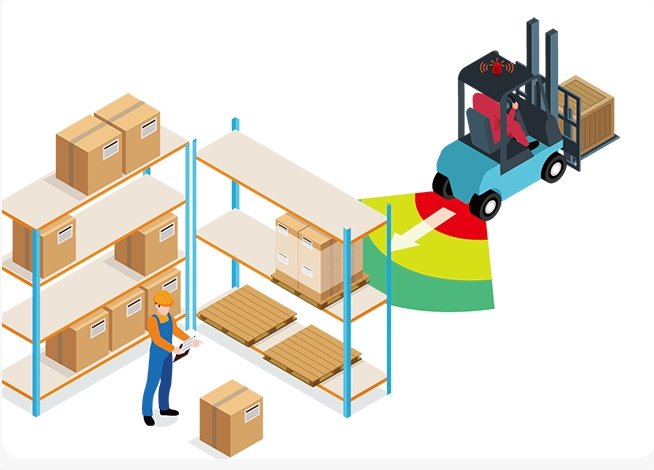
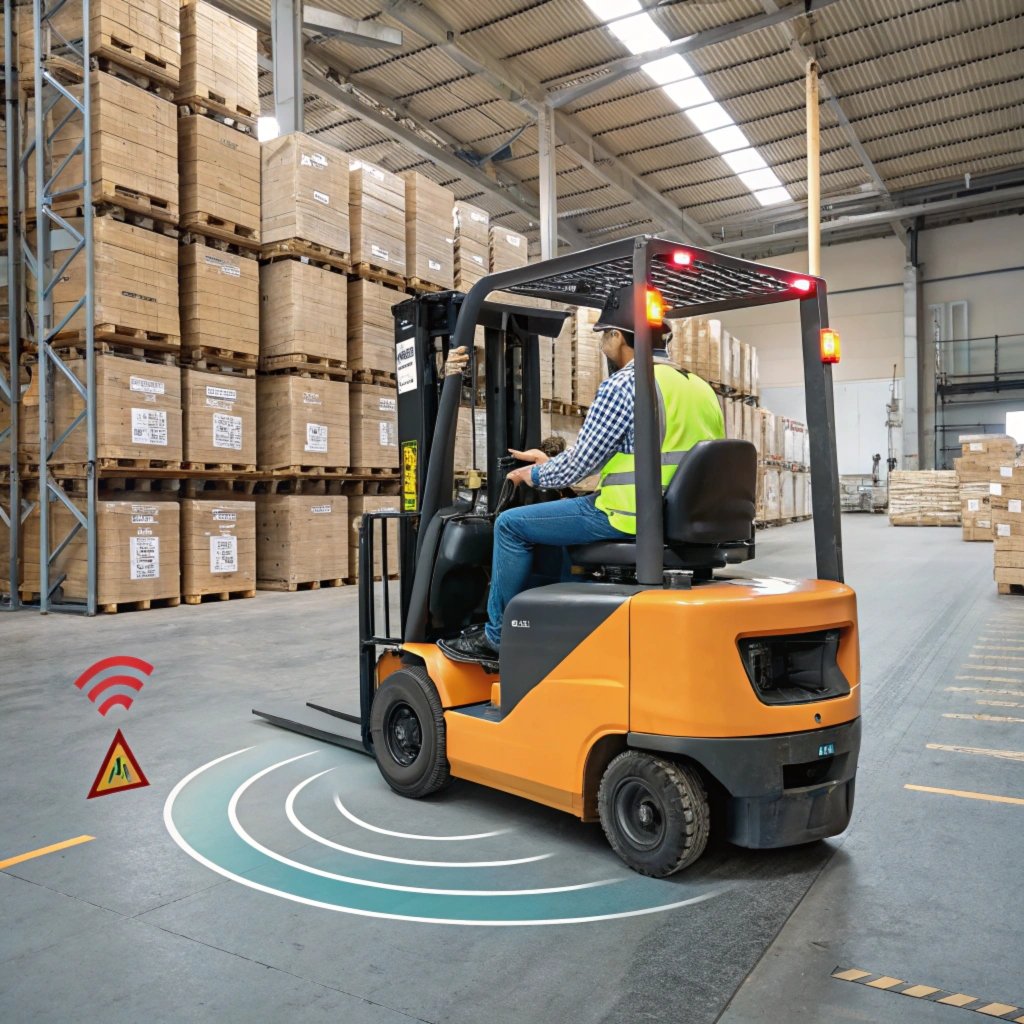
Operator skill is necessary but not sufficient on its own — even a highly disciplined driver can't physically see around a rack corner a half-second before a pedestrian steps out. A pedestrian detection system is built specifically to close that exact gap, alerting the operator the instant someone enters a blind zone rather than relying on the horn habit alone.
3. Top Forklift Safety Tips for Pedestrians & Warehouse Staff
Forklift safety isn't only an operator responsibility — pedestrians on the floor make just as many split-second decisions that determine whether a close call stays a close call.
- Make eye contact with the operator before crossing a forklift path — a truck moving toward an intersection can't always confirm you've seen it, and an operator can't always confirm you've seen them.
- Stay out of a forklift's turning radius, not just its direct path — the rear end of a forklift swings wider than most people expect, especially on counterbalance trucks.
- Never walk under a raised load, ever — even a secured load can shift, and a dropped pallet at height is one of the most severe warehouse injury categories.
- Use marked pedestrian walkways even when they add a few extra steps — cutting through an aisle to save 15 seconds is the single most common contributing factor in struck-by incidents.
- Assume every forklift you can't see has not seen you either — blind corners are blind in both directions.
- Wear high-visibility clothing in any zone with active forklift traffic — it doesn't replace awareness, but it materially shortens an operator's reaction window.
4. Top Forklift Safety Tips for Load Handling
Unstable and overloaded lifts are the second-biggest driver of severe forklift incidents after pedestrian strikes, and nearly all of them are preventable at the moment the load goes on the forks.
- Check the data plate before assuming capacity — rated capacity drops as load center distance increases, so a bulky, off-center load can exceed the safe limit even if it "feels" light enough.
- Center the load evenly across both forks — an unevenly loaded pallet shifts the center of gravity and makes tip-overs far more likely on turns.
- Never stack a load higher than the load backrest — anything above it can slide backward toward the operator during a stop or turn.
- Reduce speed before any turn with a raised or bulky load — cornering is when the combination of speed and load height most often triggers a tip-over.
- Re-check load stability after any partial unstack — removing part of a load changes its balance point, even when the remaining pallet looks stable.
- Never use forks to lift a person unless using an approved, secured work platform rated for that purpose — improvised lifts are consistently among the most severe incident categories reported.
5. Top Forklift Safety Tips for Facility & Traffic Design
Layout is the lever most warehouses underuse. A few targeted changes at your highest-traffic intersections often reduce risk more than an entire year of additional training.
- Mark every point where a forklift route crosses a walkway — not just main aisles, but every rack-end crossing and dock access point.
- Install convex mirrors at blind corners under 15 feet of sightline — cheap, effective, and still worth doing even alongside active detection technology.
- Separate pedestrian and forklift traffic physically wherever the floor plan allows — caged walkways, barriers, or raised curbs remove the decision entirely instead of relying on markings alone.
- Set lower speed zones near intersections, break rooms, and time-clock areas — these are predictable high-foot-traffic windows, especially at shift change.
- Keep staging pallets out of forklift turning radii — a truck making a tight turn around staged material has far less room to react to a pedestrian appearing unexpectedly.
- Light blind corners and dock areas properly — poor lighting is a quiet multiplier on nearly every other risk factor on this list.
If you haven't formally scored your facility's intersections and blind spots, a structured warehouse risk assessment is the fastest way to find out which five locations deserve attention first, instead of guessing.
Not sure where your blind spots actually are?
We help warehouse and fleet managers map high-risk intersections and match them with the right detection technology — no guesswork required.
Request a Free Safety Walkthrough6. Top Forklift Safety Tips for Pre-Shift Inspection & Maintenance
A documented pre-operation inspection at the start of every shift is one of the cheapest safety controls a warehouse has — and one of the first things skipped when the floor gets busy.
- Check brakes and steering at low speed before loading the truck — before it's carrying weight is the safest time to catch a problem.
- Inspect forks for cracks, bends, or uneven wear — a compromised fork can fail exactly when it's under the most load.
- Test the horn, lights, and backup alarm every shift — these are the components most likely to fail quietly and go unnoticed until they're needed.
- Look for hydraulic fluid leaks under the truck before starting it — a slow leak today is a lift-failure risk next week.
- Confirm mirrors and any camera monitors are clean and correctly aligned — a dirty or knocked-out-of-position mirror is functionally the same as not having one.
- Take any truck with a safety-relevant defect out of service immediately — "it's probably fine for one more shift" is one of the most common ways a known issue turns into a documented incident.
7. Manual Safety Practices vs. Technology-Assisted Safety
Rules, training, and layout changes form the foundation of any forklift safety program — but each one has a limit to what it can catch on its own. Here's how manual controls compare with technology-assisted controls across the risks that matter most.
| Risk Area | Manual Control | Where It Falls Short | Technology-Assisted Control |
|---|---|---|---|
| Pedestrian at blind corner | Horn, mirrors, training | Depends on both parties looking at the right moment | Pedestrian detection & alert system |
| Forklift-to-forklift collision | Intersection signage, speed limits | No warning if either operator misses the cue | Proximity warning system |
| Reversing blind spots | Mirrors, spotter | Limited field of view, spotter not always available | Backup alarm & camera |
| Excess speed in high-traffic zones | Posted limits, verbal enforcement | Relies entirely on operator self-regulation | Automatic speed limiter |
| Unbuckled seat belt | Training, spot checks | Only as reliable as the last check | Seat belt warning system |
| Recurring near-miss patterns | Verbal reports, memory | Easy to under-report or forget details | Recorded-event footage & fleet data logging |
None of this makes manual controls optional — training and layout are still the foundation everything else sits on. But pairing them with active detection and alert technology gives a warehouse two independent layers of protection instead of one, which is exactly what keeps a single missed glance from becoming an injury.
8. Building a Forklift Safety Culture That Actually Lasts
Individual tips only compound into real risk reduction when they're backed by a culture that treats safety as routine, not an event that happens once a year during an audit.
- Run short, frequent refreshers instead of one long annual session — a five-minute toolbox talk repeated monthly beats an eight-hour class remembered for a week.
- Make near-miss reporting blame-free — operators who fear discipline for reporting will simply stop reporting, and the pattern goes dark until it becomes an actual incident.
- Retrain immediately after any near-miss or unsafe observation — waiting for the next scheduled session means the lesson lands too late to matter.
- Have supervisors visibly follow the same rules operators are held to — a supervisor who skips the seat belt or ignores a marked walkway undoes months of training in one walk across the floor.
- Review incident and near-miss data on a set schedule — monthly is common — so patterns get caught while they're still cheap to fix.
9. Common Mistakes That Quietly Undermine Safety Programs
- Treating the facility layout as fixed because it's always been that way — even small marking and barrier changes at high-traffic points meaningfully cut risk.
- Logging near-misses informally or not at all — without a pattern to review, the same blind corner keeps almost causing the same incident until it finally does.
- Letting training lapse after initial certification — complacency, not lack of skill, is what tends to creep in on repetitive routes.
- Relying on mirrors alone at your highest-traffic blind corners — they help, but they still depend on both parties looking at the right moment.
- Assuming a "quiet" floor is a safe one — the absence of a recent incident isn't the same as the absence of risk; it often just means the near-misses haven't been counted yet.
- Buying safety technology without first mapping where it's actually needed — the best results come from pairing a risk assessment with the right mix of detection, alert, and speed-control tools for each specific zone.
Ready to Put These Tips Into Practice?
We design AI-powered pedestrian detection, proximity warning, and speed-control systems that give your operators an extra layer of protection your layout and training alone can't provide.
Talk to a Forklift Safety Specialist10. Frequently Asked Questions
Tap a question to expand the answer — tap again to collapse it.
Treat pedestrian visibility as the top priority. Struck-by incidents at blind corners and intersections cause the most severe forklift injuries, so separating foot traffic from forklift routes and giving operators an active pedestrian alert closes the biggest risk gap faster than any single other change.
Before every single shift and every operator change, not just once a day. A documented pre-operation check takes a few minutes and catches brake, tire, fork, and alarm issues before they turn into an incident or a failed audit.
There is no single universal number — safe speed depends on aisle width, pedestrian traffic, floor condition, and load. Most sites set a facility-wide cap (often 5–8 mph in open areas and slower near intersections and pedestrian zones) and enforce it with signage, training, and increasingly with automatic speed-limiting technology.
No, and it isn't meant to. Training and layout changes reduce risk significantly, but neither fully compensates for the split-second timing of a blind-corner encounter. Detection and alert technology adds an independent layer of protection that catches what even a well-trained, attentive operator can't always see in time.
Struck-by pedestrian incidents at blind corners and intersections are consistently the most severe category, followed closely by tip-overs from unstable or overloaded lifts and forklift-to-forklift collisions at shared crossing points.
Rules stick when they're visible, easy to follow, and consistently enforced — clear floor markings, short and frequent refreshers instead of one long annual session, near-miss reporting without blame, and visible leadership follow-through when a rule is ignored.