Skip to content
The Ultimate Guide to Forklift Hazards: Types, Causes & Prevention
Every warehouse runs on forklifts — and every warehouse carries forklift hazards it may not have fully mapped out. This guide breaks down the six hazard categories that cause almost every forklift accident, how to assess them, and the controls that actually reduce risk on your floor.

Ask most warehouse managers to name a forklift hazard and they'll say "pedestrians" or "tip-overs" — and they're right, but that's only part of the picture. A forklift hazard is anything in your operation that creates a realistic chance of a forklift causing injury, damage, or loss: a blind corner, a worn brake pad, an unmarked charging bay, a driver on hour ten of a double shift. Most facilities have all six categories present at once, and they usually don't realize it until an incident — or a near-miss log they finally start taking seriously — shows them where.
This guide is written for warehouse managers, EHS coordinators, and operations leads who need a practical, complete answer to two questions: what are the forklift hazards in my facility, and what actually reduces them? We'll walk through the six hazard categories, the numbers behind them, a step-by-step assessment process, and where technology closes the gaps that training and layout alone can't.
1. What Is a Forklift Hazard?
A forklift hazard is any condition, behavior, or piece of equipment that could reasonably lead to a forklift-related injury, equipment loss, or property damage. That definition matters because it's broader than most safety teams treat it — a hazard doesn't need to have caused an accident yet to count. A cracked warehouse floor, a supervisor who lets operators skip pre-shift checks when the schedule is tight, and a rack corner with no mirror are all hazards, whether or not anyone has been hurt there yet.
The distinction that trips people up is hazard versus risk. The hazard is the thing itself — the blind corner. The risk is the likelihood that the hazard actually causes harm, combined with how bad that harm would be. A blind corner in a rarely used back aisle is a low-risk hazard. The same blind corner at the intersection of your two busiest forklift routes is a high-risk hazard that deserves attention this week, not next quarter.
💡 Why this framing matters: Once you separate "hazard" from "risk," prioritization gets much easier. You don't need to eliminate every hazard in your facility overnight — you need to find the handful of high-risk ones and fix those first.
2. The 6 Categories of Forklift Hazards
Nearly every forklift incident traces back to one (or a combination) of six hazard categories. Knowing which category is driving your near-misses tells you exactly where to focus your safety budget.
| Category | Typical Examples | Most Common Outcome |
|---|---|---|
| Pedestrian & blind-spot | Blind corners, shared aisles, workers stepping out of a pick zone unexpectedly | Struck-by injuries — the most severe outcome category |
| Load-handling | Overloading, off-center loads, unstable stacking, raised-fork travel | Tip-overs, dropped loads |
| Operator-related | Fatigue, lack of certification, speeding, distraction, complacency on routine routes | Collisions, tip-overs |
| Mechanical / equipment | Worn brakes, faulty horn or backup alarm, damaged forks or mast, bald tires | Loss of control, failure to stop in time |
| Facility & environmental | Narrow aisles, poor lighting, wet or uneven floors, congested dock areas | Collisions, slips, tip-overs |
| Hazardous energy | LPG cylinder handling, battery charging stations, overhead power lines, unguarded charging bays | Fire, chemical exposure, burns |
The first two rows carry disproportionate weight. Pedestrian strikes and tip-overs together account for roughly half of all serious forklift incidents, which is why Sections 6 and 7 go deeper on those two categories specifically.
3. Forklift Hazard Statistics You Should Know
The scale of forklift risk surprises a lot of people who work around this equipment every day and have never had an incident themselves. A few figures worth knowing, drawn from OSHA and National Safety Council estimates:
- OSHA estimates roughly 85 forklift-related fatalities occur in U.S. workplaces each year, alongside an estimated 34,900 serious injuries and around 61,800 non-serious injuries.
- The National Safety Council recorded 84 work-related deaths tied to forklifts in 2024, with over 25,000 nonfatal injuries reported across 2023–2024.
- Tip-overs are the single most common type of forklift accident, accounting for roughly a quarter of all incidents.
- More than a third of forklift-related fatalities involve someone other than the operator — usually a pedestrian.
- OSHA estimates that about 70% of forklift accidents are preventable with more consistent training and safety procedures.
- An estimated 1 in 10 forklifts in active use will be involved in some type of accident in a given year.
That last figure is worth sitting with. If your facility runs ten or more forklifts, the statistical expectation isn't "if" but "which one, and how severe" — which is exactly why a structured hazard assessment (Section 4) isn't optional overhead, it's the thing that changes those odds.
4. How to Conduct a Forklift Hazard Assessment
A forklift hazard assessment doesn't need to be complicated, but it does need to be structured and repeated on a schedule — a one-time walkthrough two years ago tells you very little about the floor you're running today. Here's a practical five-step process:
Step 1 — Walk every forklift route from both perspectives
Walk each route as an operator would drive it, then walk it again as a pedestrian would cross it. Note every point where sightlines drop below roughly 10–15 feet.
Step 2 — Pull your near-miss and incident logs
If near-misses aren't being logged at all, that's your first finding — an assessment built without near-miss data is only looking at half the picture.
Step 3 — Score each hazard by likelihood and severity
A simple 1–5 scale for likelihood multiplied by a 1–5 scale for severity gives you a rough risk score you can rank hazards against — this is usually enough to separate "fix this month" from "monitor for now."
Step 4 — Assign an owner and a control to each high-risk item
A hazard with no owner rarely gets fixed. Every item scoring in your top risk tier should have a named person and a target date attached to it.
Step 5 — Re-assess on a fixed schedule
Review the full assessment at least annually, and immediately after any layout change, new equipment purchase, or reported near-miss. For a deeper walkthrough of scoring methodology, see our warehouse risk assessment framework.
Not sure where your highest-risk blind spots actually are?
Request a Free Facility Safety Review5. The Hierarchy of Controls Applied to Forklift Hazards
Once a hazard is identified, the order in which you consider solutions matters. Safety professionals use a five-level hierarchy, from most to least effective:
- Elimination — remove the hazard entirely, e.g. rerouting a forklift path so it no longer crosses a pedestrian walkway at all.
- Substitution — replace it with something less hazardous, e.g. swapping a manual reach truck route for a fixed conveyor on a repetitive transfer task.
- Engineering controls — physically separate people from the hazard, e.g. barriers, guardrails, or an automated pedestrian-detection system that alerts the operator directly.
- Administrative controls — change how people work around the hazard, e.g. posted speed limits, one-way aisle rules, staggered shift breaks near loading docks.
- PPE — the last line of defense, e.g. high-visibility vests and hard hats, which reduce the severity of an incident but don't prevent it.
Most facilities over-rely on the bottom two levels — training and PPE — because they're the cheapest and fastest to roll out. The bigger, more durable risk reductions almost always come from elimination and engineering controls higher up the list.
6. Pedestrian & Blind-Spot Hazards
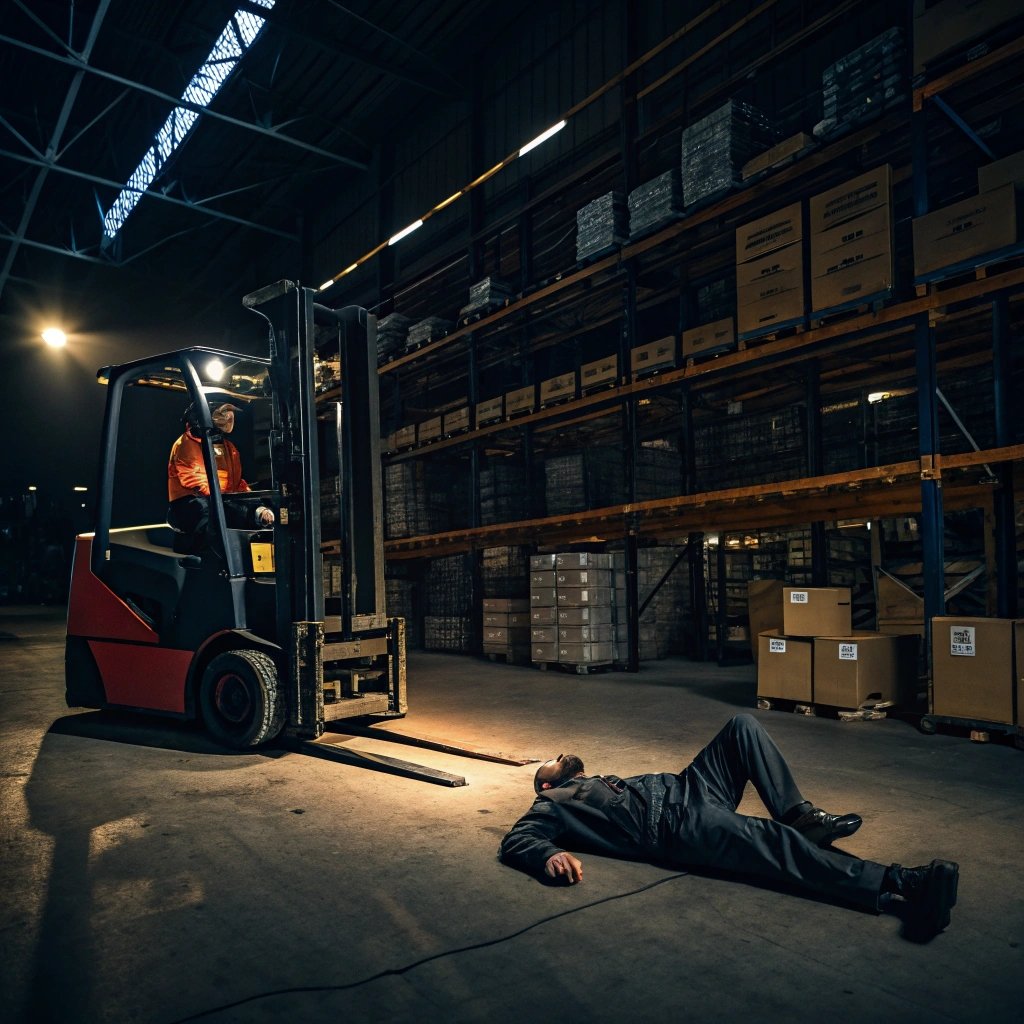
Struck-by incidents are the most severe outcome in forklift safety, and they're almost always a visibility problem, not a rule-following one. An operator can be certified, alert, and driving at a safe speed and still not see a worker who steps around a rack corner at the wrong moment. Reducing this hazard means working three angles at once:
- Separate paths physically where you can — painted lanes, floor markings, and barriers between forklift routes and walkways reduce how often a truck and a person occupy the same square footage.
- Fix the blind corners you can't design away — convex mirrors help at low speed, but they require both parties to be looking at the right moment.
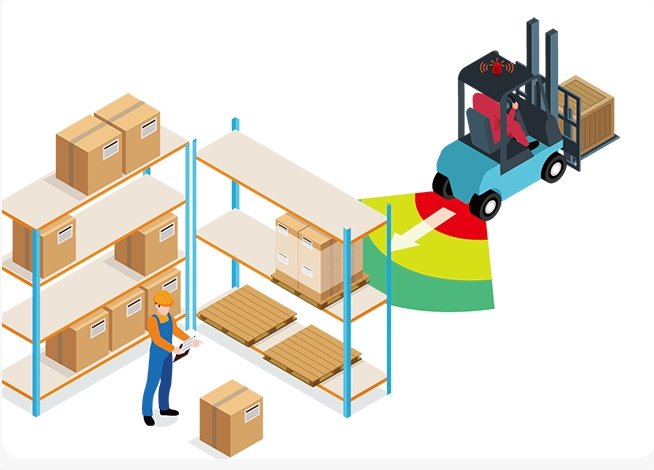
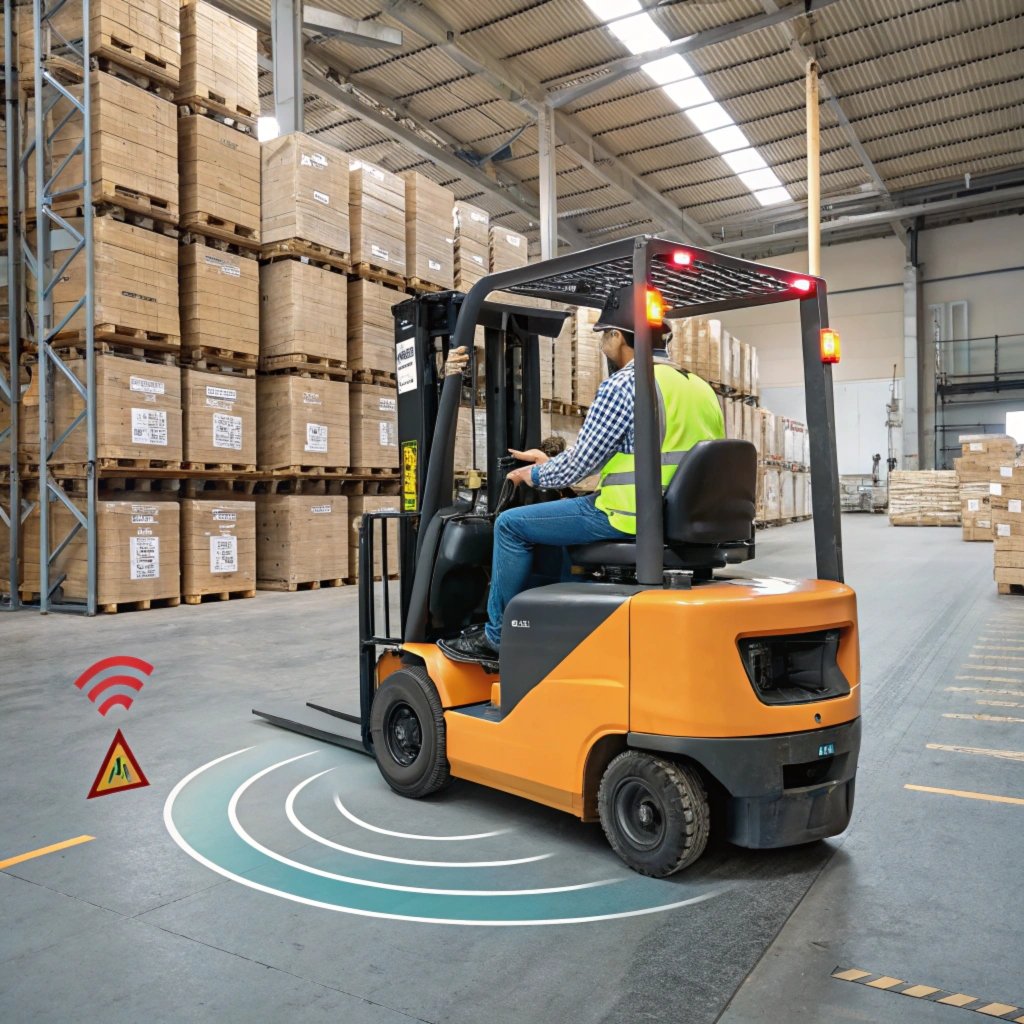
- Give the operator an active warning — this is where facilities typically see the biggest single improvement: a system that alerts the operator the instant a pedestrian enters a blind zone, instead of relying on either party to spot the other first.
⚠️ Why mirrors alone aren't enough: A mirror only works if the operator looks at it at the exact right second. An active pedestrian detection system closes that gap by alerting the operator directly, regardless of where either party happens to be looking.
If you're not yet distinguishing near-misses from actual incidents in your reporting, that's worth fixing before anything else — near-misses are your earliest warning that a specific corner or route is a live hazard, not a resolved one.
7. Load-Handling & Tip-Over Hazards
Tip-overs account for roughly a quarter of all forklift accidents, and they're almost always preventable with basic load discipline. The physics are unforgiving: forklifts are rear-weighted to counterbalance a loaded front end, and once that balance point is crossed — by an overloaded fork, an off-center pallet, or a turn taken too fast — the operator has very little time to react.
- Overloading beyond the rated capacity, especially at extended load centers or with attachments that shift the truck's effective capacity.
- Off-center or unstable loads that shift the truck's center of gravity mid-travel.
- Traveling with forks raised, which raises the load's center of gravity and reduces stability during turns.
- Turning too fast or on a ramp/incline, particularly when compounded by a heavy or elevated load.
- Uneven floor transitions such as dock plates, expansion joints, or debris that destabilize a loaded truck mid-turn.
Load charts exist for a reason most operators never fully internalize under time pressure — the rated capacity drops as load center distance increases, and a "close enough" estimate on an oversized pallet is one of the most common paths to a tip-over.
8. Facility & Environmental Hazards
Because facility layouts are usually built around storage density and production flow first, forklift safety often has to be retrofitted onto an existing floor plan rather than designed in from scratch. A few targeted changes go a long way even on a layout you can't fully redesign:
- Mark every crossing point between a forklift route and a walkway with floor tape, hatching, or raised markers — not just the main aisles.
- Address lighting gaps, especially near dock doors, mezzanine undersides, and the back of high racking, where shadows hide both pedestrians and floor hazards.
- Keep floors clean and dry — spills, debris, and pallet fragments left in aisles contribute to both tip-overs and pedestrian slips near forklift paths.
- Treat loading docks as a distinct risk zone — trailer creep, poor lighting, and the transition between dock and open floor account for a disproportionate share of incidents relative to how much floor space they cover.
- Keep staged material out of forklift turning radii so a truck making a tight turn has room to react if a pedestrian appears unexpectedly.
💡 Start with your intersection points: You don't need to redesign the whole floor at once. List every point where a forklift route crosses a walkway or another forklift route, rank them by traffic volume, and fix the top five first — that's usually where most near-misses are already happening.
9. Operator Hazards: Training, Fatigue & Certification
Most facilities already run initial certification training. Where programs break down is what happens after that first certification — training that stops at hire tends to fade exactly when complacency sets in, usually six months to a year into an operator running the same routes.
- Site-specific orientation for every operator, including experienced hires transferring from another facility — a different site's blind corners aren't intuitive on day one.
- Scheduled refresher training, not just training triggered by an incident.
- Immediate retraining after any near-miss, observed unsafe behavior, or a switch to a different truck class or attachment.
- Fatigue and attention awareness built into refresher sessions — a tired or distracted operator is statistically more likely to be involved in a struck-by incident, which is why some facilities pair training with a driver fatigue monitoring system on longer shifts.
10. Technology That Closes the Gaps Training Can't
Training and layout changes reduce risk substantially, but neither fully compensates for the split-second nature of a blind-corner encounter. This is the gap safety technology is built to close — not as a replacement for training, but as the layer that catches what a well-trained, attentive operator still can't physically see in time.
- Pedestrian detection gives an active alert the moment a person enters a blind zone or intersection, rather than relying on the operator spotting them first.
- Forklift-to-forklift proximity warning reduces collisions at shared intersections and staging points where multiple trucks converge on a predictable schedule — see our proximity warning system.
- Camera systems extend the operator's field of view around racking and reversing blind spots that mirrors alone don't fully cover — our forklift camera vs. mirrors comparison breaks down how the two stack up in practice.
- Speed limiting keeps trucks inside a safe travel speed automatically in high-traffic zones, cutting stopping distance at exactly the intersections where it matters most — see our forklift speed limiter.
- Recorded-event footage turns every near-miss into usable data, so you can review exactly what happened, retrain the right operator, and fix the specific layout issue that caused it.
None of this replaces a trained, alert operator — but a facility pairing solid training with active detection technology is working with two independent layers of protection instead of one, which is exactly what keeps a single missed glance from becoming an injury.
Managing Forklift Hazards on Your Floor?
We design the AI pedestrian detection, camera, proximity warning, and speed-control systems that give your operators an extra layer of protection your layout and training alone can't provide.
Talk to a Forklift Safety Specialist11. Forklift Hazard Prevention Checklist
A short, recurring checklist keeps hazard management from becoming a once-a-year exercise. Here's a practical breakdown by frequency:
🗓 Daily
- Pre-shift inspection completed and logged
- Horn, alarm, and lights functional
- Aisles clear of debris and spills
- Any defect reported takes the truck out of service
📆 Weekly / Monthly
- Review near-miss and incident logs for patterns
- Check floor markings and signage for wear
- Inspect charging/fueling area housekeeping
- Spot-check operator adherence to speed limits
📅 Quarterly / Annually
- Full hazard assessment refresh
- Operator refresher training scheduled
- Layout review after any process change
- Technology and equipment audit
12. Common Mistakes When Managing Forklift Hazards
- Treating the layout as fixed because it's always been that way — even small marking and barrier changes at high-traffic intersections meaningfully cut risk.
- Logging near-misses informally, or not at all — without a pattern to look at, the same blind corner keeps almost causing the same incident until it finally does.
- Letting training lapse after initial certification — complacency, not lack of skill, is what tends to creep in over time on repetitive routes.
- Relying on mirrors alone at high-traffic blind corners — they help, but they depend on both parties looking at the right moment.
- Skipping pre-shift inspections when the schedule is tight — a known mechanical issue is one of the fastest paths from hazard to incident.
- Assuming a "quiet" facility means a safe one — the absence of a recent incident isn't the same as the absence of risk; it often just means the near-misses haven't been counted yet.
13. Frequently Asked Questions
Tap a question to expand the answer — tap again to collapse it.
The most common forklift hazards fall into six categories: pedestrian and blind-spot hazards, load-handling and tip-over hazards, operator hazards like fatigue or lack of training, mechanical or equipment hazards, facility and environmental hazards such as blind corners and poor lighting, and hazardous-energy hazards from LPG, batteries, or charging stations. Struck-by pedestrian incidents and tip-overs together account for roughly half of all serious forklift accidents.
Tip-overs are the single most common type of forklift accident, accounting for roughly a quarter of all incidents, usually caused by overloading, off-center loads, turning too fast, or uneven floor surfaces. Struck-by pedestrian incidents are less frequent but tend to produce the most severe outcomes, including the majority of forklift-related fatalities.
Identify forklift hazards by walking every forklift route with both an operator's and a pedestrian's perspective, logging every blind corner, intersection, and near-miss, reviewing incident and inspection records for patterns, and scoring each hazard by likelihood and severity so you know which ones to fix first. This process is usually documented as a formal forklift hazard or risk assessment.
Training and facility design meaningfully reduce risk, but neither fully solves the split-second timing of a blind-corner encounter. Active detection technology, including pedestrian alert systems, proximity warning between trucks, cameras, and automatic speed limiting, adds an independent layer of protection that catches what even a well-trained, attentive operator can miss.
A forklift hazard assessment should be reviewed at least once a year, and immediately after any layout change, new equipment purchase, process change, or reported near-miss. Facilities with high forklift traffic or frequent layout changes often review it quarterly instead.
OSHA regulates powered industrial trucks under 29 CFR 1910.178, which covers operator training and certification, pre-shift inspections, safe operating practices, and equipment design and maintenance requirements. It does not name a single hazard category as "the standard," since it's written to apply broadly across the hazards forklifts create in different workplaces.