Skip to content

AI Camera vs UWB Forklift Safety System: Which One Actually Prevents Accidents?
Both technologies claim to stop forklift collisions before they happen — but they detect danger in completely different ways. Here's how AI camera systems and UWB proximity systems actually compare on coverage, accuracy, cost, and where each one fits your warehouse.

Ask two different warehouse managers how to stop forklift-pedestrian and forklift-to-forklift accidents, and you'll likely get two different answers: "put cameras on the trucks" or "give everyone a proximity tag." Both are right — and both are incomplete. AI cameras and UWB (Ultra-Wideband) systems solve overlapping but genuinely different problems, and picking the wrong one for your traffic pattern means paying for technology that doesn't cover your actual risk.
This guide breaks down exactly how each system detects danger, where each one is strongest, what they cost to own, and — for most fleets — why the real answer isn't "AI camera or UWB" but a layered combination of both.
1. What Is an AI Camera Forklift Safety System?
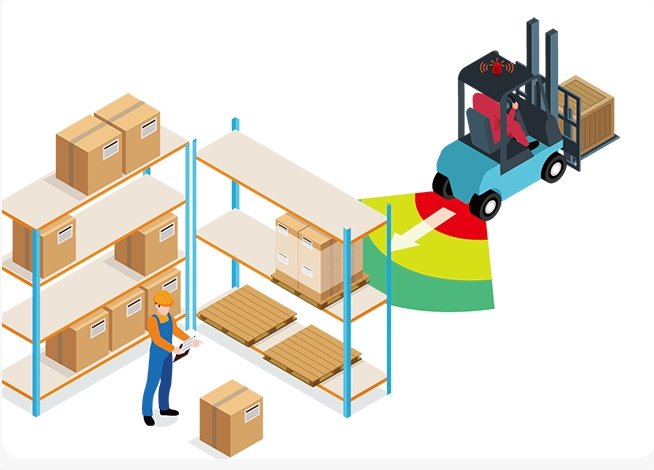
An AI camera-based forklift anti-collision system mounts wide-angle or AI-processing camera units on the truck — typically rear, side, or mast-facing — and feeds live video to a cab display. The "AI" part is what separates it from a basic backup camera: onboard processing analyzes the video in real time, recognizes a human shape entering a defined danger zone, and fires an audible or visual alert automatically, without the operator needing to watch the screen at the exact right second.
Because it's a vision-based system, it doesn't require the pedestrian to be carrying or wearing anything. It sees what's physically in front of the lens — which is exactly its biggest strength and its biggest limitation at the same time.
2. What Is a UWB Forklift Safety System?
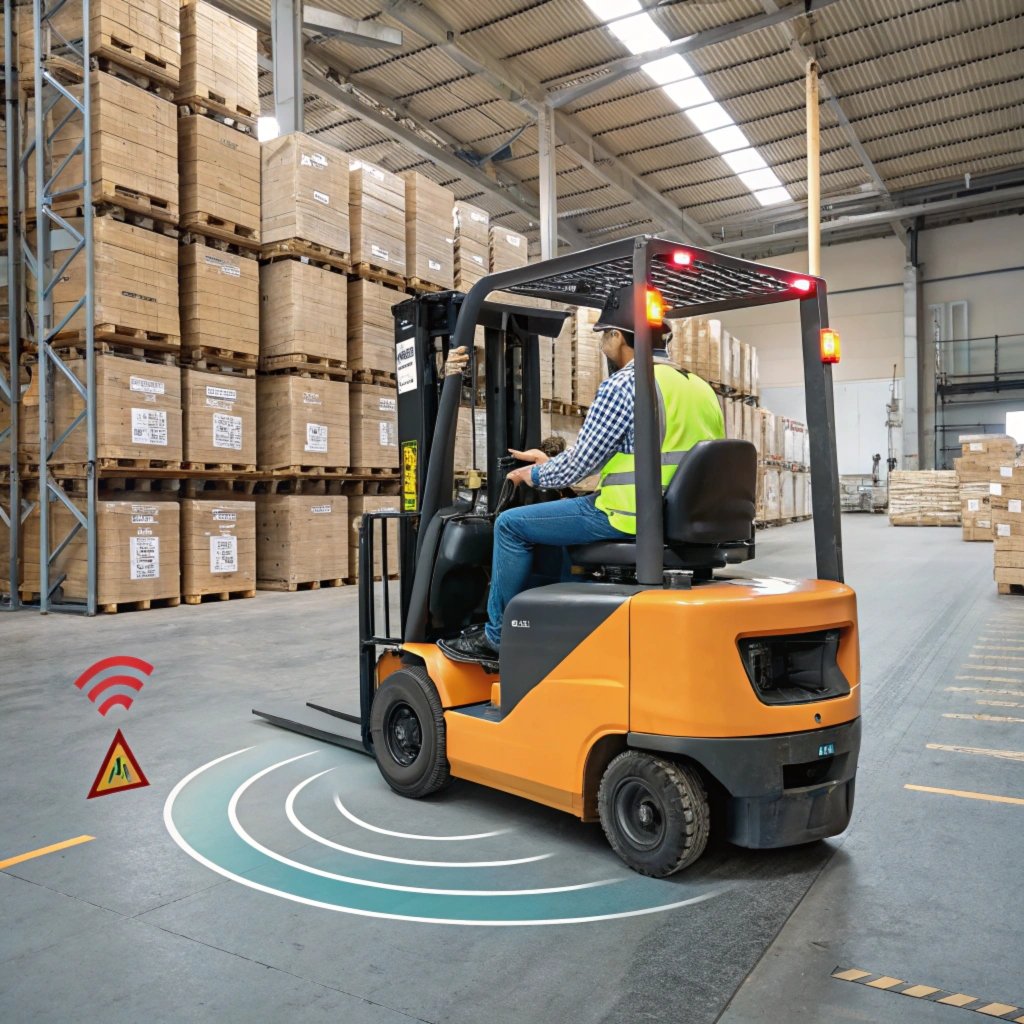
A UWB (Ultra-Wideband) forklift safety system works completely differently. Instead of watching for a shape on video, it measures distance using radio signal travel time between a forklift-mounted anchor unit and small tags worn by pedestrians or mounted on other vehicles. When a tagged person or truck enters a set distance threshold, the system triggers an alert — in the cab, on the pedestrian's wearable, or both.
Because UWB is a radio-ranging technology rather than a camera, it doesn't need a clear line of sight. It can detect a tagged pedestrian standing around a blind rack-aisle corner or on the other side of a stack of pallets — something no camera, however smart, can see through.
📷 AI Camera System
- Vision-based — detects people without any wearable device
- Needs a workable line of sight to the danger zone
- Can provide a live image and, on recorder models, footage for review
- Best at fixed, high-traffic zones like reversing paths and dock doors
- Alerts on anyone in frame, including visitors with no tag
📡 UWB Proximity System
- Radio-based — measures real distance to tagged people or trucks
- Works through non-line-of-sight obstructions like racking
- 360-degree coverage around the truck, not a fixed camera angle
- Best for forklift-to-forklift and tagged-pedestrian proximity warning
- Requires everyone at risk to be wearing a tag or badge

3. AI Camera vs UWB: Head-to-Head Comparison
| Factor | AI Camera System | UWB Proximity System |
|---|---|---|
| Detection method | Computer vision on live video | Radio signal travel-time ranging |
| Works without a wearable tag | ✓ Yes | ✕ No, tag required |
| Sees around corners / through racking | ✕ No, needs line of sight | ✓ Yes, non-line-of-sight |
| Coverage pattern | Fixed camera angle(s) | 360° around the truck |
| Detects untagged visitors or contractors | ✓ Yes | ✕ No |
| Forklift-to-forklift detection | Limited | ✓ Strong, tag-to-tag |
| Visual footage for incident review | ✓ On recorder-equipped models | ✕ No image, distance/event log only |
| Affected by dust / low light / glare | Yes, more sensitive | Minimal impact |
| Affected by dense metal racking | No | Can require anchor tuning |
| Rollout effort | Install on truck only | Truck install plus tag distribution to staff |
| Typical best fit | Reversing zones, dock doors, pedestrian crossings | Multi-truck aisles, blind rack corners, mixed pedestrian/forklift traffic |
An AI camera answers "is there a person in front of this lens right now?" A UWB system answers "how far away is that tagged person or truck, in any direction?" Neither question is more important than the other — they're just different questions.
4. How Detection Actually Differs
The technical gap between these two systems comes down to what they're actually measuring. A camera captures light reflected off a scene and runs a detection model against it — which means its accuracy depends heavily on lighting, contrast, weather, and whether the target is even inside the frame. A UWB system measures the time it takes a radio pulse to travel between an anchor and a tag, which is a physical measurement largely unaffected by darkness, dust, or fog.
That's why UWB ranging is typically accurate to roughly 10-30 centimeters regardless of visibility conditions, while an AI camera's distance estimate can shift with lighting and angle. On the other hand, a camera can identify that a human is present even if that person forgot their tag at the start of the shift — something a UWB system structurally cannot do, since it only knows about tagged assets.
5. Where an AI Camera System Wins
- Untagged foot traffic: Visitors, new hires, delivery drivers, and contractors who haven't been issued a tag are still detected by a camera, but invisible to a tag-based system.
- Fixed high-risk zones: Loading dock reversing paths and single-direction pedestrian crossings are exactly the kind of predictable, line-of-sight zone a camera covers well.
- Incident documentation: Recorder-equipped camera systems capture footage that supports coaching, insurance claims, and root-cause review after a near miss — something a distance log alone can't fully replace.
- No personnel rollout required: Nothing to badge, charge, or distribute. Install the camera and it's protecting the zone from day one.
6. Where a UWB System Wins
- Blind rack-aisle corners: UWB doesn't need a clear sightline, so it catches a tagged pedestrian or truck approaching from around a blind corner — a scenario no camera can physically see.
- Forklift-to-forklift proximity: In facilities running multiple trucks through shared aisles, UWB tag-to-tag ranging gives both drivers a proximity warning that a single camera on one truck can't replicate.
- 360-degree coverage: Rather than watching one fixed angle, a UWB-equipped truck is aware of tagged risks approaching from any direction at once.
- Consistent performance in poor visibility: Dust, fog, and low light barely affect radio-based ranging, which matters in facilities with variable lighting or heavy particulate.
A UWB system is only as good as tag compliance. If pedestrians remove tags, forget to charge them, or visitors walk the floor without one, that person becomes invisible to the system — which is exactly the gap camera-based detection is designed to fill.
7. Real Cost and ROI Comparison
Upfront pricing for both technologies scales with the number of trucks and the amount of coverage you need, but the cost structures differ in an important way. AI camera systems are largely a one-time install cost per truck: camera units, a display, and optional recording hardware. UWB systems carry that same per-truck anchor cost, plus an ongoing personnel cost — tags need to be purchased, distributed, tracked, and occasionally replaced or recharged as staff turn over.
Neither cost structure should be compared in isolation from what they prevent. A single forklift-to-pedestrian or forklift-to-forklift incident — with downtime, product damage, workers' compensation exposure, and potential OSHA involvement — routinely outweighs several years of either system's ownership cost. The right comparison isn't "camera price vs UWB price," it's "cost of the system vs the specific accident pattern it's built to catch."
Not Sure Which System Fits Your Traffic Pattern?
We help fleet and warehouse managers map where near misses actually happen and match the right mix of AI camera and UWB proximity technology to those exact zones.
Get a Free Fleet Safety Assessment8. Three Warehouse Scenarios Compared
Scenario 1: The Blind Rack-Aisle Intersection
A forklift approaches a T-intersection formed by tall racking, with zero line of sight around the corner. A camera mounted on the truck can't see through steel racking — but a UWB-tagged pedestrian or oncoming truck on the other side still triggers a proximity alert, because the system doesn't rely on a clear view.
Scenario 2: A Visitor Walking the Dock Without a Badge
A delivery driver steps out of their cab and walks toward a dock door without ever being issued a UWB tag. A tag-only system has no way to know they exist. An AI camera watching that dock zone detects the person visually and triggers an alert regardless of whether they're wearing anything.
Scenario 3: Two Forklifts Sharing a Narrow Aisle
Two trucks approach the same aisle from opposite ends, each one's driver focused on their own load. A single truck-mounted camera generally isn't aimed at the other vehicle's approach angle. UWB tag-to-tag ranging between the two trucks gives both operators a proximity warning well before either camera would catch the other truck in frame — directly supporting the goals covered in our forklift proximity warning system guide.
9. Can You Run Both Together?
Yes — and for facilities with mixed traffic (multiple trucks, pedestrian foot traffic, and visitors), layering both technologies usually covers more ground than either one alone. A practical layered setup looks like: UWB anchors and tags handling continuous, 360-degree, tagged-personnel and forklift-to-forklift proximity warning, plus AI cameras covering the specific reversing paths, dock doors, and pedestrian crossings where untagged foot traffic is common and visual confirmation matters.
This mirrors the same logic we cover in Forklift Camera vs Mirrors — it's rarely an "either/or" decision. The goal is matching each technology to the specific blind spot or risk pattern it's actually built to solve, not picking a single system and hoping it covers everything.
UWB Tag-Based Forklift Anti-Collision System
Wearable UWB tags give pedestrians and other forklifts a real-time proximity warning that works around corners and through racking — no line of sight required.
See how the UWB system works →10. How to Choose for Your Fleet
There's no single correct answer for every facility — the right mix depends on your traffic mix and where incidents actually cluster. A few practical questions to work through before buying either system:
- Do untagged people regularly enter your operating zones? Visitors, drivers, and contractors point toward camera coverage; a fully badged internal workforce points toward UWB.
- Do you have blind corners formed by racking or stacked inventory? That's a structural case for UWB's non-line-of-sight ranging.
- How many trucks share the same aisles at once? Multi-truck facilities benefit most from UWB's forklift-to-forklift detection.
- Do you need footage for incident review or insurance documentation? That requirement favors recorder-equipped AI camera systems.
- What does your near-miss data actually show? Pull the last 6-12 months of reports before buying — most facilities find the risk concentrated in two or three specific zones, which often points to a mixed solution rather than an all-or-nothing choice. Our warehouse risk assessment guide walks through that process step by step.
Build a Layered Safety System Around Your Actual Risk
We design and install both AI camera and UWB forklift safety systems, matched to the specific blind spots and traffic patterns in your facility — not a one-size-fits-all package.
Talk to a Forklift Safety Specialist11. Frequently Asked Questions
Tap a question to expand the answer — tap again to collapse it.
Is UWB better than AI camera for forklift safety?
Do pedestrians need to wear a tag for UWB forklift systems to work?
Can AI cameras and UWB systems be installed on the same forklift?
Which system has more false alarms, AI camera or UWB?
Does UWB work in areas with no cell signal or WiFi?
How accurate is UWB positioning compared to a camera detecting distance?
Which system is easier to retrofit onto an existing forklift fleet?
Stop Guessing Which Technology Your Fleet Actually Needs
Tell us about your facility's traffic pattern and we'll recommend the right mix of AI camera and UWB proximity technology — no over-buying, no guesswork.
Get Your Free Safety Consultation