Skip to content

UK HSE Forklift Safety Guide: The Pedestrian Rules Every Warehouse Must Get Right
The Health and Safety Executive doesn't publish one single "forklift law." It expects you to join up five overlapping regulations into one working system — and pedestrian segregation is the part inspectors check first. Here's exactly what HSE looks for, in plain English.

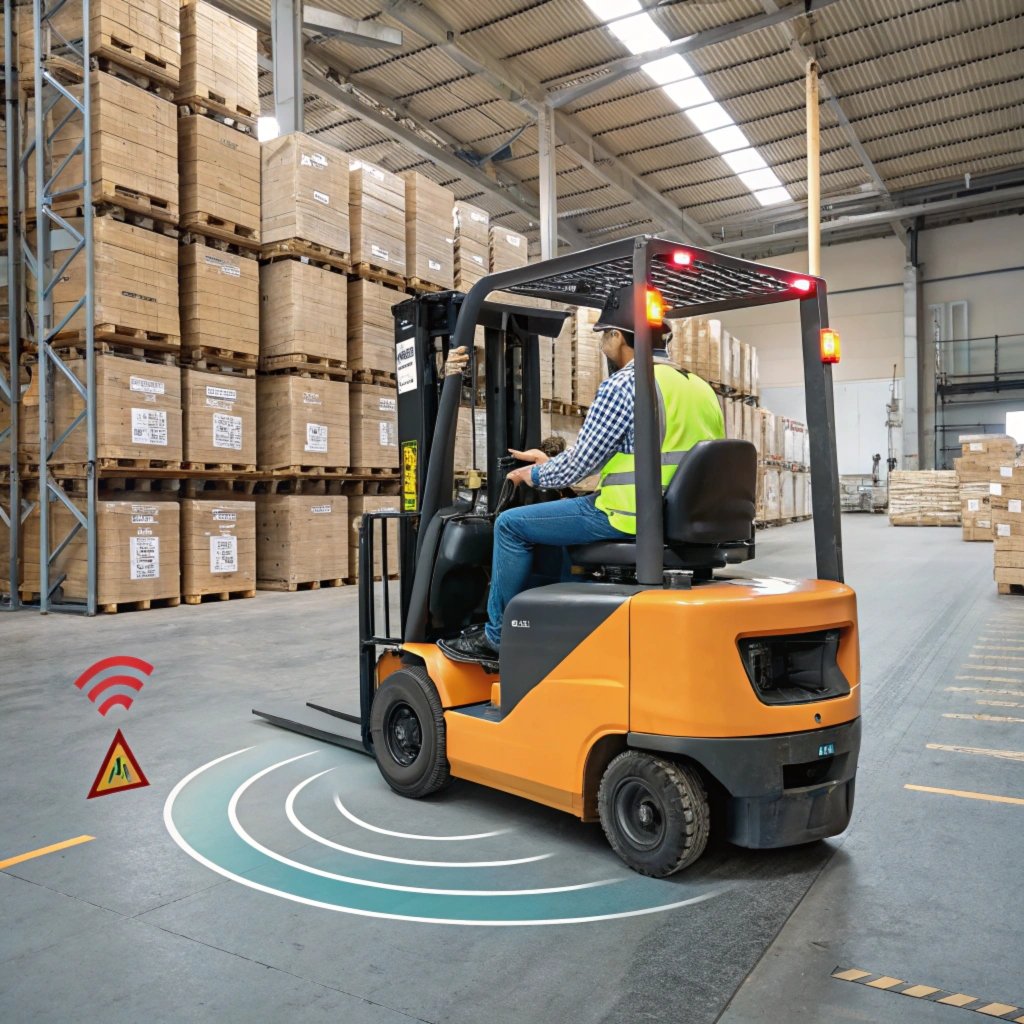
A segregated pedestrian route, physical barriers, and active supervision — the three controls HSE inspectors look for first on any workplace transport walk-round.
📋 Table of Contents
- 1. What "HSE Forklift Compliance" Actually Means
- 2. The Legal Framework: Five Laws in One System
- 3. HSE's Hierarchy of Control for Pedestrian Risk
- 4. Pedestrian Segregation: What HSG136 Expects
- 5. Operator Training & Competence (ACOP L117)
- 6. Building a Site Traffic Management Plan
- 7. RIDDOR: When an Incident Must Be Reported
- 8. What Happens When Sites Get It Wrong
- 9. Where Technology Closes the Gap Training Can't
- 10. HSE Compliance Checklist
- 11. FAQs
1. What "HSE Forklift Compliance" Actually Means
Search "HSE forklift regulations" and most guides list a single Approved Code of Practice and stop there. In practice, HSE assesses a site against a system — how a truck is maintained, how the operator was trained, how pedestrians and vehicles are kept apart, and how near-misses get reported and acted on. Miss one link in that chain and the rest doesn't count for much when an inspector or an incident investigator turns up.
Forklift-pedestrian collisions remain one of the most common causes of severe and fatal injury in UK warehousing and logistics. The pattern behind most of these incidents is strikingly consistent: a pedestrian enters an active operating area on foot, sightlines are blocked by racking, a load, or a blind corner, and there is no physical or technological control to close the gap once human attention fails. That pattern is exactly what HSE's forklift guidance is built to prevent.
HSE doesn't expect perfection from operators — it expects your site to be designed so that one moment of inattention, from either the driver or the pedestrian, doesn't result in a collision.
2. The Legal Framework: Five Laws in One System
Forklift safety in the UK sits at the intersection of general workplace law and equipment-specific regulation. There's no single "Forklift Act" — instead, five pieces of legislation combine to set out what's expected:
| Legislation | What It Covers |
|---|---|
| Health and Safety at Work etc. Act 1974 (HSWA) | The overarching duty of care employers owe to workers and anyone affected by their operations, including forklift movements. |
| PUWER 1998 (Provision and Use of Work Equipment Regulations) | Treats the forklift itself as "work equipment" — requiring it to be suitable for the task, properly maintained, and operated only by trained, authorised staff. |
| LOLER 1998 (Lifting Operations and Lifting Equipment Regulations) | Applies to the lifting function specifically — thorough examination intervals, safe planning of lifts, and attachment suitability. |
| Workplace (Health, Safety and Welfare) Regulations 1992, Reg. 17 | Requires traffic routes to be organised so pedestrians and vehicles can circulate safely — the legal basis for segregated walkways. |
| Management of Health and Safety at Work Regulations 1999 | Requires a documented risk assessment covering forklift-pedestrian interaction, with controls reviewed and updated over time. |
HSE's own workplace transport guidance — commonly referenced by its former document number HSG136, Workplace Transport Safety — pulls these threads together into practical expectations for site layout, vehicle selection, and pedestrian management. It isn't itself a standalone law, but inspectors use it as the benchmark for what "reasonably practicable" looks like on a real site.
These regulations aren't a compliance checkbox exercise. In enforcement cases involving forklift-pedestrian incidents, HSE investigators consistently point to the same root cause: no effective segregation between people on foot and trucks in operation. That single failure has led to six-figure fines under the HSWA 1974 for otherwise well-run operations.
3. HSE's Hierarchy of Control for Pedestrian Risk
When HSE assesses how a site manages forklift-pedestrian risk, it applies the same control hierarchy used across all workplace hazards — controls that remove the risk are always preferred over controls that rely on people behaving correctly.
- Eliminate — remove pedestrian foot traffic from active operating areas entirely wherever the process allows it.
- Substitute / Reduce — replace foot-based tasks near trucks with mechanised handling, or reduce the number of forklift movements through better layout.
- Segregate — physically separate people and vehicles using barriers, marked routes, and dedicated crossing points.
- Control — speed limits, one-way systems, mirrors at blind corners, and warning signage where full segregation isn't achievable.
- PPE and behavioural measures — high-visibility clothing, training, and supervision. HSE treats this as the weakest layer, not the primary defence.
A recurring theme in HSE inspection findings is that sites over-rely on the bottom of this hierarchy — hi-vis vests and verbal reminders — while under-investing in the physical and engineering controls further up the list, including barriers, layout redesign, and detection technology.
4. Pedestrian Segregation: What HSG136 Expects On Site
This is the section most warehouse managers are actually looking for. In practical terms, HSE's expectations for pedestrian segregation break down into a handful of concrete site features:
- Dedicated pedestrian walkways, physically separated from forklift operating routes wherever the building layout allows.
- Marked crossing points where a walkway must cross a vehicle route, positioned away from blind corners and reversing zones.
- Physical barriers — rated racking-protection barriers or pedestrian guardrail — at high-risk boundaries such as racking end-bays adjacent to main truck aisles.
- Blind-corner mitigation — convex mirrors, warning signage, and reduced speed zones at any junction where sightlines are obstructed.
- Loading bay controls — a documented procedure keeping delivery drivers and visitors out of active forklift zones, since visiting drivers are a recurring casualty group in incident data.
- Clear floor marking and colour coding so that both operators and pedestrians can instantly identify which zone they're standing in.
Full segregation is rarely achievable everywhere — most warehouses have at least one point where forklifts and people must share space, typically at goods-in, packing stations, or racking end-of-aisle. HSE's expectation isn't that this risk disappears; it's that you can show it was assessed and that proportionate controls — physical, procedural, or technological — were put in place for exactly that point.
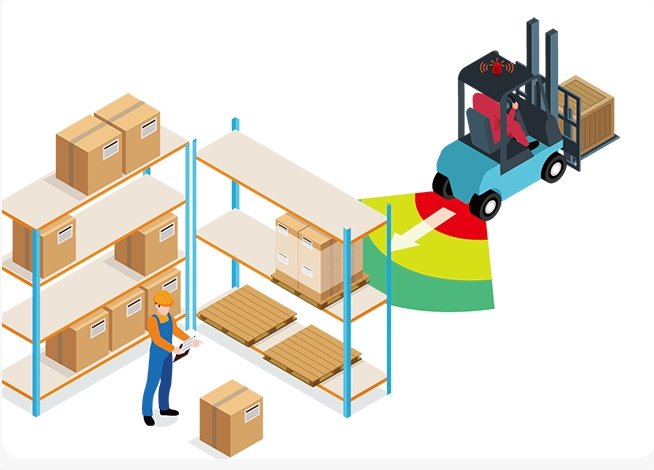
Those shared-space zones are precisely where forklift pedestrian safety systems add the most value — detecting a person in the danger zone at the moment barriers and floor markings alone can't, and alerting the driver, the pedestrian, or both before the gap closes.
5. Operator Training & Competence (ACOP L117)
PUWER 1998 requires that anyone operating a forklift be adequately trained — HSE's Approved Code of Practice L117, Rider-Operated Lift Trucks: Operator Training, sets out what "adequate" looks like in practice, structured around three stages:
- Basic training — core operating skills, delivered by a competent trainer, covering the truck type the person will actually use.
- Specific job training — familiarisation with the particular site, racking layout, attachments, and any unusual hazards specific to that workplace.
- Familiarisation training — supervised practice under normal working conditions before the operator works fully unsupervised.
Certification from basic training doesn't expire automatically, but HSE expects employers to refresh and re-assess competence periodically, and immediately after any incident, near-miss, extended absence from driving, or change of truck type. "Trained once" is not the same as "competent now" — and that gap is where a large share of avoidable incidents happen.
Even a fully certified, competent operator cannot see through racking, around a stacked load, or through a wall. Training closes the competence gap — it can't close the sightline gap. That's a physical and technological problem, not a behavioural one, which is why HSE's guidance treats camera and detection systems as a complement to training, not a substitute for it.
6. Building a Site Traffic Management Plan
A written traffic management plan is the document HSE most commonly asks to see during a workplace transport inspection or after an incident. A workable plan typically covers:
| Plan Element | What It Should Define |
|---|---|
| Site layout | Marked vehicle routes, pedestrian walkways, one-way systems, and speed limits by zone. |
| High-risk points | Every blind corner, doorway, loading bay, and racking end-of-aisle, with the specific control applied at each. |
| Vehicle selection | Confirmation that trucks in use are suitable for the site — aisle widths, load types, ground conditions. |
| Visitor and contractor rules | How delivery drivers and visitors are kept out of active operating zones. |
| Review triggers | Layout changes, near-misses, or incidents that require the plan to be reassessed. |
Request a Site Risk Review
7. RIDDOR: When an Incident Must Be Reported
Under the Reporting of Injuries, Diseases and Dangerous Occurrences Regulations (RIDDOR), certain forklift-related incidents must be formally reported to HSE — including deaths, specified serious injuries, and any incident causing a worker to be off work or restricted from normal duties for more than seven days. Near-misses aren't reportable under RIDDOR, but HSE strongly encourages logging them internally, since near-miss data is usually the earliest warning sign that a segregation gap exists before it results in a reportable injury.
8. What Happens When Sites Get It Wrong
HSE has shown a consistent willingness to prosecute where pedestrian-vehicle segregation has failed, and enforcement outcomes in this area tend to follow a pattern: the investigation finds no effective segregation, no documented risk assessment specific to the incident location, or a walkway that existed on paper but wasn't usable in practice. Fines under the HSWA 1974 for forklift-pedestrian incidents have reached well into six figures for companies of all sizes, alongside reputational damage and, in serious cases, restrictions on continued operation until controls are demonstrably fixed.
The financial risk is only part of the picture. Every case behind these fines involves a real injury — and in the most severe incidents, a fatality that a documented traffic management plan and a working detection system could plausibly have prevented.
9. Where Technology Closes the Gap Training Can't
Barriers, marked routes, and training remove most of the risk — but every warehouse has at least a handful of points where a pedestrian can still step into an operator's blind spot with no warning to either party. This is the specific gap HSE's hierarchy points toward when it lists engineering controls above behavioural ones, and it's exactly where AI-powered detection systems fit into a compliant site:
- AI camera-based pedestrian detection — identifies people in the truck's path in real time and warns the operator before a blind corner or racking gap becomes a collision.
- Blind-spot detection systems — cover the exact zones a loaded mast or racking structure hides from the operator's direct line of sight.
- Proximity warning systems — alert both driver and pedestrian when they enter each other's danger zone, reinforcing physical segregation rather than replacing it.
- Speed limiters — enforce the site's speed policy automatically in higher-risk zones, rather than relying on drivers to self-regulate.
None of this replaces the legal groundwork above — a camera system on an unassessed, unsegregated site is a patch, not a plan. But layered onto a documented traffic management plan and proper operator training, it's the piece that catches the moment a physical barrier can't reach and a driver's eyes can't cover.
Segregation Handles the Layout. We Handle the Blind Spots.
We build the AI camera, radar, and proximity systems that give operators a warning at the exact points HSE guidance flags as highest-risk — blind corners, racking ends, and shared pedestrian zones.
Talk to a Forklift Safety Specialist10. HSE Compliance Checklist
A quick self-audit against the areas HSE typically checks first:
- Documented risk assessment specific to forklift-pedestrian interaction, reviewed within the last 12 months.
- Written traffic management plan covering routes, speed limits, and high-risk junctions.
- Physically segregated pedestrian walkways wherever the building layout allows it.
- Marked crossing points and blind-corner mirrors at every junction where routes must cross.
- Operator training records showing basic, specific, and familiarisation training under L117.
- Thorough examination records for lifting equipment under LOLER 1998.
- A process for logging and acting on near-misses, not just reportable RIDDOR incidents.
- Engineering controls — barriers, detection systems, or speed limiters — at points where full segregation isn't achievable.
11. Frequently Asked Questions
Tap a question to expand the answer — tap again to collapse it.