Skip to content

CSA Forklift Safety Requirements: A Practical Guide to CSA B335-15 Compliance
CSA B335-15 is the standard Canadian workplaces are measured against when a forklift incident is investigated. This guide breaks down what it actually requires — for your safety program, your training records, and your equipment — and where technology like AI anti-collision systems fits into closing the gaps a written policy alone can't cover.

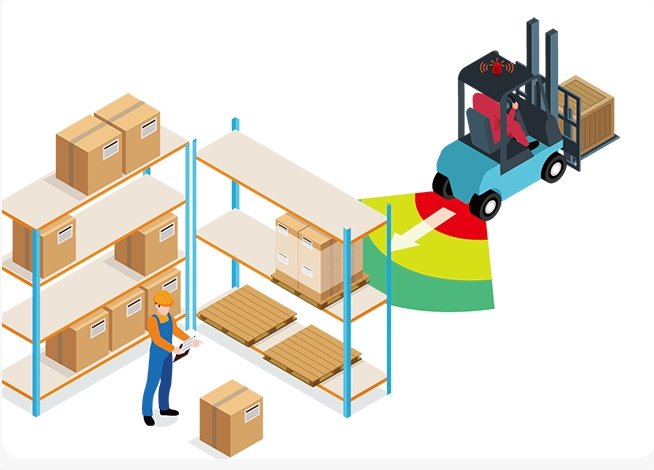
Pedestrians working close to active forklift traffic is exactly the scenario CSA B335-15's facility design and traffic management clauses are written to address.
Most forklift buyers and safety coordinators have heard the term "CSA certified forklift" thrown around by sales reps, but the standard itself is often misunderstood. CSA B335-15 isn't a sticker that gets applied to a truck at the factory — it's a full safety framework covering four separate areas: how the lift truck is built, how your facility manages it, how operators are trained, and how the whole program is documented and audited. Getting any one of those four wrong is what shows up in an incident report.
This guide walks through each requirement in plain language, shows you where CSA B335-15 overlaps with OSHA and ANSI rules if you also operate in the US, and flags the areas where most warehouses quietly fall out of compliance without realizing it.
📋 Table of Contents
- 1. What Is CSA B335-15, Exactly?
- 2. Which Lift Trucks the Standard Covers
- 3. The Four Pillars of a CSA-Compliant Safety Program
- 4. Operator Training & Retraining Requirements
- 5. Pre-Operation Inspection Requirements
- 6. Facility Design & Pedestrian Traffic Requirements
- 7. CSA B335-15 vs OSHA vs ANSI B56.1
- 8. Where Anti-Collision Technology Fits Into Compliance
- 9. Common Compliance Mistakes
- 10. FAQs
1. What Is CSA B335-15, Exactly?
CSA B335-15 (reaffirmed as B335-15 R2024) is the Canadian Standards Association's Safety Standard for Lift Trucks. It's the third edition of the standard, replacing earlier versions from 1994 and 2004, and it was harmonized with the American ANSI/ITSDF B56.1 and B56.6 standards so the design and classification language lines up across both countries.
The standard's stated purpose is to reduce worker injury risk by setting requirements across the full life of a lift truck: how it's designed and built, how it's inspected and maintained, how it's operated day to day, and how operators are trained and re-evaluated. It also sets recommended qualifications for the people who train operators and the technicians who service the equipment.
Not directly — CSA develops it through a consensus process, not as legislation. But most provincial occupational health and safety regulations reference it by name as the acceptable standard for "mobile equipment" or "lift trucks," which means an OHS inspector or a court will treat it as the benchmark for what a reasonable employer should have done.
2. Which Lift Trucks the Standard Covers
CSA B335-15 applies to Class 1, 2, 3, 4, 5, and 7 powered lift trucks — covering their design, operation, and maintenance. Certain clauses also extend to Class 6 vehicles (tow tractors), non-powered high-lift trucks, and personnel and burden carriers. In practice, that means the standard reaches almost every powered material handling truck in a typical warehouse, from stand-up electric counterbalance trucks to rough-terrain and internal-combustion units.
If your fleet mixes electric and IC trucks, it's worth checking our lithium vs. lead-acid battery comparison alongside your safety program — power source affects both maintenance clauses and daily inspection items under the standard.
3. The Four Pillars of a CSA-Compliant Safety Program
CSA B335-15 is organized into clauses that map to four practical pillars. Understanding the split helps you figure out which department in your operation owns which requirement.
Pillar 1 — The Safety Program (Clause 4)
This covers the essential elements of a documented lift truck safety program, including hazard identification, general medical and physical fitness expectations for operators, and facility design requirements — aisle widths, obstruction management, and how the lift truck operation is selected for the intended application.
Pillar 2 — Design & Construction (Clause 5)
This sets the safety requirements the manufacturer must meet at the time the truck is built — things like operator compartment guards, overhead guards, and load-rating markings. As a buyer, this is mostly the manufacturer's responsibility, but it's still worth confirming the data plate and guards are intact and unmodified before putting a used truck into service.
Pillar 3 — Training (Clause 6)
Minimum requirements for initial and ongoing training in the operation of lift trucks, including attachments. This is the clause most provincial OHS regulators point to directly when assessing whether an operator was properly qualified.
Pillar 4 — Operation, Inspection & Maintenance (Clauses 7–8)
Day-to-day safe operating practices, pre-operation inspection requirements, and ongoing maintenance intervals. This is the pillar most workplaces let slip once the initial training push is over — it needs to be a routine, not a one-time event.
4. Operator Training & Retraining Requirements
Clause 6 is the most frequently cited part of the standard, largely because untrained or improperly trained operators are one of the leading contributing factors in forklift incidents. A CSA-aligned training program is built in two parts:
- Theory/classroom training covering stability and the stability triangle, load charts and capacity ratings, pre-operation inspection procedures, hazard recognition around pedestrians, overhead obstructions, ramps and uneven surfaces, refuelling safety where applicable, and relevant OHS regulations.
- Practical, hands-on training on the specific class of truck the operator will run — forward and reverse travel, load pickup, stacking and unstacking, maneuvering in confined space, operating on grades, and emergency procedures.
- Written and practical evaluation before an operator is cleared to work unsupervised, plus workplace-specific orientation for every operator — including experienced operators transferring in from another site.
- Retraining at defined intervals, and immediately after any near-miss, incident, observed unsafe operation, or a switch to a different truck class or attachment.
Operators frequently assume road driving experience transfers to forklift competency. It doesn't — a forklift steers from the rear wheels, has a completely different stability envelope, and behaves nothing like a car under load. Our article on whether car driving experience prepares you to drive a forklift covers exactly where that assumption breaks down.
5. Pre-Operation Inspection Requirements
The standard requires a documented pre-operation inspection at the start of every shift — not just an informal walk-around. The 2015 edition specifically expanded and clarified these requirements, and most provincial regulations layer their own inspection rule directly on top: an operator must inspect the equipment before starting work and again during the shift where conditions require it, and any defect affecting safe operation must be reported to a supervisor immediately, with the truck taken out of service until it's resolved.
A typical pre-shift inspection under the standard covers:
- Tires, forks, chains, and mast for visible damage or wear
- Hydraulic system for leaks and proper fluid levels
- Horn, lights, backup alarm, and any fitted safety or camera systems
- Seat belt or operator restraint system, tested and functional
- Data plate and load chart present, legible, and matching the truck's current configuration
- Brakes and steering response before the truck is loaded
The rated load must be permanently marked on the truck and legible to the operator, and where rated load varies with reach — as on a reach truck or attachment-fitted unit — a load chart has to be displayed in the operator's compartment.
6. Facility Design & Pedestrian Traffic Requirements
The 2015 edition added meaningfully expanded requirements around facility design — specifically aisleway management and how obstructions are handled — because shared travel paths between lift trucks and pedestrians are one of the highest-risk scenarios the standard is trying to design out.
Under Clause 4, employers are expected to identify all hazards associated with forklift use in the workplace, with both workers and supervisors involved in that hazard identification process. In a warehouse with mixed pedestrian and forklift traffic, that typically translates into:
- Defined, marked travel lanes separating pedestrian walkways from forklift aisles wherever the layout allows it
- Clear sightlines at blind corners, or a compensating control where they can't be achieved structurally
- Documented risk assessment of intersection points, dock areas, and racking aisles where a truck and a pedestrian could occupy the same space
- A defined process for visitors, non-operators, and out-of-province transfers to be oriented to site-specific traffic rules before entering active areas
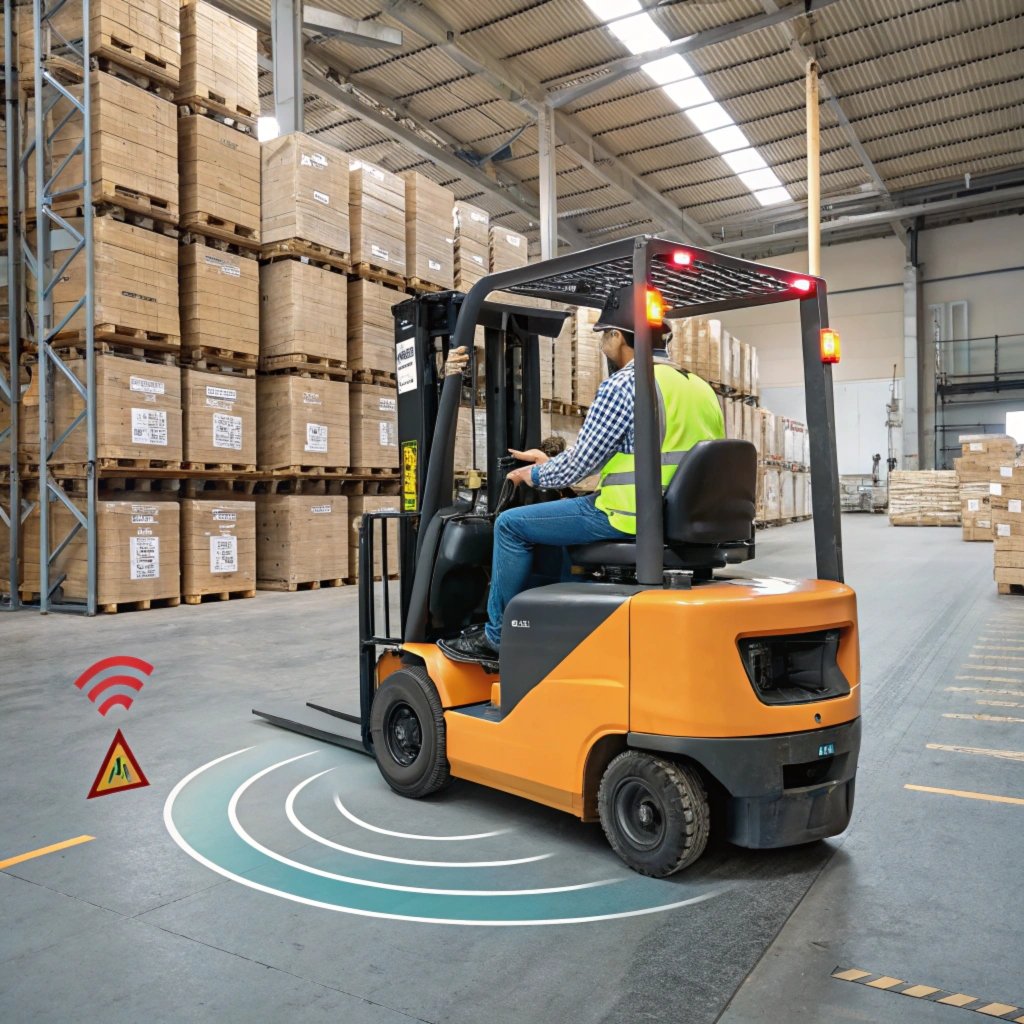
This is precisely the scenario in the photo above — pedestrians moving through an active forklift aisle. A written traffic plan reduces the risk, but in a facility where blind corners and racking are unavoidable, most safety coordinators pair the layout controls with a pedestrian detection system that gives the operator a real-time alert before a person is close enough to matter.
7. CSA B335-15 vs OSHA vs ANSI B56.1
If your operation runs across the Canada–US border, or you're sourcing equipment from a US supplier, it helps to know where these three frameworks line up and where they diverge.
| Standard | Issuing Body | Legal Status | Primary Focus |
|---|---|---|---|
| CSA B335-15 (R2024) | Canadian Standards Association | Referenced by provincial OHS regulation | Full lifecycle: design, training, operation, maintenance |
| OSHA 29 CFR 1910.178 | US Dept. of Labor | Federal law in the US | Operator training, certification, and safe operating rules |
| ANSI/ITSDF B56.1 | American National Standards Institute | Referenced by OSHA as the design benchmark | Design, construction, and classification of high/low-lift trucks |
CSA B335-15 was deliberately harmonized with ANSI/ITSDF B56.1 and B56.6 for design and classification language, which is why a truck built to US design standards generally satisfies the design clause of the Canadian standard as well. Where the two frameworks diverge most is enforcement: OSHA rules are federal law with direct citations attached, while CSA B335-15 is a referenced standard — but provincial inspectors and courts still use it as the working definition of due diligence.
8. Where Anti-Collision Technology Fits Into Compliance
CSA B335-15 doesn't mandate a specific brand of collision-avoidance technology — the standard is written around processes, training, and equipment condition rather than naming products. But several of its requirements are far easier to demonstrate and maintain with the right hardware in place, particularly the hazard identification, facility design, and pre-operation inspection clauses.
- Pedestrian detection gives operators an active alert in blind corners and racking aisles, directly supporting the traffic-management intent of Clause 4 rather than relying on markings and signage alone.
- Speed limiting keeps a truck inside a safe travel speed automatically, reducing the chance that stopping distance becomes the deciding factor in a near-miss. See our breakdown of forklift speed limiters for how these systems integrate with existing fleets.
- Camera and recorded-event systems create an evidence trail that supports the documentation an OHS inspector expects to see during an incident review, and make it easier to identify which operators need retraining before a near-miss becomes an actual injury.
- On-board weighing and load monitoring reduces overload-related tip-overs, one of the more common ways a truck fails outside its rated design envelope.
None of this replaces training or a written safety program — CSA B335-15 is explicit that those are foundational. But a documented safety program backed by hardware that actively prevents the failure modes it warns about is a materially stronger due-diligence position than paperwork alone.
Building or Auditing a CSA B335-Aligned Safety Program?
We don't set the standard — we build the AI pedestrian detection, camera, and speed-control systems that help you meet it on the floor, every shift.
Talk to a Forklift Safety Specialist9. Common Compliance Mistakes
- Treating training as a one-time event — the standard requires retraining after incidents, near-misses, or a change in truck class, not just at hire.
- No documented pre-shift inspection — a verbal "looks fine" check doesn't satisfy the standard; defects need to be logged and reported.
- Skipping site-specific orientation for experienced operators transferring from another location or province.
- Mismatched data plates on used equipment — an added attachment or swapped mast without an updated capacity plate invalidates the posted rating.
- No documented hazard identification for pedestrian and forklift traffic overlap points, leaving blind corners and shared aisles unaddressed.
- Assuming the standard is optional because it isn't itself legislation — most provincial regulators treat it as the practical definition of a reasonable safety program.
10. Frequently Asked Questions
Tap a question to expand the answer — tap again to collapse it.
CSA B335-15 itself is a voluntary consensus standard, not legislation. However, most provincial occupational health and safety regulations reference it directly as the accepted standard for lift truck design, training, and operation, which means regulators and courts treat it as the benchmark for demonstrating due diligence.
The standard requires retraining at intervals set by the employer's own risk assessment, and immediately following any near-miss, safety incident, observed unsafe operation, or a change to a different truck class or attachment. There is no single universal number of years — it's tied to demonstrated competency and workplace conditions, not a fixed calendar date alone.
Yes. The standard covers Class 1 through 5 and Class 7 powered lift trucks, which includes electric pallet jacks and walkie-type trucks, along with counterbalance, reach, and rough-terrain trucks. Certain clauses also extend to Class 6 tow tractors and non-powered high-lift equipment.
CSA B335-15 is a Canadian standard referenced by provincial OHS regulation, while OSHA 29 CFR 1910.178 is US federal law. The two are harmonized on design and classification language through ANSI/ITSDF B56.1, but enforcement differs: OSHA issues direct citations, while CSA B335 compliance is assessed as part of a broader due-diligence review.
The standard doesn't name specific products, but its Clause 4 requirements for hazard identification and facility traffic management are directly supported by active pedestrian detection technology. It strengthens your documented safety program rather than replacing the training and inspection requirements the standard sets out.
Under the standard, any defect affecting safe operation must be reported to a supervisor immediately, and the truck should be taken out of service until it's resolved. Continuing to operate a truck with a known defect is one of the clearest due-diligence failures an OHS inspector will flag during an investigation.