Skip to content

Forklift Capacity Explained: How to Read Load Ratings Before You Buy
The number on the nameplate isn't the whole story. Here's how load center, lift height, and attachments quietly change what your forklift can actually lift — and how to pick a truck that won't leave you short.
Ask a supplier "how much can this forklift lift?" and you'll get a single number — 5,000 lb, 3 tons, 2,500 kg. Most buyers write that number down and move on. That's how operations end up with a truck that's technically "rated" for the job but can't actually handle it once the load is bulky, the forks are attachments instead of bare forks, or the pallet needs to go on the top rack.
Forklift capacity isn't one fixed number — it's a relationship between weight, distance, and height. This guide breaks that relationship down in plain language, shows you how to read a data plate correctly, and walks through a real calculation so you buy a truck sized for your actual loads, not just the number printed on the brochure.
📋 Table of Contents
- 1 What "Forklift Capacity" Really Means
- 2 How to Read the Data Plate
- 3 Load Center: The Number Everyone Skips
- 4 Why Capacity Drops as You Lift Higher
- 5 Attachments Reduce Capacity Too
- 6 Turning Radius, Wheelbase & Stability
- 7 Typical Capacities by Forklift Type
- 8 Calculating the Capacity You Actually Need
- 9 Common Capacity Buying Mistakes
- 10 Overload Risk & How to Manage It
- 11 FAQs
1. What "Forklift Capacity" Really Means
A forklift's rated capacity is the maximum weight it can lift under one specific, defined set of conditions — a stated load center, a stated fork height (usually close to ground level), a stated tire type, and the truck in standard configuration with no attachments. Change any one of those conditions and the true safe lifting weight changes with it.
Manufacturers publish this figure because it's required for the data plate, but it's really a starting reference point, not a guarantee. Two forklifts both "rated" for 5,000 lb can behave very differently once you load an oversized crate, raise the forks to the third rack level, or bolt on a fork positioner.
Capacity is not a fixed weight limit — it's a weight limit tied to where that weight sits and how high it's being lifted. Move the load further out or higher up, and the safe capacity goes down.
2. How to Read the Forklift Data Plate
Every forklift has a metal nameplate (also called the capacity plate or data plate) near the operator's seat. Before buying — or before putting any used forklift into service — this is the single most important document to check, because it's specific to that exact truck, mast, and tire combination, not a generic model number.
A typical plate will show:
- Rated Capacity — maximum load weight at the stated load center and a low fork height.
- Load Center — the horizontal distance the rated capacity assumes, usually 24 in (600 mm) for standard trucks.
- Maximum Fork Height — the load capacity may already be derated for the truck's maximum lift height, or a separate capacity chart may apply.
- Tire Type — pneumatic vs. cushion tires change the stability envelope and therefore the rating.
- Attachment Notes — if an attachment is fitted, a supplemental plate should show the adjusted capacity.
If you're buying a used forklift, confirm the data plate matches the truck in front of you — mast, tires, and attachments included. A swapped mast or added attachment without an updated plate means the posted number is no longer accurate, and that's a liability problem, not just a paperwork one.
3. Load Center: The Number Everyone Skips
Load center is the horizontal distance from the vertical face of the forks to the center of gravity of the load. Most forklifts are rated at a 24 in (600 mm) load center — this assumes a fairly compact, evenly balanced load such as a standard 48x40 in pallet.
The problem: if your actual load sits further out than that — a long pipe, an oversized crate, an unevenly packed skid — the true center of gravity moves past the rated point, and the forklift can safely lift meaningfully less than the number on the nameplate, even though nothing else about the truck has changed.
Adjusted Capacity ≈ (Rated Capacity × Rated Load Center) ÷ Actual Load Center
This is a simplified approximation that manufacturers refine with their own load charts — but it illustrates the pattern: double the load center distance, and the truck's safe capacity drops toward roughly half. This is exactly why two loads of identical weight can be perfectly safe on one pallet and dangerously overloaded on another, just because the second one is bulkier or off-balance.
Sales sheets almost always lead with the rated capacity at the standard load center because it's the biggest, most impressive number. If your actual pallets, coils, or crates regularly sit at a longer load center, ask your supplier for the capacity chart at your load center — not the standard one — before you commit to a tonnage class.
4. Why Capacity Drops as You Lift Higher
Rated capacity on most nameplates is measured close to ground level. As the mast extends and the load rises, the truck's center of gravity shifts upward and forward, and the stability margin narrows — so many forklifts are also derated at their maximum lift height, sometimes by a meaningful percentage of the ground-level rating.
This matters most on triplex and quad masts used for high-bay racking, where the difference between the ground-level rating and the top-of-mast rating can be the difference between a safe lift and a tipped load. If you haven't compared mast configurations yet, our guide to forklift mast types breaks down how stage count affects both lift height and capacity at full extension.
Never size a purchase off the ground-level number alone if your racking goes above roughly 10–12 ft. Request the capacity chart at your actual top rack height — reputable suppliers will have this on hand for every mast option they quote.
5. Attachments Reduce Capacity Too
Forks aren't the only thing that can go on the carriage. Side shifters, fork positioners, clamps, rotators, and push-pull attachments all add weight in front of the mast's pivot point — which shifts the load center outward and reduces usable capacity, sometimes by several hundred pounds before you've even picked anything up.
- Side shifters — smallest capacity impact, but still not zero.
- Fork positioners — moderate reduction; very common on general warehouse trucks.
- Clamps and rotators — largest reduction; can cut usable capacity significantly depending on the attachment's own weight and reach.
Any forklift fitted with an attachment should carry a supplemental data plate showing the adjusted combined capacity. If you're planning to add an attachment after purchase, tell your supplier during the quoting stage — it can change which tonnage class you actually need to order.
6. Turning Radius, Wheelbase & Stability
Capacity doesn't exist in isolation from the rest of the truck's geometry. A forklift stays stable inside what's known as its stability triangle — an imaginary line connecting the two front wheels and the pivot point of the rear axle. As long as the combined center of gravity of the truck and load stays inside that triangle, the lift is stable; once it moves outside it, tip-over risk increases sharply.
Wheelbase and turning radius are part of that same geometry. A longer wheelbase generally supports a larger, more stable stability triangle and can support higher capacities, but it also increases the truck's turning radius — which matters directly for whether it can maneuver in your aisles while carrying a full, wide load without swinging the rear end into racking or nearby pedestrians.

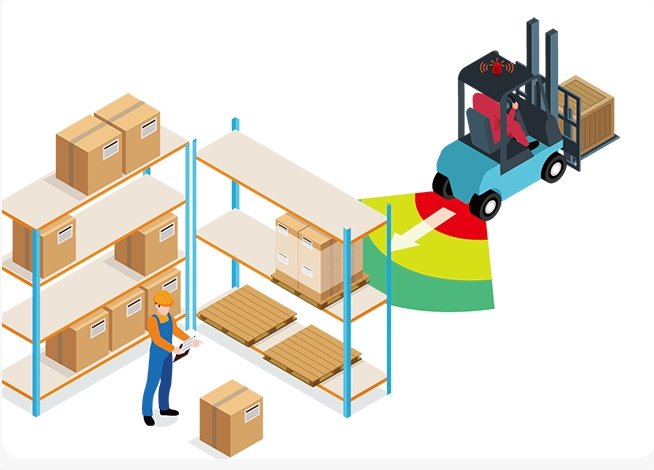
This is also where aisle-heavy, pedestrian-dense warehouses tend to run into trouble: a wider, more stable truck rated for a higher capacity often needs a wider aisle to turn safely, and a bigger swing radius means more blind corners around racking. Many operations running higher-capacity trucks in tight layouts pair them with pedestrian safety systems or camera-based blind-spot detection specifically to offset that larger footprint.
7. Typical Capacities by Forklift Type
"Capacity" ranges enormously depending on the class of truck. Here's a general reference for common types — always confirm exact figures against the specific model and load center your supplier quotes.
| Forklift Type | Typical Capacity Range | Common Use Case |
|---|---|---|
| Electric Pallet Jack / Walkie | 2,000–4,500 lb (1–2 t) | Dock work, short-distance pallet moves |
| Electric Counterbalance (3-Wheel) | 2,500–4,000 lb (1.1–1.8 t) | Tight-aisle indoor warehousing |
| Electric Counterbalance (4-Wheel) | 3,000–6,500 lb (1.4–3 t) | General indoor material handling |
| IC (Diesel/LPG) Counterbalance | 3,000–8,000 lb (1.4–3.6 t) | Mixed indoor/outdoor, docks and yards |
| Reach Truck | 2,500–5,500 lb (1.1–2.5 t) | Narrow-aisle, high-bay racking |
| Rough Terrain Forklift | 6,000–12,000 lb (2.7–5.4 t) | Construction sites, uneven outdoor ground |
| Heavy-Duty / Container Handler | 10,000–50,000+ lb (4.5–22+ t) | Ports, steel handling, container yards |
These are typical industry ranges, not fixed values — always verify against the exact model, load center, and mast height you're being quoted before making a decision.
Higher-capacity trucks mean bigger blind spots and heavier stakes if something goes wrong.
Talk to a Safety Specialist8. Calculating the Capacity You Actually Need
Instead of shopping by tonnage first, work backward from your heaviest, bulkiest real-world load. Here's a simple worked example:
- Identify your heaviest regular load. Example: a crate weighing 4,400 lb (2,000 kg).
- Measure its actual load center — the distance from the fork face to the load's center of gravity. Example: the crate's center of gravity sits at 30 in (760 mm), not the standard 24 in.
- Check the truck's rated capacity chart at that load center — not just the nameplate figure — and compare it to your load weight, with margin to spare.
- Add your tallest lift height and check the capacity chart at that height too, since it may be lower than the ground-level figure.
- Factor in any attachment you plan to run, using its supplemental capacity chart.
- Build in a safety margin. Don't buy a truck that's rated exactly at your heaviest load — leave headroom for uneven loading, future heavier orders, or attachment changes.
Size the truck to your heaviest realistic combination of weight, load center, and lift height — not to your average load. Most warehouses have one or two outlier loads that quietly decide the correct capacity class, even if 90% of daily pallets are lighter.
9. Common Capacity Buying Mistakes
- ✕Buying off the headline capacity number alone — without checking the load center it's based on.
- ✕Ignoring the height-specific load chart — assuming ground-level rating applies at full mast extension.
- ✕Forgetting to account for attachments ordered separately from the truck itself.
- ✕Sizing for the average load instead of the heaviest one — leaving no margin for outlier crates or pallets.
- ✕Overlooking tire type — pneumatic and cushion tire versions of the same model can carry different capacity ratings.
- ✕Skipping the aisle and turning radius check — a higher-capacity truck that can't maneuver in your space isn't a usable upgrade.
10. Overload Risk & How to Manage It
Overloading — whether from misjudging a load's weight, ignoring load center, or lifting too high — is one of the leading causes of forklift tip-overs. Unlike a slow leak of underperformance, an overload event tends to happen suddenly, often with a heavy or oddly-shaped load that "looked fine" going onto the forks.
Two practical ways operations reduce this risk without relying purely on operator judgment:
- Know the weight before you lift. An on-board forklift weighing scale gives the operator a real weight reading at the point of lift, instead of an estimate — catching overloads before the forks ever leave the ground.
- Control speed and awareness around loaded lifts. A loaded, high-capacity truck takes longer to stop and swings a wider arc; pairing it with a forklift speed limiter or an automatic braking system reduces the chance that a marginal load becomes an accident.
If you're finalizing a purchase decision, it's also worth comparing power sources — see our lithium vs. lead acid forklift battery comparison — and brand-level reliability in our Toyota vs. Crown forklift guide.
Whatever Capacity You Choose, Your Operators Still Need to Lift Safely
We don't sell forklifts or racking — we build the AI camera, weighing, and anti-collision systems that keep the truck you buy operating inside its safe limits, every shift.
Get a Free Safety System Consultation11. Frequently Asked Questions
What's the difference between rated capacity and actual usable capacity?
Rated capacity is the maximum weight the truck can lift under one specific test condition — usually a 24 in load center and a low fork height. Actual usable capacity for your specific load can be lower once you account for a wider load center, greater lift height, or an attachment on the carriage.
Does load center really make that much difference to capacity?
Yes. Because capacity and load center are roughly inversely related, a load sitting well beyond the standard 24 in load center can reduce the truck's safe lifting weight substantially — sometimes by a third or more, depending on the truck and mast.
How do I know if a forklift is overloaded?
Warning signs include the rear wheels lifting slightly off the ground, the mast tilting forward under load, or reduced steering control at the rear axle. The most reliable method is to know the load's weight in advance — an on-board weighing scale removes the guesswork entirely.
Should I buy a higher-capacity forklift than I currently need?
A reasonable safety margin above your heaviest regular load is wise, but sizing far beyond your actual needs adds unnecessary purchase and operating cost, and a larger truck may not fit your existing aisle widths or turning space.
Do attachments always require a new capacity rating?
Any attachment added to the carriage should come with a supplemental capacity plate showing the truck's adjusted rating with that attachment fitted. If a used forklift has an attachment but no supplemental plate, treat the original nameplate rating as unreliable until it's re-verified.
Is a forklift's capacity rating the same regardless of tire type?
No. Pneumatic and cushion tire versions of the same base model often carry different capacity and stability ratings, since tire type affects the truck's ground clearance, stance, and stability triangle.