Skip to content

Types of Forklift Masts Explained: Which One Should You Buy?
Single, Duplex, Triplex, Quad, Full Free Lift — the mast you choose decides how high you can stack, how well you can see, and whether the truck even fits through your doorway. Here's how to pick the right one before you sign the purchase order.
Most forklift buyers spend weeks comparing engines, tonnage, and brands — then treat the mast as an afterthought. That's a mistake. The mast is the single component that determines whether your truck can actually do the job: reach the top rack, clear your warehouse doorway, tilt a pallet safely, or let the operator see where the forks are going. Get the mast wrong and you've bought a truck that looks right on paper but fights you every shift.
This guide walks through every common mast configuration — what it is, where it belongs, and what it costs you in visibility, capacity, or price — so you can walk into your next forklift quote already knowing what to ask for.
1. Why Mast Type Matters When You're Buying a Forklift
The mast is the vertical rail assembly at the front of the truck that raises, lowers, and tilts the forks. It's built from nested steel channels called stages (or "sections"), connected by hydraulic lift and tilt cylinders and roller chains. How many stages a mast has — and how those stages telescope — changes three things that matter to every buyer:
- Maximum lift height — how high you can place a pallet, which decides how tall you can build your racking.
- Collapsed (lowered) height — whether the truck fits through your door, under a mezzanine, or into a container.
- Operator visibility — how much of the load path the driver can actually see through the mast rails while lifting.
More stages = more lift height from the same collapsed height, but more overlapping steel in the operator's line of sight, more moving parts, and a higher price tag. Fewer stages = simpler, cheaper, and more visibility, but less reach. Every mast decision is a balance between these two forces.
2. Forklift Mast Basics: Key Terms You'll See on Every Spec Sheet
Before comparing mast types, it helps to know the four numbers that actually describe a mast on a spec sheet:
- Stages (Sections): The number of nested rail channels. More stages allow a taller lift from a shorter collapsed mast, at the cost of visibility and price.
- Maximum Fork Height (MFH): The highest point the forks can reach, fully extended.
- Free Lift: How far the forks rise before the outer mast sections start to telescope upward. This is critical in low-ceiling spaces like trailers and containers.
- Collapsed (Lowered) Height: The mast's height when fully lowered — this is what has to clear your warehouse doorway, container opening, or overhead obstruction.
Free Lift means the forks can rise a limited distance without the mast extending upward at all. Full Free Lift (FFL) means the forks can rise almost the entire available lift height — right up to maximum fork height on some designs — before any outer stage telescopes. FFL masts are purpose-built for loading trucks, trailers, and shipping containers where overhead clearance is tight.
3. Single Stage (SS) Mast
A single stage mast has just one set of rails — no telescoping sections at all. The forks and carriage move straight up and down within that single channel. It's the simplest mast design on the market.
Best for
- Outdoor yards, lumber and steel handling
- Low-rise racking (under ~10 ft / 3 m)
- Applications where clear sightlines matter more than height
Limitations
- Very tall collapsed height for the lift height achieved
- Rarely usable indoors with standard door heights
- Uncommon on modern counterbalance trucks
4. Two-Stage (Duplex) Mast
The duplex mast is the standard mast on most forklifts sold today. It has two nested sections — an inner and an outer rail — that telescope to reach a moderate lift height while keeping the collapsed height low enough to move through a standard warehouse doorway.
Best for
- General warehousing, floor stacking, single-deep racking to ~15 ft (4.5 m)
- Loading docks and general material handling
- Buyers who don't need to reach tall racking or load trailers
Limitations
- Standard duplex has only partial free lift — the outer rail telescopes early, which can be a problem loading closed trailers or containers
- Not tall enough for multi-level racking
5. Two-Stage Full Free Lift (Duplex FFL) Mast
Same two-stage structure as a standard duplex mast, but engineered with an internal hydraulic cylinder (instead of a chain-driven outer rail) so the forks can rise close to their full travel before the outer section moves at all. This gives you duplex-level height with the overhead clearance needed for trailer and container work.
Best for
- Loading/unloading enclosed trucks, trailers, and rail cars
- Warehouses with low ceilings or overhead sprinklers/ductwork
- Double-stacking pallets under a fixed overhead limit
Limitations
- Costs more than a standard duplex mast
- Still limited to duplex-range maximum lift height
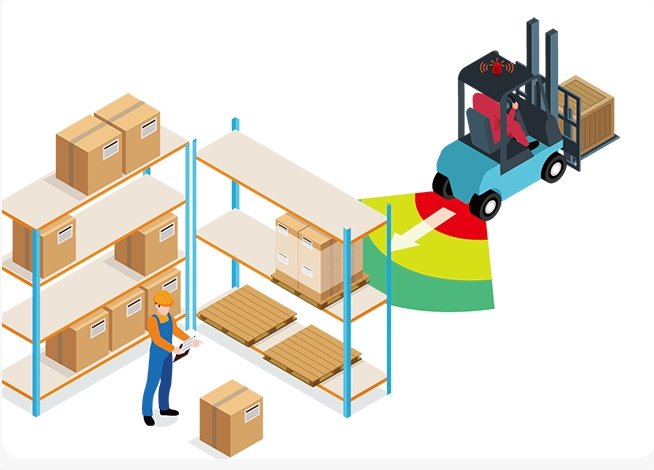
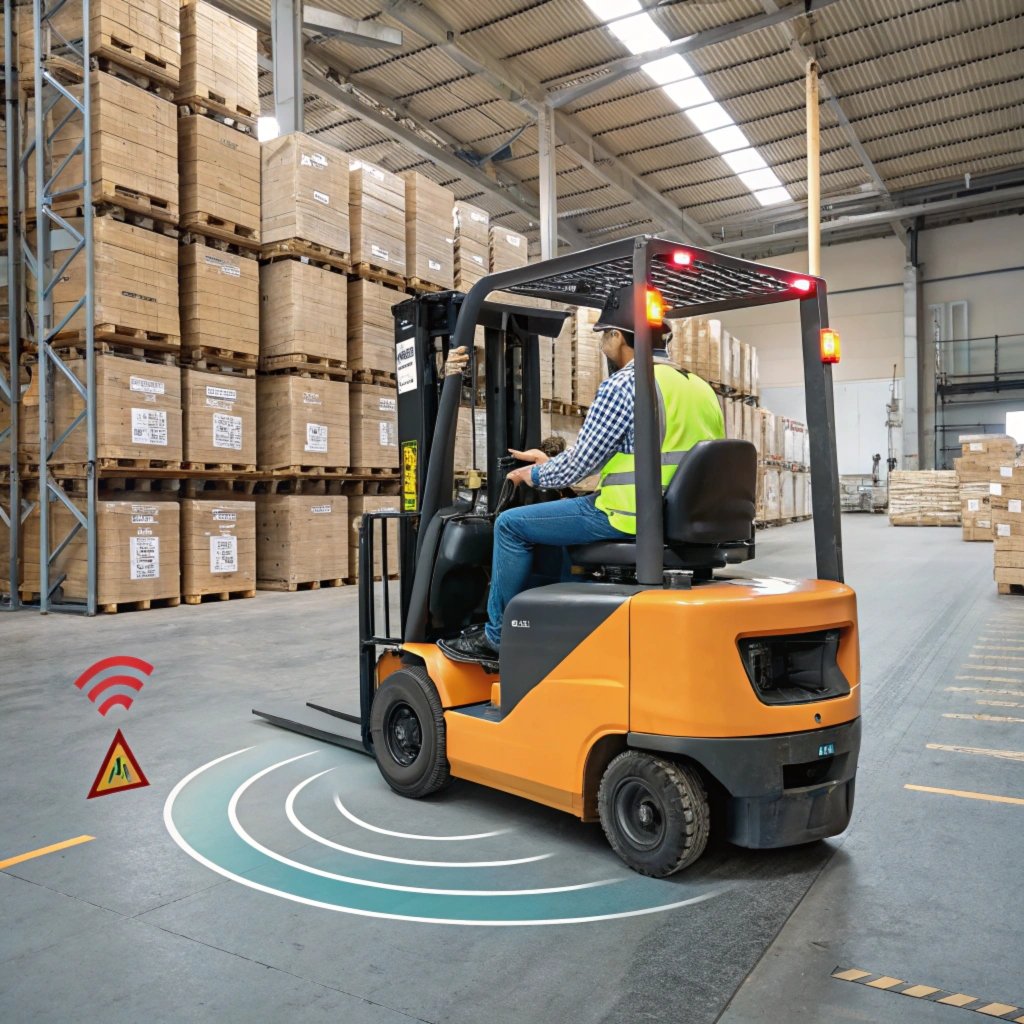
Taller mast, bigger blind spot. See how an AI camera or anti-collision system keeps operators and pedestrians safe around it.
See Safety Systems →6. Three-Stage (Triplex) Mast
The triplex mast adds a third nested section, letting the truck reach significantly greater heights — often 18 to 22+ feet (5.5–7 m) — without needing a taller collapsed mast. This is the go-to choice once a warehouse moves beyond single-level storage into multi-tier selective racking.
Best for
- Selective racking with 3 or more pallet levels
- Distribution centers and 3PL warehouses
- Operations that need real reach without upgrading to a reach truck
Limitations
- Three overlapping rail sections reduce upward visibility more than a duplex
- Heavier mast reduces capacity slightly at maximum height (always check the derated load chart, not just the base capacity)
7. Three-Stage Full Free Lift (Triplex FFL) Mast

This is the mast most warehouse buyers end up on once they need both height and overhead clearance in the same truck: three stages for tall racking, combined with a full free lift cylinder so the forks can rise most of the way to maximum height before the outer sections move. It's the configuration that shows up most often on RFQs for indoor, multi-level, high-density warehouses.
Best for
- High-bay warehouses with 4+ pallet levels and low ceilings or sprinkler lines
- Mixed operations — trailer loading in the morning, rack put-away in the afternoon
- Buyers who want one truck to cover the widest range of tasks
Limitations
- Highest price of the three-stage options
- Heaviest mast in this class — verify the derated capacity chart at your actual lift height
A forklift's rated capacity on the nameplate is measured at a standard load center and often at a lower mast height. Ask your supplier for the capacity chart at your actual required lift height — a truck rated for 3,000 kg at ground level can be rated meaningfully lower once the triplex mast is fully extended.

8. Four-Stage (Quad) Mast
Quad masts add a fourth telescoping section, pushing lift heights well past 25–30 feet (7.5–9 m+) while keeping a collapsed height low enough to still fit through a standard doorway. These are specialist masts, not general warehouse equipment.
Best for
- Very high-bay automated or semi-automated storage
- Facilities where headroom is limited but stacking height demand is extreme
- Specialized industries (aviation, aerospace hangars, cold storage with tall racking)
Limitations
- Significant capacity derating at full height — always confirm the load chart
- Reduced visibility with four overlapping sections in the operator's sightline
- Higher purchase price and more hydraulic components to maintain
- For most operations above ~25 ft, a reach truck or VNA truck is a better fit than a quad-mast counterbalance forklift — worth comparing both before you buy
9. Forklift Mast Type Comparison Table
Here's how the six configurations stack up side by side. Use this as a quick reference when comparing quotes from different suppliers.
| Mast Type | Typical Max Height | Free Lift | Visibility | Relative Cost | Best Application |
|---|---|---|---|---|---|
| Single Stage (SS) | Up to ~10 ft (3 m) | None | Excellent | $ | Outdoor yards, low storage |
| Duplex (2-Stage) | ~13–15 ft (4–4.5 m) | Low–Moderate | Very Good | $$ | General warehousing |
| Duplex FFL | ~13–15 ft (4–4.5 m) | High (near full) | Very Good | $$$ | Trailer & container loading |
| Triplex (3-Stage) | ~18–22 ft (5.5–7 m) | Moderate | Good | $$$ | Multi-level selective racking |
| Triplex FFL | ~18–22 ft (5.5–7 m) | High (near full) | Good | $$$$ | High-bay warehouses, mixed use |
| Quad (4-Stage) | 25–30+ ft (7.5–9 m+) | Varies by model | Fair | $$$$$ | Extreme-height, specialist storage |
Figures are typical industry ranges for counterbalance forklifts and vary by manufacturer, tonnage class, and specific model — always confirm exact figures on the manufacturer's spec sheet for the truck you're quoting.
10. How to Choose the Right Mast for Your Operation
Work through these questions before you finalize any forklift order — the answers will point you straight to the correct mast type.
- What is your tallest racking level? Add roughly 4–6 in (10–15 cm) of buffer above your top pallet position, then match that to the mast's maximum fork height.
- What is your lowest overhead obstruction? Measure your doorway, dock canopy, and any sprinkler or duct lines — the mast's collapsed height must clear all of them with room to spare.
- Will you load enclosed trailers or containers? If yes, you need a full free lift (FFL) mast — a standard mast's outer rail will hit the trailer roof before the forks reach load height.
- How narrow are your aisles? Taller masts with more stages are usually paired with narrower-aisle trucks; confirm your aisle width against the truck's full turning and stacking dimensions, not just the mast.
- What's your heaviest load at your tallest lift point? Always check the capacity chart at that specific height and load center — not just the nameplate rating.
- How much does operator visibility matter in your layout? Busy, pedestrian-heavy aisles favor masts with fewer stages, or a mast paired with camera and proximity-alert systems to offset the extra rail sections in the driver's line of sight.
11. Mast Type and Operator Visibility: The Trade-Off Nobody Mentions
Every additional mast stage adds another layer of steel rail directly in the operator's forward and upward line of sight. On a triplex or quad mast, especially at partial lift height, the overlapping sections can hide a surprising amount of the load path and anything — or anyone — standing just beyond it.
This is a real, measurable safety trade-off, not a minor inconvenience. Warehouses running taller masts in pedestrian-heavy areas typically offset the reduced visibility with camera systems, blind-spot detection, and pedestrian anti-collision technology mounted on the truck, rather than relying on the mast design alone.
If you're speccing a triplex or quad mast for a busy, multi-level warehouse, it's worth pairing it with a forklift pedestrian safety system or a forklift camera system to compensate for the reduced sightlines — both are common additions on taller-mast trucks operating around foot traffic.
Whatever Mast You Run, Your Operators Still Need to See What's Around Them
Triplex, Quad, or FFL — every extra mast stage cuts into the operator's sightline. Our AI camera, pedestrian anti-collision, and blind-spot detection systems are built to close that gap on any forklift, regardless of mast type.
Get a Free Safety System Consultation12. Frequently Asked Questions
What's the difference between a triplex mast and a triplex full free lift mast?
Both have three telescoping stages and reach the same general height range. The difference is how the forks rise: on a standard triplex, the outer section starts telescoping almost immediately, while a triplex FFL uses an internal cylinder that lets the forks travel much further before the outer rail moves — which matters when you're loading under a low ceiling, trailer roof, or container top.
Does adding mast stages reduce a forklift's lift capacity?
Yes, typically. Taller masts with more stages are heavier and flex slightly more at full extension, which usually means a lower rated capacity at maximum height compared to the truck's base nameplate rating. Always request the capacity chart at your actual required lift height before buying.
Can I retrofit a different mast onto an existing forklift?
In some cases, yes — many manufacturers offer mast swaps or upgrades on the same chassis. However, hydraulics, carriage width, and counterweight may need to change as well, so it's usually more cost-effective to compare new or upgraded mast options during purchase rather than retrofitting later.
Which mast type is best for a general warehouse with no special requirements?
For most single- to two-level racking, a standard duplex mast covers the job at the lowest cost. Once you move to three or more racking levels, or need to load enclosed trailers, a triplex or triplex FFL mast becomes the practical choice.
Do taller masts create a bigger blind spot for the operator?
Yes. Additional mast stages add more overlapping steel rail in the operator's forward sightline, particularly at mid-lift positions. Many warehouses running triplex or quad masts pair the truck with a camera or pedestrian-detection system to offset the reduced visibility.