Skip to content

Can Forklifts Drive on Public Roads? Laws, Risks & Safer Alternatives
A forklift is built to move pallets around a warehouse floor, not to merge with traffic. But plenty of yards, docks, and job sites are split by a public street — so the question isn't hypothetical. Here's what actually determines whether a forklift can legally cross or travel on a public road, and what to do if the answer is "not safely."

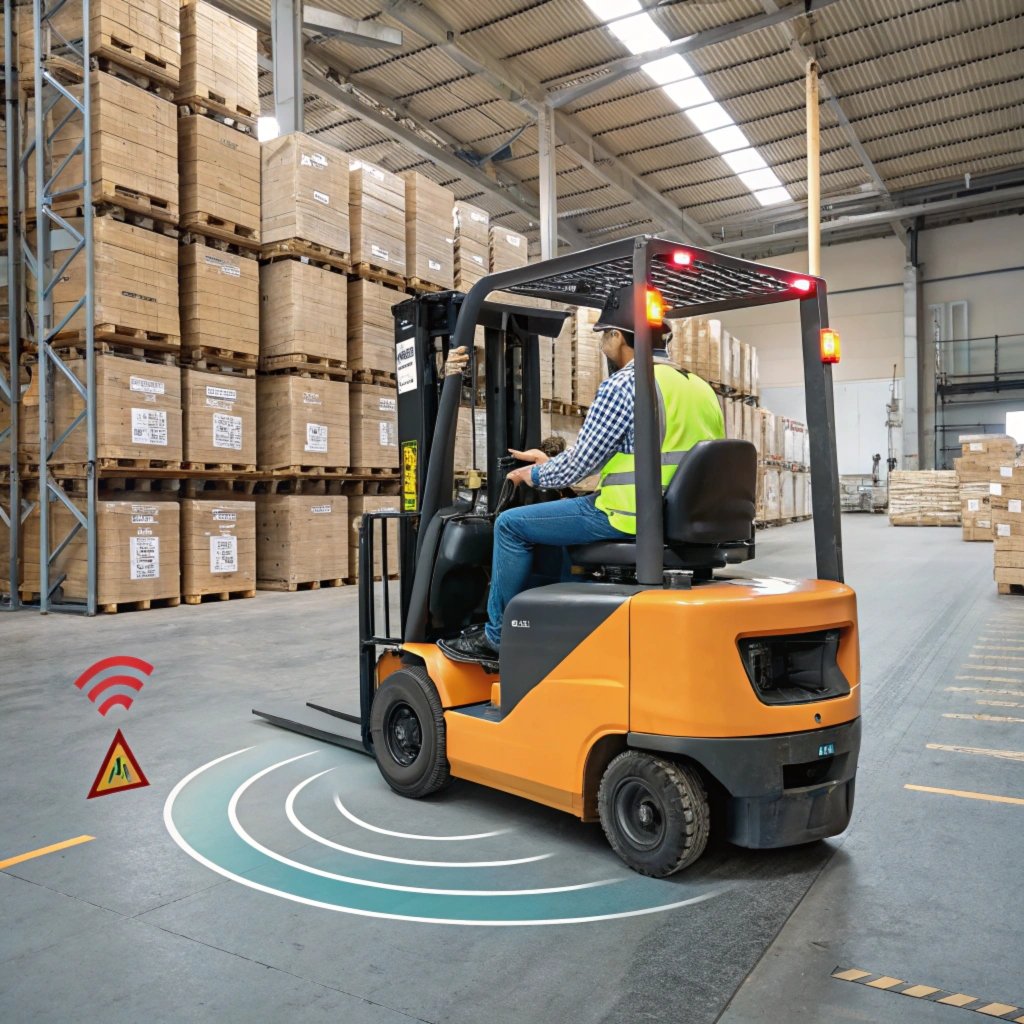
A forklift crossing a public road between two facility yards — exactly the situation where the rules get complicated fast.
⚡ The Short Answer
In most places, forklifts are not designed or approved for regular public road use — but limited, short-distance travel is sometimes allowed under specific conditions.
Forklifts are classified as off-highway "powered industrial trucks," not on-highway vehicles. Regulators generally don't ban every foot of public pavement, but they do require the truck to be equipped and operated like a road vehicle (lights, slow-moving signage, sometimes a permit) for any stretch it uses, and this varies significantly by country, state, and even by municipality. When in doubt, treat any public-road segment as the highest-risk part of the entire move.
- 1. Why Forklifts Aren't Built for the Road
- 2. What "Road Legal" Actually Requires
- 3. Common Real-World Scenarios
- 4. How Rules Differ by Region
- 5. Why This Is a Genuine Safety Risk
- 6. Pre-Trip Checklist If You Must Cross a Road
- 7. Safer Alternatives to Driving on the Road
- 8. Reducing Risk With On-Truck Safety Systems
- 9. Common Mistakes That Lead to Fines or Accidents
- 10. FAQs
1. Why Forklifts Aren't Built for the Road
A forklift and a delivery van look like they belong to the same family of vehicles, but under the hood — and under the law — they're worlds apart. Forklifts fall under the category regulators call "powered industrial trucks": equipment engineered for stable, low-speed lifting on flat, controlled surfaces, not for merging into traffic or holding a lane at 35 mph.
That distinction matters because most workplace safety standards governing forklifts were written with indoor and yard use in mind. In the U.S., for example, the core federal forklift standard focuses on training, load handling, and hazardous-location classifications inside a facility — it isn't a highway traffic code, and it doesn't grant a forklift the right to be on a public street. Separate transportation and motor vehicle authorities decide that question, and they typically start from the opposite assumption: a vehicle is not permitted on a public road unless it meets on-highway equipment standards, not the other way around.
That's the core tension behind this whole topic. A forklift can be perfectly safe and fully compliant inside your facility and still be flatly non-compliant the moment its tires touch a public road, simply because it lacks the equipment, speed, and stability that road-vehicle rules assume.
Think of it less as "forklifts vs. cars" and more as two separate rulebooks that were never designed to overlap. Workplace safety regulators own the warehouse floor; transportation and motor vehicle authorities own the public road. A forklift moving from one to the other doesn't get to pick which rulebook applies — both do, at the same time.
2. What "Road Legal" Actually Requires
Where public road travel is permitted at all, it's rarely automatic. Authorities generally expect the forklift and the operator to meet a version of the same baseline requirements ordinary vehicles meet, scaled to a slow-moving industrial machine. The specifics vary by jurisdiction, but the recurring categories are:
Lighting and visibility equipment
Working headlights, taillights visible from the rear, and often a slow-moving vehicle (SMV) triangle or a flashing amber beacon — since a forklift's top speed is a fraction of normal traffic speed, other drivers need a clear, early signal that it's there.
Operator qualification
Forklift operator certification covers safe operation inside a facility; it typically does not cover public roads. Many jurisdictions require the operator to also hold a valid standard driver's license before taking any powered industrial truck onto a public street, even for a short crossing.
Registration, insurance, and permits
Some regions require the forklift to be registered and insured like any other road vehicle before it can use public roads at all; others allow brief, incidental crossings without full registration but still expect liability coverage and, in some cases, a specific permit tied to a job site or route.
Speed and route limitations
Even where road use is allowed, it's usually capped to very short distances — crossing a street, moving between adjacent lots, or traveling a fixed route between a job site and a staging area — not sustained travel or anything resembling a commute.
Regulators generally distinguish between equipment that occasionally crosses a public road to reach a job site and equipment that's actually being used for transportation between locations. The first is sometimes tolerated with the right precautions; the second usually isn't. If your forklift is regularly making a trip down a public street rather than briefly crossing it, that's the point to stop and get a definitive answer from your local transportation authority before it becomes a habit.
3. Common Real-World Scenarios
Most forklifts don't end up on a public road because someone decided to go for a drive — it happens because of how a site is laid out. A few situations come up again and again:
- Split-site facilities — a warehouse and its overflow yard sit on opposite sides of a public street, and pallets need to move between them.
- Construction and job sites — a forklift needs to reach a work area that's only accessible by briefly using a public road or shoulder.
- Port, rail, and distribution yards — internal roads intersect a public right-of-way at one or two crossing points.
- Equipment relocation — moving a forklift from a dealer, a repair shop, or one nearby facility to another without a trailer.
None of these automatically make road use legal — they just explain why the question comes up so often. Each one deserves its own answer, not an assumption borrowed from "everyone does it."
4. How the Rules Differ by Region
There's no single global standard here, and treating one country's rule as universal is one of the fastest ways to end up non-compliant. The table below summarizes the general pattern in a few commonly referenced regions — always confirm the current requirement with your local transportation or motor vehicle authority before relying on it.
| Region | General Approach | Typical Extra Requirements |
|---|---|---|
| United States | Governed at state/local level; federal transportation rules generally exempt brief, incidental crossings to reach a site, but not sustained road use. | State DMV registration or exemption, SMV sign, amber beacon, insurance, sometimes a local permit. |
| United Kingdom | Industrial trucks may be used on the road only if built or adapted to meet road vehicle construction rules; most warehouse forklifts are not. | Registration plate, lighting, rear-visible lights, amber beacon under a set speed, valid driving licence, insurance. |
| European Union (general) | Member states generally require type-approval or a specific road-use permit for off-highway industrial equipment; enforcement and exceptions vary by country. | National vehicle registration or exemption certificate, lighting and marking standards, operator licensing. |
| Australia | State-based rules typically treat forklifts as unregistered plant unless specifically fitted and approved for road use. | State road authority approval, warning devices, restricted routes/distances, insurance. |
Even where "occasional" or "incidental" road crossings are tolerated, the burden of proof sits with the equipment owner and operator, not the regulator. If you can't point to the specific rule, permit, or exemption that covers your situation, assume it isn't covered yet — and confirm before your next site move, not after an incident or a citation.
5. Why This Is a Genuine Safety Risk — Not Just a Paperwork Issue
Compliance aside, there's a physical reason regulators are cautious here: forklifts and public roads have almost nothing in common in how they behave.
- Speed mismatch. Most forklifts top out well under 20 mph — far slower than surrounding traffic, which creates sudden closing speeds for approaching drivers who don't expect something that slow.
- Narrow stability margin. Forklifts are designed to stay balanced on flat, even surfaces at low speed. Road cambers, potholes, and sudden braking can push a loaded truck outside its stability triangle in a way a warehouse floor never would.
- Limited visibility. A raised load, a mast, or a counterweight can block the operator's view of an intersection or an oncoming vehicle — the same blind-spot problem that causes indoor pedestrian incidents, at road speeds instead of walking speeds.
- No occupant protection built for a collision. Forklift cabs and overhead guards are engineered to protect against tip-overs and falling loads, not a highway-speed vehicle impact.
- Weather and surface exposure. Rain, glare, and road debris affect tire grip and visibility differently than a warehouse floor, and most forklifts weren't tested against those conditions.
This is really the same underlying theme that runs through most forklift incident data: the truck performs exactly as designed, right up until it's asked to operate outside the environment it was designed for.
6. Pre-Trip Checklist If a Public Road Crossing Is Unavoidable
If your operation has confirmed the crossing is legally permitted and there's genuinely no practical alternative, treat it as a planned, controlled event — not a routine drive. A workable pre-trip checklist looks like this:
- Confirmed in writing with your local transportation/DMV authority (or equivalent) that this specific crossing is permitted.
- Operator holds both a valid forklift certification and, where required, a standard driver's license.
- Headlights, taillights, and an SMV sign or amber beacon are fitted and working.
- Insurance and any required permit or registration documents are current and on file.
- A spotter or escort is positioned at the crossing point during the move, not just at the loading dock.
- The route is the shortest safe distance available — not a shortcut that adds unnecessary road time.
- The crossing is scheduled outside peak traffic hours where possible.
- The forklift is unloaded or carrying the lowest, most stable load configuration the task allows.
Don't treat this as a judgment call for the operator to make on the spot. An unconfirmed crossing is both a compliance exposure for the business and a safety exposure for the operator and everyone around that intersection. Pause the move and get the missing piece resolved first.
7. Safer Alternatives to Driving a Forklift on the Road
In practice, most operations that hit this question end up concluding the same thing: it's rarely worth building a road-legal forklift program for one recurring crossing. A few alternatives solve the same problem with far less exposure:
- Flatbed or low-loader trailer transport — even for a short distance, transporting the forklift rather than driving it removes almost every risk on this page.
- Dedicated tow tractors or yard trucks — purpose-built for site-to-site travel, often already road-rated, without repurposing lifting equipment for a job it wasn't designed for.
- A second forklift stationed on each side — if volume justifies it, keeping equipment on both sides of the road avoids the crossing entirely.
- Physical or scheduled crossing controls — a marked, signaled crossing point with fixed hours can turn a risky ad hoc move into a controlled, repeatable one.
If your facility is still in the planning stage and you're sizing equipment for a split site, it's worth revisiting your forklift turning radius and aisle-width planning and capacity requirements together — the right internal layout often removes the need for a road crossing altogether.
8. Reducing Risk With On-Truck Safety Systems
Whether a forklift is crossing a public road under permit, moving through a mixed yard where trucks and pedestrians share space, or simply operating in a busy dock area, the underlying risks are the same ones this article has been describing: low visibility, mismatched speeds, and narrow reaction time. That's the exact gap safety systems are built to close.
We design and supply the AI camera, detection, and alert systems that give operators earlier warning in precisely these conditions — not the forklifts themselves. A few examples relevant to road-adjacent and yard-crossing operations:
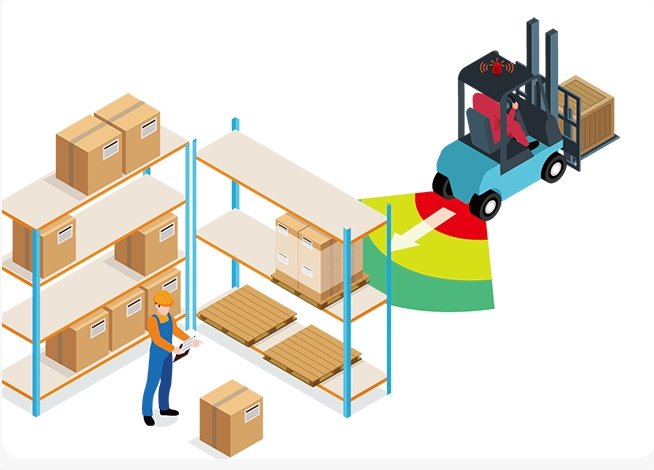
- Pedestrian detection systems that flag people near a crossing point before the operator's line of sight would.
- Camera-based visibility systems that cover blind spots created by masts, loads, and counterweights.
- Speed limiters that enforce a safe maximum speed for yard and crossing zones, regardless of operator judgment in the moment.
- Blue safety lights and back-up alarms that give pedestrians and drivers near a crossing an earlier visual and audible warning.
If your site has a public road running through or alongside it, that crossing point is usually the single highest-risk spot in the whole operation — for exactly the reasons covered above. It's worth a dedicated look, separate from your general yard safety plan.
Get a Free Crossing-Point Safety Review9. Common Mistakes That Lead to Fines or Accidents
- Assuming "everyone does it" equals "it's allowed." Informal local habits aren't the same as a documented permit or exemption.
- Treating a forklift operator's card as a driver's license. The two certifications cover completely different environments and usually aren't interchangeable.
- Skipping lighting and SMV signage because the crossing "only takes a minute."
- Letting an occasional crossing quietly become a routine transport route without revisiting whether it's still covered by the original permission.
- Crossing during peak traffic instead of scheduling the move for a lower-risk window.
- Not re-checking local rules after equipment changes — a different forklift, load, or mast height can change which requirements apply.
10. Frequently Asked Questions
Tap a question to expand the answer — tap again to collapse it.
Only if that specific route is confirmed as permitted by your local transportation or motor vehicle authority, and the truck meets the lighting, signage, and (where required) registration standards for road use. Without that confirmation, treat it as not permitted rather than assuming it's fine because the distance is short.
In many jurisdictions, yes — forklift operator certification alone typically doesn't authorize road use. Check the specific requirement in your area before assigning the crossing to an operator who only holds a forklift certification.
Requirements vary, but commonly include working headlights and taillights, a slow-moving vehicle sign or amber warning beacon, and in some regions formal registration, insurance, and a permit. Some areas also cap the distance or route the forklift can travel.
Generally yes. Trailer transport avoids the speed mismatch, stability, and visibility issues that make forklift road travel risky, and it sidesteps most of the licensing and equipment requirements that apply to on-road use.
Consequences vary by jurisdiction but can include fines, equipment impoundment, and liability exposure if an incident occurs during the unauthorized crossing. Insurance coverage may also be affected if the road use wasn't disclosed or permitted.
Power source generally isn't the deciding factor — road-use rules focus on equipment like lighting, speed, and registration status rather than how the truck is powered. Always confirm the requirement for your specific model rather than assuming based on fuel type.
This article provides general safety and compliance information and isn't a substitute for legal advice. Regulations for forklifts and public roads vary by country, state/province, and municipality, and they change over time — confirm current requirements with your local transportation or motor vehicle authority before relying on this guide.
Wherever Your Forklift Travels, Visibility Shouldn't Stop at the Yard Gate
We build the AI camera, pedestrian detection, and anti-collision systems that protect the riskiest points of a forklift's route — including crossings, blind corners, and shared traffic areas. We don't sell forklifts; we help keep the ones you already run out of trouble.
Talk to a Forklift Safety Specialist