Skip to content

Jungheinrich vs Linde Forklift: Which One Fits Your Warehouse in 2026?
Two of Germany's biggest material handling names, two very different engineering philosophies. Here's how they actually compare on capacity, drivetrain, ergonomics, technology, and total cost — before you sign the purchase order.
Jungheinrich and Linde show up on almost every shortlist for European-engineered forklifts, and for good reason — both companies have been building material handling equipment for over 70 years and both are consistently ranked among the largest forklift manufacturers in the world. But "both are excellent German brands" isn't a buying decision. The two companies grew out of different engineering traditions, and that shows up in real, practical differences: how the truck drives, how it feels after an eight-hour shift, how it's serviced, and what it costs to run over five years.
This guide compares Jungheinrich and Linde forklifts across the factors that actually affect a purchase decision — not marketing taglines. We'll also flag where brand choice matters less than you'd think, because the bigger safety and productivity gains in most warehouses come from how the fleet is managed and monitored, not which badge is on the mast.
📋 Table of Contents
- 1. Company Snapshot: Jungheinrich vs Linde
- 2. Product Range & What Each Brand Specializes In
- 3. Drivetrain Difference: Hydrostatic Drive vs Electric Warehouse Focus
- 4. Capacity, Lift Height & Class Comparison
- 5. Ergonomics & Operator Comfort
- 6. Fleet Technology, Telematics & Automation
- 7. Power Options: Lithium-Ion, Lead-Acid & IC
- 8. Dealer Network, Parts & Service
- 9. Total Cost of Ownership
- 10. Which Brand Fits Your Operation?
- 11. Buying Mistakes to Avoid
- 12. The Question Neither Brand Answers: Pedestrian & Blind-Spot Safety
- 13. FAQs
1. Company Snapshot: Jungheinrich vs Linde
Jungheinrich was founded in Hamburg in 1953 and remains an independent, publicly listed company. It built its reputation primarily on electric warehouse trucks — pallet trucks, reach trucks, and narrow-aisle equipment — and has grown into one of the world's largest suppliers of intralogistics equipment, including racking systems and warehouse automation.
Linde Material Handling traces its engineering roots back to the 1950s as well, but today operates as part of the KION Group, alongside sister brand STILL. Linde is best known for internal combustion (IC) forklifts built around its proprietary hydrostatic drive system, along with a full electric lineup that shares components and engineering DNA across the KION portfolio.
| Factor | Jungheinrich | Linde |
|---|---|---|
| Founded | 1953, Hamburg, Germany | 1904 origins (Linde AG); Linde Material Handling formalized mid-20th century |
| Ownership | Independent, publicly listed | Part of KION Group (with STILL, Baoli) |
| Core strength | Electric warehouse trucks, narrow-aisle, automation/AGVs | IC hydrostatic drive, ergonomic full-range fleets |
| Global reach | Strong in Europe, expanding warehouse automation globally | Strong global dealer network via KION distribution |
2. Product Range & What Each Brand Specializes In
Both manufacturers now sell across nearly every forklift category — electric counterbalance, IC counterbalance, reach trucks, pallet trucks, and order pickers — so on paper the catalogs look similar. The difference shows up in depth, not breadth.
Jungheinrich's strongest categories
- Narrow-aisle & VNA trucks — a core specialty, with a wide range of reach trucks and very-narrow-aisle equipment for high-density racking.
- Electric pallet trucks and order pickers — deep model range for e-commerce and distribution center picking operations.
- Warehouse automation — automated guided vehicles (AGVs) and integration with warehouse management software are a growing focus.
Linde's strongest categories
- IC counterbalance trucks — diesel and LPG models built around Linde's hydrostatic transmission, popular in yards, lumber, and outdoor bulk handling.
- Heavy-duty and container handling equipment — a well-established lineup for ports and steel handling.
- Ergonomically-focused electric trucks — Linde has invested heavily in operator seating, visibility, and control layout across its E-series.

3. Drivetrain Difference: Hydrostatic Drive vs Electric Warehouse Focus
If there's one genuine engineering differentiator between the two brands, it's how Linde's IC trucks put power to the wheels. Linde's hydrostatic drive replaces the conventional torque converter and mechanical transmission with a hydraulic pump-and-motor system, giving the operator stepless, continuously variable acceleration with no gear shifting.
In practice this means smoother starts and stops, reduced brake wear because the hydrostatic system provides built-in braking resistance, and generally less driveline maintenance over the truck's life compared to a conventional torque-converter transmission. It's a genuine point of difference — most competitors, Jungheinrich's IC range included, use more conventional automatic transmissions.
Jungheinrich, by contrast, has put more of its engineering investment into electric drive efficiency, regenerative braking tuning, and compact chassis design for its warehouse trucks — areas where it's historically been rated highly by fleet operators running tight-aisle electric fleets.
4. Capacity, Lift Height & Class Comparison
Both brands cover a comparable range of load capacities across their catalogs, but the emphasis differs. Always confirm exact figures against the specific model, mast, and load center your dealer quotes — the ranges below are general industry positioning, not a substitute for the data plate.
| Truck Class | Jungheinrich Typical Range | Linde Typical Range |
|---|---|---|
| Electric pallet truck | 1.6–2.5 t | 1.6–2.5 t |
| Electric counterbalance (3-wheel) | 1.0–2.0 t | 1.0–2.0 t |
| Electric counterbalance (4-wheel) | 1.4–5.0 t | 1.4–5.0 t |
| Reach truck / VNA | 1.0–2.5 t, up to ~13 m lift height | 1.0–2.0 t, up to ~11 m lift height |
| IC counterbalance (diesel/LPG) | 1.5–8.0 t | 1.5–9.0 t |
| Heavy-duty / container handling | Limited range, partner-sourced in some markets | Extensive in-house range up to 45+ t |
The practical takeaway: Jungheinrich generally has the deeper bench in narrow-aisle and very-high-lift warehouse equipment, while Linde's advantage widens in heavy IC and heavy-duty container handling classes. If your fleet is a mix of both, it's common for operations to run one brand for indoor electric trucks and the other for outdoor heavy IC work — there's no rule that says a fleet has to be single-brand.
5. Ergonomics & Operator Comfort
Operator fatigue is a real productivity and safety cost, and both manufacturers have invested significantly here — but with different emphasis.
Cabin & Control Focus
- Compact, low-step-in cabins suited to frequent mounting/dismounting in pick operations
- Multi-function control levers designed for high-frequency warehouse tasks
- Strong visibility packages on reach trucks for high-rack put-away
Seating & Long-Shift Comfort
- Linde Load Control joystick system reduces repetitive hand/wrist strain
- Wider seating and suspension options favored for long outdoor shifts
- Quieter cabin insulation on IC models, notable on longer yard routes
6. Fleet Technology, Telematics & Automation
Both brands offer fleet management software — access control, utilization tracking, impact detection, and maintenance scheduling — bundled or optional depending on the market and model. Jungheinrich has pushed further into warehouse automation, offering AGV lines that integrate with its trucks and warehouse management systems, aimed at operations planning a phased move toward automation. Linde's telematics platform, distributed through the KION group's connected fleet tools, focuses more on mixed-fleet visibility across IC and electric trucks operating together.
7. Power Options: Lithium-Ion, Lead-Acid & IC
Both manufacturers now offer lithium-ion battery options across most of their electric ranges, alongside traditional lead-acid and, for Jungheinrich in particular, a long-standing lead-acid manufacturing heritage of its own. If you're still weighing battery chemistry for an electric truck purchase, it's worth reading through the tradeoffs in detail before locking in a brand — charging infrastructure and shift patterns often matter more than which manufacturer's battery is under the seat. Our lithium vs. lead-acid forklift battery comparison breaks down charging time, lifespan, and total cost differences that apply regardless of whether you land on Jungheinrich or Linde.
8. Dealer Network, Parts & Service
Service coverage often matters more than spec sheets once a truck is in daily operation. Linde benefits from the scale of the KION Group's distribution network, which shares logistics and parts infrastructure with STILL in many regions — useful if your operation is spread across multiple countries. Jungheinrich operates its own extensive direct-sales and service branch network in Europe, which some operators prefer because it reduces the layers between the buyer and the manufacturer.
- Before buying either brand, ask your local dealer for average parts lead time on your specific model, not just the brand's global average.
- Confirm whether service technicians are direct-employed or third-party subcontracted in your region — response time can vary significantly between the two.
- Ask about loaner/rental truck availability during major repairs, especially for single-shift-critical operations.

9. Total Cost of Ownership
Purchase price differences between comparable Jungheinrich and Linde models tend to be modest and highly dependent on local dealer pricing, financing terms, and promotions — there's no consistent industry-wide gap in favor of either brand. The bigger cost swings usually come from three places instead:
- Maintenance interval design. Linde's hydrostatic drive reduces certain wear items (like transmission clutches) on IC trucks, which can lower long-run maintenance cost on that specific segment.
- Energy efficiency on electric trucks. Regenerative braking tuning and drive efficiency affect electricity cost per shift; ask both dealers for real operating-cost data from a comparable customer site, not just brochure figures.
- Residual value. Resale value for both brands is generally strong in the used equipment market given their reputations, but regional demand varies — a local equipment appraiser can give a more accurate answer than either manufacturer's sales team.
10. Which Brand Fits Your Operation?
| Your Priority | Better Fit | Why |
|---|---|---|
| High-density racking, narrow aisles | Jungheinrich | Deeper VNA/reach truck range and higher lift heights |
| Outdoor yard, diesel/LPG counterbalance | Linde | Hydrostatic drive smoothness and durability advantage |
| Planning a move toward automation/AGVs | Jungheinrich | More mature in-house AGV and WMS integration |
| Multi-country fleet needing broad dealer coverage | Linde | KION Group's larger combined distribution footprint |
| Heavy container/port handling | Linde | Broader in-house heavy-duty product range |
| E-commerce order picking, pallet trucks | Jungheinrich | Extensive electric pallet truck and picker lineup |
11. Buying Mistakes to Avoid
- ✕ Comparing brochure capacity numbers without checking load center and mast height — see our forklift capacity guide before finalizing a class of truck.
- ✕ Choosing a brand before choosing the right truck class — a well-matched reach truck from either brand will outperform a poorly-matched counterbalance truck from the "better" brand.
- ✕ Ignoring aisle width and turning radius — a higher-capacity truck that can't maneuver in your layout isn't a real upgrade.
- ✕ Skipping a real operator test drive — ergonomic differences between brands are subtle on paper and obvious after two hours on the forks.
- ✕ Assuming brand telematics covers pedestrian safety — most factory fleet software tracks the truck, not what's walking around it.
12. The Question Neither Brand Answers: Pedestrian & Blind-Spot Safety
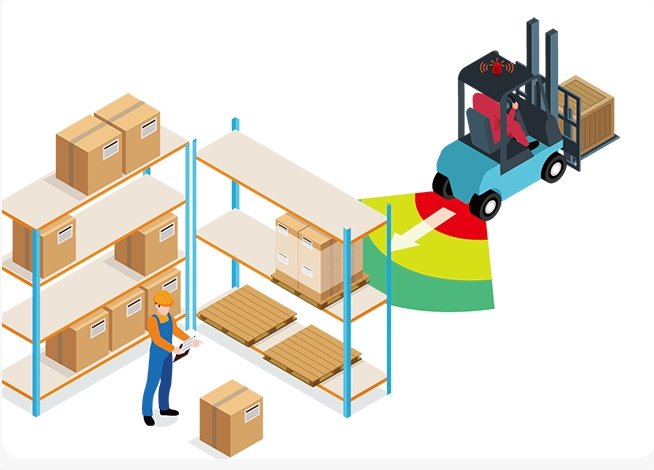
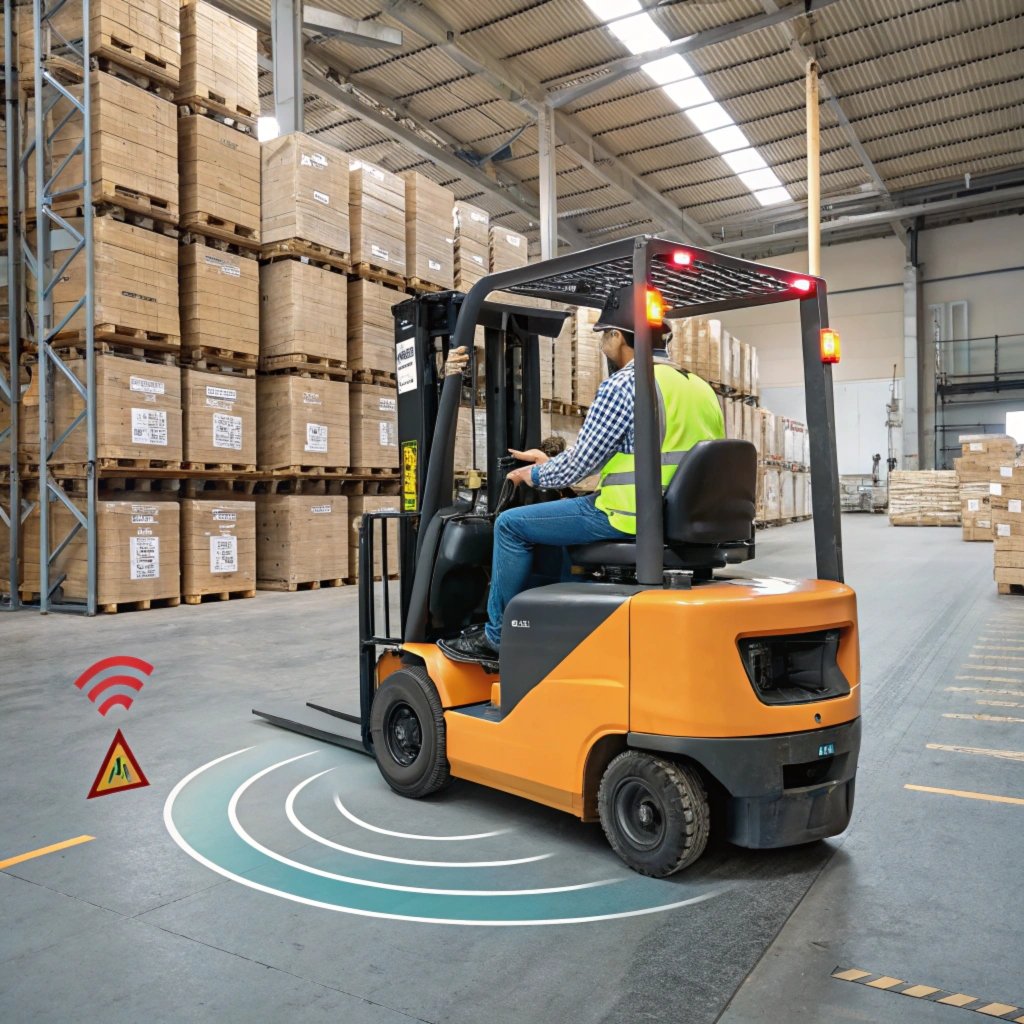
Here's something worth knowing before you finalize either brand: neither Jungheinrich nor Linde's standard factory package is built around detecting pedestrians in blind spots. Electric trucks from both manufacturers are notably quiet in warehouse operation — a comfort feature for the operator, but also a reason pedestrians often don't hear an approaching truck until it's close. Reach trucks and high-mast VNA equipment from either brand also carry significant rear and load-side blind spots by design, simply because of mast and load positioning.
This is exactly where operations layer additional protection on top of whichever brand they choose — pedestrian safety systems that detect people in the truck's blind zones, AI camera systems that give the operator real visibility around the mast and rear, and speed limiters that keep a fast-moving truck from closing distance faster than a pedestrian can react. None of these require replacing your forklift — they retrofit onto Jungheinrich, Linde, or virtually any other brand already in your fleet.
Whichever Brand You Choose, Your Fleet Still Needs Eyes on Every Blind Spot
We're not a forklift dealer — we build the AI camera, pedestrian detection, and anti-collision systems that keep Jungheinrich, Linde, and every other brand operating safely around your people, day and night.
Get a Free Safety System Consultation13. Frequently Asked Questions
Is Jungheinrich or Linde more reliable?
Both brands have strong reliability reputations in their core categories — Jungheinrich in electric warehouse trucks, Linde in IC hydrostatic-drive counterbalance trucks. Reliability in practice depends heavily on maintenance discipline and local dealer service quality as much as brand engineering.
Which brand is better for a narrow-aisle warehouse?
Jungheinrich generally has the deeper range of reach trucks and very-narrow-aisle equipment, along with higher maximum lift heights in that category, making it a common first choice for high-density racking operations.
What is Linde's hydrostatic drive and does it matter?
It's a transmission system that uses hydraulic pumps and motors instead of a conventional gearbox and torque converter, giving stepless acceleration and reduced brake wear. It matters most on diesel and LPG counterbalance trucks, where operators typically notice smoother control within the first shift.
Are Linde and Jungheinrich the same company?
No. Jungheinrich is an independent, publicly listed company. Linde Material Handling is part of the KION Group, alongside sister brand STILL — they are separate competing manufacturers.
Do either brand's forklifts include pedestrian detection as standard?
Standard factory packages from both brands focus on truck performance, operator ergonomics, and fleet telematics rather than dedicated pedestrian blind-spot detection. Most operations add a separate pedestrian safety or camera system regardless of which forklift brand they select.
Can I mix Jungheinrich and Linde trucks in the same fleet?
Yes, and many multi-site operations do — commonly running one brand for indoor electric warehouse trucks and another for outdoor IC counterbalance work. Parts and service contracts are typically managed per-brand rather than fleet-wide in this setup.