Skip to content
Can Forklift Anti-Collision Systems 100% Prevent Accidents?
The short answer is no — and any supplier who claims otherwise is overselling. Here’s what these systems actually deliver, where they fall short, and how to combine them with speed control, training, and layout changes for the highest practical level of forklift safety.
Warehouse managers and safety officers often ask the same question when evaluating pedestrian detection or collision-avoidance technology: “Will this stop every forklift accident?” The honest answer is that no single system can deliver absolute prevention. Anti-collision technology is one of the most effective engineering controls available today, but it is still an aid — not a replacement for trained operators, clear traffic rules, and disciplined speed management.
This guide explains exactly what modern systems can and cannot do, why residual risk always remains, and how pairing anti-collision sensors with a properly configured forklift speed limiter and solid operating procedures gets you as close to zero incidents as practical operations allow.
1. What Forklift Anti-Collision Systems Actually Do
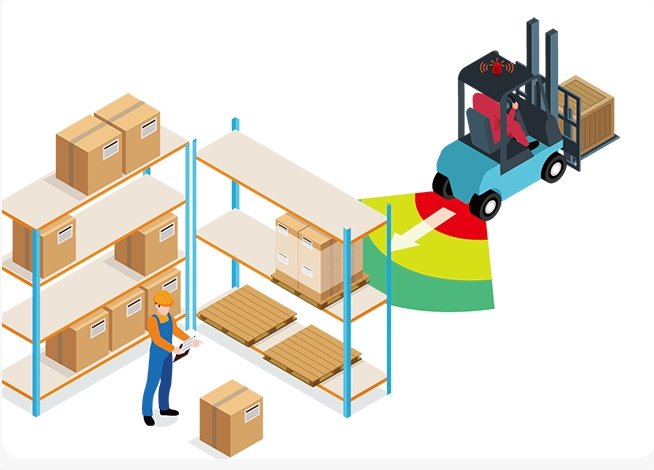
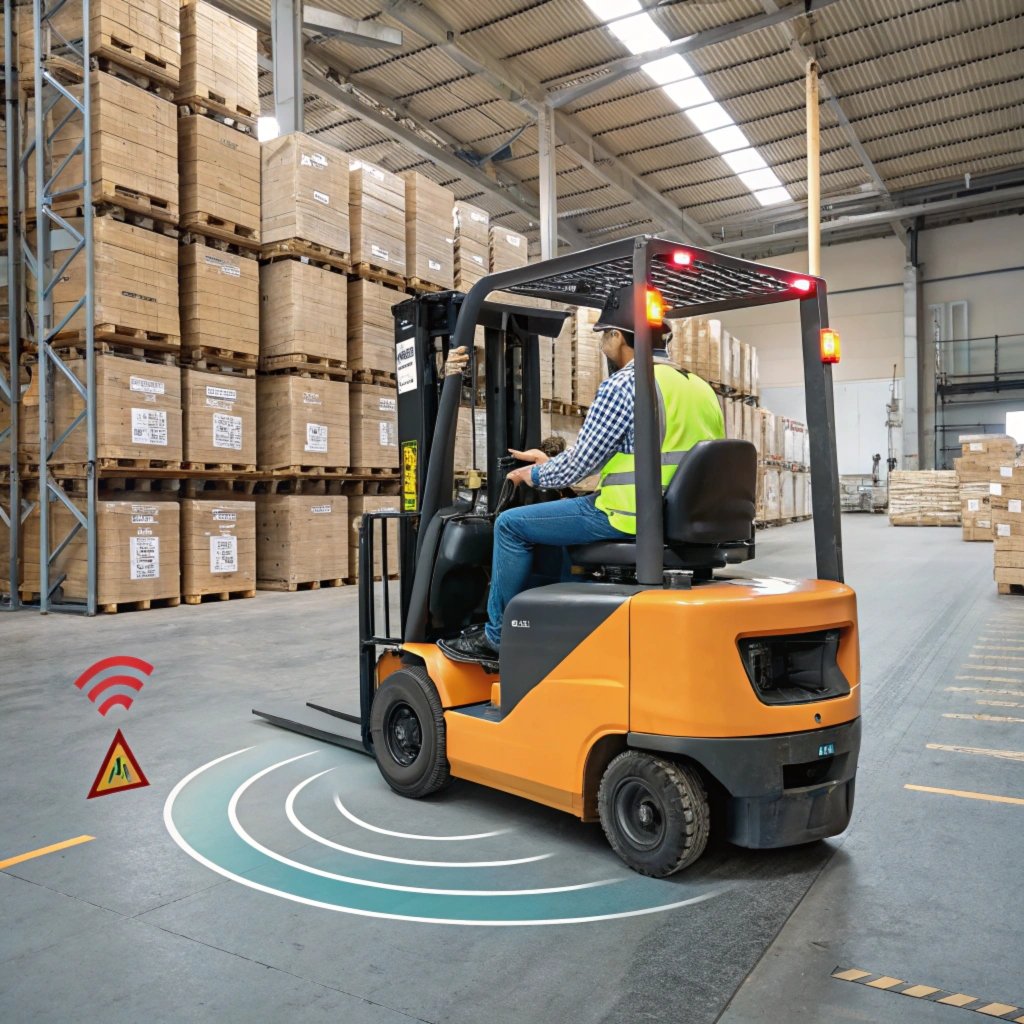
Modern forklift anti-collision systems use a mix of technologies — AI cameras, radar, ultrasonic sensors, or ultra-wideband (UWB) tags — to detect pedestrians, other vehicles, and fixed obstacles around the truck. When a hazard enters a defined warning or danger zone, the system typically:
- Alerts the operator with visual and audible warnings
- Alerts the pedestrian (via wearable tags, lights, or vibration in some systems)
- Automatically slows the forklift to a crawl or applies controlled braking
- Records the event for later review and training
The best systems act faster than human reaction time. At typical warehouse speeds, an operator’s perception-reaction lag of 1–1.5 seconds can cover 4–8 meters. An active system can begin deceleration in a fraction of that time, giving both the driver and the pedestrian a critical extra window.

Reversing is one of the highest-risk maneuvers. Anti-collision systems are especially valuable when the load or mast blocks rear visibility.
Anti-collision systems reduce the frequency and severity of collisions by detecting hazards earlier and intervening automatically — they do not eliminate every possible failure mode.
2. Why 100% Prevention Is Not Realistic
Manufacturers of reputable systems are careful in their language. Most manuals and safety statements explicitly note that the technology is an additional aid and does not guarantee complete avoidance of accidents. There are several unavoidable reasons:
- Human factors still dominate. An operator can override, ignore, or disable alerts. Pedestrians can walk into the path of a moving truck at the last second.
- Physics and reaction limits. Even with automatic slowdown, a heavy forklift carrying a high load cannot stop instantly. Stopping distance remains.
- Detection gaps. Sensors have blind spots, range limits, and environmental sensitivities (heavy dust, steam, extreme glare, dense metal racking).
- System and maintenance failures. Dirty camera lenses, damaged sensors, low battery on tags, or software glitches can degrade performance.
- Non-tagged pedestrians or unexpected objects. Tag-based UWB systems only protect people wearing active tags. Camera systems can miss partially occluded or unusually clothed individuals in some lighting conditions.
In short, the technology dramatically lowers risk but cannot remove the last residual percentage that comes from extreme edge cases, deliberate misuse, or complete system failure.
3. Real-World Limitations You Must Plan For
Understanding the specific weaknesses of each technology helps you choose the right system and design compensating controls.
| Technology | Strengths | Key Limitations |
|---|---|---|
| AI Camera / Vision | Tagless detection of people; visual evidence; good classification | Performance drops in low light, heavy dust, fog, or when lens is dirty; limited ability to “see” through solid obstacles |
| Radar / Ultrasonic | Works in dust, darkness, and weather; reliable distance measurement | Less precise classification (person vs object); can struggle with soft or angled surfaces; possible false triggers from clutter |
| UWB / Tag-based | Detects through racking and around corners; accurate positioning | Only protects tagged people; requires daily tag compliance; infrastructure (anchors) needed for best performance |
| Hybrid (Camera + Radar or UWB) | Best overall coverage and redundancy | Higher cost and more complex installation/calibration |

In high-traffic zones where pedestrians and forklifts share space, layered controls become essential because no single sensor covers every scenario.
Additional practical constraints include:
- Automatic slowdown or stop is usually limited to a pre-set creep speed rather than an emergency hard stop in every situation (to avoid creating new hazards such as load shift or rear-end collisions from following trucks). See how automatic braking systems handle this in practice.
- Some systems only activate in reverse or in designated zones.
- False positives that are too frequent lead operators to ignore or disable the system — defeating the purpose.
For environments with heavy pedestrian traffic, dedicated forklift pedestrian safety systems and camera-based detection are often the most effective first layer.
4. How Speed Limiters Multiply the Protection
Anti-collision systems work best when the forklift is already traveling at a controlled speed. A dedicated forklift speed limiter (also called a speed governor or zone-based speed controller) enforces maximum speeds by area or by condition, independent of the operator’s judgment.
Typical high-value uses:
- Hard limit of 8–10 km/h (5–6 mph) in open travel lanes
- Crawl speed (3–5 km/h / 2–3 mph) in pedestrian-dense zones, cross-aisles, and near doorways
- Automatic reduction when the anti-collision system detects a person in the warning zone
- Different profiles for loaded vs unloaded travel or high vs low mast height
Lower speed directly reduces stopping distance and impact energy. Even if detection is slightly delayed or the operator is momentarily distracted, the truck is already moving slowly enough that the automatic intervention or the driver’s own reaction can still prevent contact.
5. The Layered Safety Approach That Works
The highest-performing warehouses treat technology as one layer among several. A practical hierarchy looks like this:
- Eliminate or separate — Physical barriers, dedicated pedestrian walkways, and one-way traffic where possible.
- Engineering controls — Anti-collision systems + speed limiters + blue-spot / red-zone lights + cameras and blind-spot detection.
- Administrative controls — Clear right-of-way rules, intersection protocols, speed policies by zone, and mandatory reporting of near-misses.
- Training & culture — Regular refresher training that includes the exact behavior of the installed safety systems, so operators understand both the protection and the residual risks.
- Maintenance & verification — Daily visual checks of sensors and tags, periodic function tests, and prompt repair of any degraded component.
- Confirm all cameras/lenses are clean and unobstructed
- Verify pedestrian tags (if used) have charge and are being worn
- Test warning lights and audible alerts at the start of shift
- Confirm speed-limiter profiles match the current zone map
- Review any system-generated near-miss events from the previous day
When these layers work together, many sites report 70–90%+ reductions in forklift–pedestrian incidents and near-misses. That is outstanding progress — but it is still not a mathematical guarantee of zero forever. A structured warehouse risk assessment remains the foundation for deciding which layers to prioritize.
6. What to Look for When Buying a System
If you are evaluating anti-collision technology or a speed limiter for your fleet, focus on these practical criteria:
- Active intervention capability — Warning-only systems are better than nothing, but systems that can automatically reduce speed or apply controlled braking deliver far higher protection. Look at solutions with automatic braking or slowdown functions.
- Integration with speed control — Prefer solutions that can talk to a speed limiter or have built-in zone-based speed management.
- Environment fit — Match the sensing technology to your lighting, dust levels, and layout. Hybrid systems are often the most robust choice for mixed conditions.
- False-alarm rate — Ask for real-site references. High nuisance alerts destroy operator trust.
- Retrofit friendliness — Most modern systems can be added to existing electric and IC forklifts without major vehicle modification.
- Data & reporting — Event logging helps you identify problem intersections and coach operators.
- Support and calibration — Local or responsive technical support for initial setup and ongoing adjustments is essential.
Ready to Reduce Forklift Collision Risk?
We design and supply practical forklift anti-collision systems and speed limiters that work together. Tell us about your layout and traffic patterns — we’ll help you choose the right combination for your site.
Talk to a Safety Specialist7. FAQs
Do forklift anti-collision systems completely eliminate accidents?
What is the difference between a warning system and an active anti-collision system?
Should I install a speed limiter together with an anti-collision system?
Can these systems be retrofitted to existing forklifts?
How often do sensors and cameras need maintenance?
Are tag-based (UWB) systems better than camera systems?
Will automatic slowdown reduce productivity?
Anti-collision technology is one of the strongest tools available for forklift safety in 2026. Used realistically — as part of a layered program that includes speed control, training, and layout discipline — it can move your operation dramatically closer to the goal of zero serious incidents. The key is to choose systems that match your environment, keep them maintained, and never treat them as a complete substitute for good operating practice.