Skip to content

Forklift Safety Training Guide: How to Build a Program That Actually Prevents Accidents
A step-by-step forklift safety training guide for warehouse managers — what OSHA actually requires, how to structure the curriculum, and the technology that keeps training from wearing off between certifications.
Most warehouses don't have a forklift accident problem because their operators never went through training. They have one because training happened once, at hiring, and was never reinforced again. OSHA certification proves an operator passed a class — it doesn't guarantee they're still driving safely eighteen months later, on a floor that's since had racking moved, new hires added, and pedestrian traffic patterns nobody updated the training for.
This guide is written for warehouse managers, EHS coordinators, and operations leads who need something more useful than "get everyone certified." It walks through what the regulation actually requires, how to structure a curriculum that holds up under a real evaluation, and where active safety technology should sit alongside training rather than instead of it.
📋 Table of Contents
- 1. Why Training Is the First Line of Warehouse Defense
- 2. OSHA Forklift Training Requirements Explained (29 CFR 1910.178(l))
- 3. Who Actually Needs Forklift Safety Training
- 4. The Three Components of OSHA-Compliant Training
- 5. Building Your Training Program, Step by Step
- 6. Core Training Curriculum: What to Actually Cover
- 7. Hands-On Evaluation: What a Real Skills Test Looks Like
- 8. Refresher & Retraining Triggers
- 9. Recordkeeping: Protecting Your Program and Your Company
- 10. Where Technology Reinforces Training
- 11. Common Training Mistakes Warehouse Managers Make
- 12. FAQs
1. Why Training Is the First Line of Warehouse Defense
Every layout fix, every camera, every proximity sensor in a warehouse is built on one assumption: the person in the seat knows how to operate the truck safely and understands why the rule exists, not just that it exists. Skip that foundation and every other safety investment works harder than it should to compensate.
Training also does something a policy document can't — it's the only control that travels with the operator. A marked aisle only protects the aisle it's painted in. A well-trained operator carries stability-triangle awareness, load-center judgment, and pedestrian scanning habits into every corner of the building, including the ones your layout hasn't gotten around to fixing yet.
A forklift training program isn't a one-time event that produces a certified operator. It's an ongoing system with three jobs: teach the skill, prove the skill under evaluation, and catch the moment the skill starts to fade. Most programs only do the first one well.
2. OSHA Forklift Training Requirements Explained (29 CFR 1910.178(l))
In the United States, powered industrial truck training is governed by 29 CFR 1910.178(l). The rule doesn't hand you a curriculum — it sets the outcome employers are responsible for: operators must be trained and evaluated before they operate a forklift independently, and that training has to be specific to the truck type and the environment they'll actually be working in.
A few points get misunderstood often enough to spell out directly:
- There is no single national "forklift license." Certification is issued by the employer (or a training provider on the employer's behalf) once formal instruction, practical training, and an evaluation are complete — not by a government agency. If you're comparing which credential fits which truck class, see our breakdown of which forklift license is best for your operation.
- Certification is truck-class and workplace specific. An operator certified on a Class I sit-down counterbalance truck at one site isn't automatically qualified on a Class II reach truck, or on the same truck class at a different facility with a different layout.
- Recertification is required at least every three years, and sooner if any of the retraining triggers in Section 8 apply.
- The employer is responsible for compliance, even when training is outsourced to a third-party provider. If your evaluator can't demonstrate they observed the operator drive your actual truck on your actual floor, the certification is on shaky ground in an audit.
Online-only "certification" courses can satisfy the formal instruction portion of training, but OSHA still requires practical, hands-on training and an in-person evaluation on the specific truck and worksite. A certificate with no documented hands-on evaluation attached to it is one of the first things an inspector will flag.
3. Who Actually Needs Forklift Safety Training
"Operators" is the obvious answer, but a training program that stops there is leaving out most of the people forklift accidents actually happen to.
- New operators, before they touch the controls unsupervised — no exceptions for "experienced" hires from another site.
- Experienced operators transferring facilities, since site-specific hazards, aisle widths, and traffic patterns don't transfer with the person.
- Operators switching truck class or attachment — a reach-truck-certified operator isn't automatically qualified on a rough-terrain or order-picker truck.
- Pedestrians and floor staff — not a legal certification requirement, but a short pedestrian-awareness briefing on forklift blind spots and right-of-way rules closes a gap that operator-only training leaves wide open. Nearly one in five forklift accidents involves a pedestrian, and most of those workers never received any forklift-specific safety orientation.
- Supervisors doing the evaluation, who need enough hands-on knowledge to actually judge a skills test rather than sign off on a checklist from the office.
If your hiring process doesn't currently screen for prior certification and driving history before day one, it's worth tightening — our forklift operator hiring guide covers what to verify before someone gets near your fleet.
4. The Three Components of OSHA-Compliant Training
OSHA breaks compliant training into three parts, and all three have to happen — skipping any one leaves the certification incomplete even if the paperwork looks fine.
Formal instruction
Lecture, video, written material, or e-learning covering operating principles, truck-specific mechanics, load handling, and the relevant regulations. This is the part most providers do well, and the part that's easiest to outsource or deliver online.
Practical training
Hands-on demonstration and exercises performed by the trainee under the direct supervision of a qualified person, on the actual truck type the operator will use. This is where a certificate that skipped real seat time falls apart under scrutiny.
Evaluation
A documented observation of the operator's performance in the actual workplace, confirming they can operate safely under real conditions — not a simulator, not a parking lot, your floor. Section 7 below covers what this should actually include.
5. Building Your Training Program, Step by Step
- Audit who's currently certified, on what truck class, and when they expire. Most gaps get found here — an operator running a truck class they were never evaluated on is more common than warehouse managers expect.
- Map your site-specific hazards before writing curriculum — blind corners, ramps, dock plates, narrow aisles, pedestrian crossing points. Training that ignores your actual floor plan teaches generic skills, not the ones your building needs. A warehouse risk assessment is the fastest way to build this map if you haven't done one recently.
- Select or build formal instruction content covering both general OSHA requirements and your site-specific hazards from step 2.
- Assign a qualified evaluator — someone with the experience to actually judge a skills test, not just administer a checklist.
- Run practical training and evaluation on the real truck, on the real floor, before anyone operates independently.
- Document everything — see Section 9 — with dates, evaluator name, truck class, and pass/fail criteria.
- Set refresher and retraining triggers on the calendar in advance, rather than waiting for an incident to prompt them.
Want a second set of eyes on your training program?
We work with warehouse and manufacturing teams to identify the blind spots training alone can't close — and the technology that backs it up.
Request a Free Training & Safety Review6. Core Training Curriculum: What to Actually Cover
A curriculum that only covers "how to drive the truck" is missing the half of training that actually prevents accidents — judgment under real conditions.
| Topic | Why It Belongs in the Curriculum |
|---|---|
| Stability triangle & load center | The single most misunderstood concept behind tip-overs — most operators can recite it but can't apply it to an off-center or oversized load |
| Pre-operation inspection | Builds the habit of catching mechanical issues before a shift starts, not after something fails mid-lift |
| Rated capacity & data plates | Operators frequently don't know their own truck's capacity changes with attachments or lift height |
| Pedestrian right-of-way & blind spots | Directly addresses the leading cause of severe forklift injuries |
| Site-specific hazards | Ramps, dock plates, narrow aisles, and blind corners unique to your building — generic training skips this entirely |
| Traveling with an elevated or loaded fork | A frequent source of tip-overs and struck-by incidents during travel, not just lifting |
| Refueling / recharging procedures | Fire and chemical exposure risk that's easy to overlook until it's an incident |
| Ramp and grade operation | Loaded vs. unloaded travel direction on inclines is one of the most commonly missed rules |
| Emergency procedures | What to do in a tip-over, near-miss, or mechanical failure — most operators have never practiced this |
7. Hands-On Evaluation: What a Real Skills Test Looks Like
A checklist your evaluator fills out from memory isn't an evaluation — it's a formality. A real skills test puts the operator through conditions that mirror what they'll actually face on shift.
- Performs a complete pre-operation inspection unprompted, and correctly flags a planted defect if you're testing thoroughness
- Demonstrates safe travel with forks lowered and tilted back, at a controlled speed appropriate to the aisle
- Handles a load at or near rated capacity without exceeding the stability triangle
- Navigates a blind corner or intersection using horn, mirrors, or fitted alert systems correctly
- Executes a controlled stop and correctly assesses a pedestrian crossing scenario
- Operates on a ramp or grade in the correct direction, loaded and unloaded
- Parks, lowers forks, and secures the truck correctly at the end of the evaluation
Evaluations should happen on the operator's actual assigned truck and floor — an evaluation on a demo unit in an empty aisle doesn't prove much about how that operator will handle your busiest intersection at peak shift.
8. Refresher & Retraining Triggers
OSHA requires evaluation at least every three years, but waiting for the three-year mark as your only retraining trigger means your program is purely reactive. These events should trigger retraining immediately, regardless of certification date:
| Trigger | Why It Can't Wait |
|---|---|
| Operator involved in an accident or near-miss | The single strongest predictor that a skill or judgment gap needs to be addressed before the next shift, not the next cycle |
| Observed unsafe operation | A supervisor who sees unsafe driving and says nothing is documenting a problem they chose not to fix |
| Assigned to a different truck class or attachment | Certification doesn't transfer across truck types — this is a new evaluation, not a formality |
| Workplace conditions change | New racking layout, new traffic pattern, or a relocated pedestrian walkway all change the hazards the original training covered |
| Three years since last evaluation | The regulatory floor — treat it as the latest acceptable point for retraining, not the target |
A near-miss is a free lesson — it tells you exactly which operator, which location, and which skill needs reinforcement before it becomes an actual accident. Warehouses that log near-misses informally, or not at all, lose that early warning entirely. See our guide on forklift near-miss vs. accident reporting for how to build that habit into your training cycle.
9. Recordkeeping: Protecting Your Program and Your Company
Untracked training is functionally the same as no training in an audit or after an incident — you need to be able to prove, on request, exactly who was trained, on what, by whom, and when.
- Operator name, truck class, and site the certification applies to
- Date of formal instruction, practical training, and evaluation — as three distinct entries, not one bundled date
- Evaluator name and qualifications
- Pass/fail criteria and evaluation notes, especially anything corrected during the test
- Retraining history, including the trigger that prompted each session
Digital access-control systems that tie a badge, PIN, or biometric login to a verified training record — like forklift access control — go a step further by physically preventing an untrained or expired operator from starting the truck at all, rather than relying on paperwork catching the gap after the fact.
10. Where Technology Reinforces Training
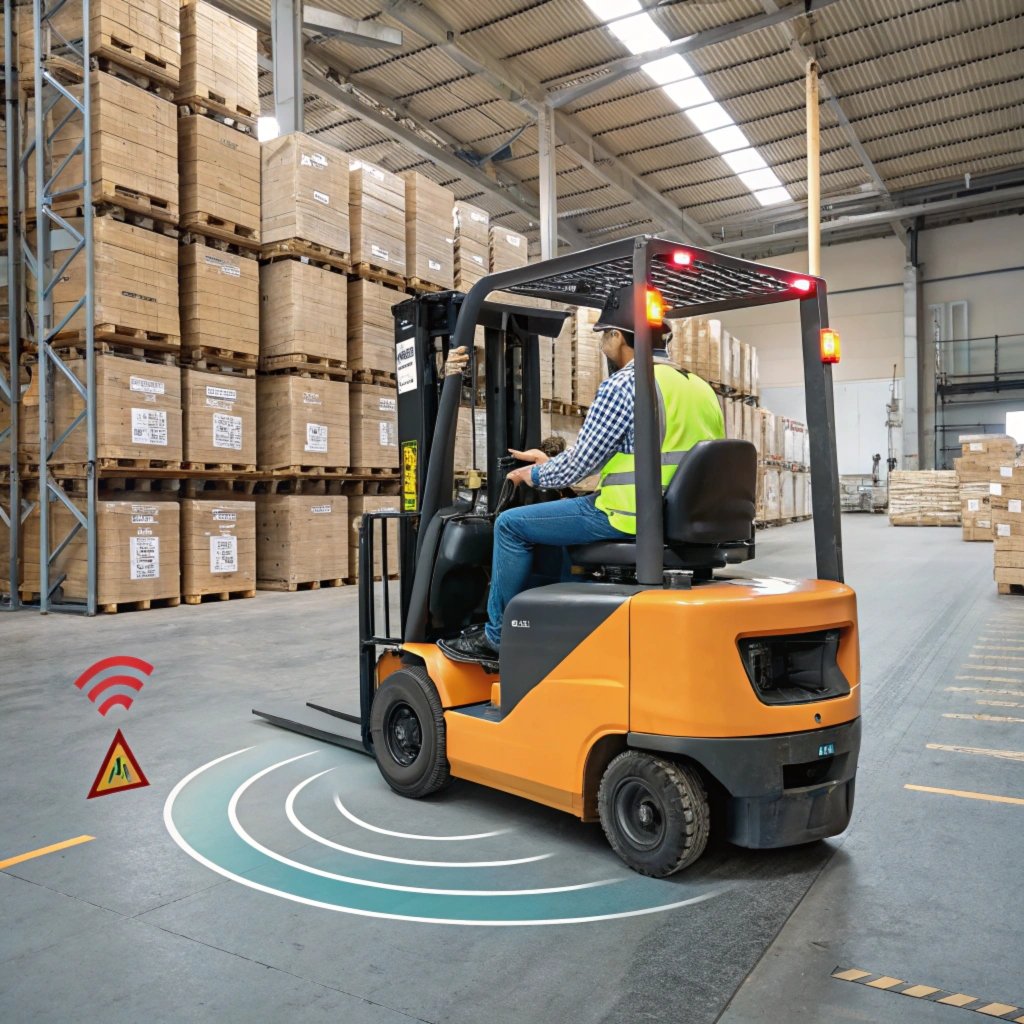
Training builds judgment; it doesn't compensate for a blind corner or a split-second timing gap that no amount of classroom instruction can fully prepare someone for. Active safety technology is the layer that catches what even a well-trained operator can still miss in the moment:
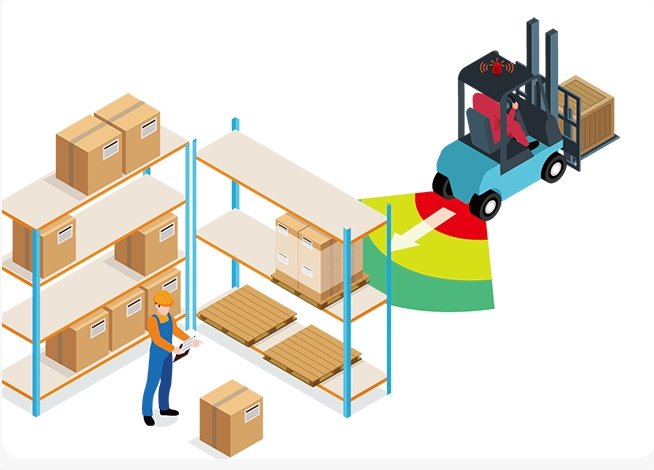
- Pedestrian detection systems alert operators the instant someone enters a blind zone, reinforcing exactly the right-of-way judgment covered in training — see forklift pedestrian safety systems.
- Anti-collision and proximity warning systems back up intersection training at the shared aisles and crossing points where forklift-to-forklift incidents concentrate — see our forklift anti-collision system and proximity warning system.
- Speed limiters enforce the safe-travel-speed rules covered in training automatically, rather than relying purely on operator discipline in high-traffic zones — see forklift speed limiter systems.
- Camera systems extend visibility around blind corners and racking, closing gaps that mirror-based training simply can't — see forklift camera systems.
- Driver fatigue monitoring catches the attention lapses that even a recently-retrained, skilled operator is statistically more prone to on long or repetitive shifts — see our driver fatigue monitoring system.
None of this replaces training. It's the difference between a program that assumes an operator will always apply what they learned perfectly, and one that has a second layer in place for the moment they don't.
Backing Your Training Program with Active Safety Technology?
We design the AI pedestrian detection, anti-collision, and speed-control systems that reinforce what your operators already learned in training — every shift, not just on evaluation day.
Talk to a Forklift Safety Specialist11. Common Training Mistakes Warehouse Managers Make
- Treating certification as a one-time box to check instead of a program with ongoing retraining triggers built in.
- Using generic training with no site-specific component — a curriculum that never mentions your actual blind corners or ramp grades is teaching half the job.
- Letting online formal instruction stand in for practical training and evaluation, which OSHA does not accept as sufficient on its own.
- Skipping pedestrian and floor-staff awareness training entirely, on the assumption that only operators need it.
- Not logging near-misses, which removes the earliest and cheapest signal that a specific operator or location needs attention.
- Assigning evaluation to whoever's available rather than someone with the experience to actually judge a skills test critically.
- Assuming a wall of certificates means the fleet is safe — a certificate proves a moment in time passed, not that the habit is still there eighteen months later.
12. Frequently Asked Questions
Tap a question to expand the answer — tap again to collapse it.
Forklift Safety Solutions Built to Back Up Your Training
Ready to Strengthen Your Forklift Safety Program?
Get a free review of your current training and technology setup from our forklift safety team.
Get Your Free Safety Review