Skip to content
What Is the OSHA Forklift Pedestrian Safe Distance?

There's no single OSHA "feet and inches" rule — the safe distance depends on speed, load, and sightlines. Here's how to work it out for your floor.
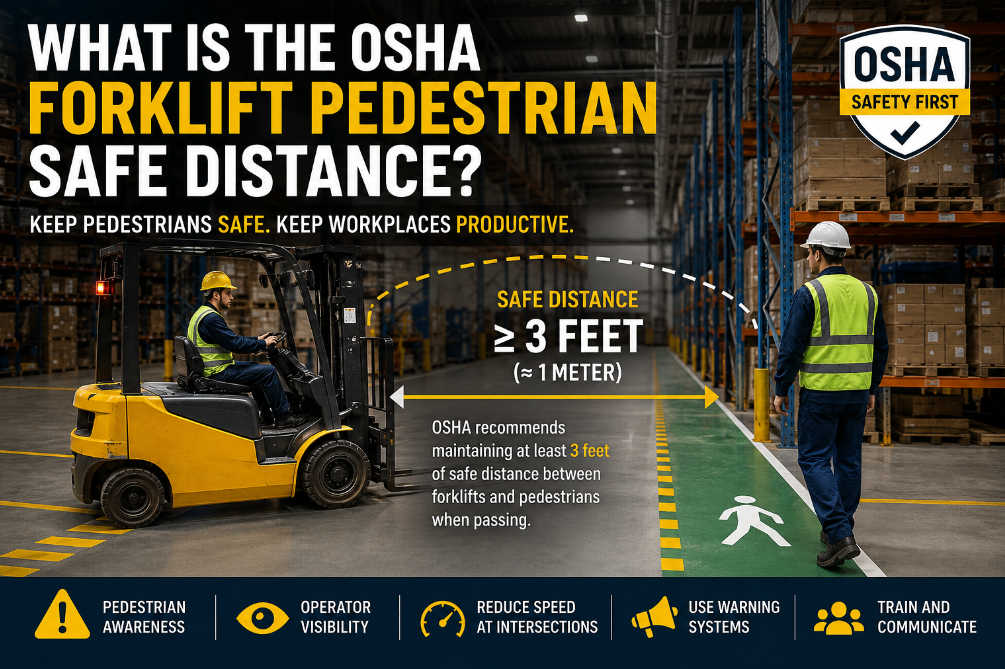
Search "OSHA forklift pedestrian safe distance" and you'll find a lot of articles confidently quoting a number — 3 feet, 4 feet, 5 feet. None of them cite an actual OSHA standard, because that number doesn't exist. What OSHA actually requires is a workplace free of recognized hazards, achieved through marked pedestrian paths, trained operators, and controls sized to the real risk on your floor — not a single distance that's supposed to work everywhere from a slow-moving pallet jam to a loaded counterbalance truck at full speed.
OSHA does not publish a fixed forklift-to-pedestrian distance in feet. Its requirements come from 29 CFR 1910.178 (powered industrial trucks), 29 CFR 1910.176(a) (marked, unobstructed pedestrian paths), and the General Duty Clause, which together require employers to control the hazard — not hit one universal number.
In practice, most safety programs still need a working number for training and signage. A commonly used baseline is roughly 3 truck lengths (about 20 feet) between forklifts, and enough clearance from an elevated load that a tip-over or falling material can't reach a pedestrian — but the right figure for your site depends on speed, load height, and how much warning your operators and pedestrians actually get.
📋 Table of Contents
- 1. The "3–4 Foot Rule" Myth — What OSHA Actually Says
- 2. The Three OSHA Standards Behind Pedestrian Safety
- 3. Why OSHA Doesn't Set One Fixed Distance
- 4. Working Distance Guidelines by Scenario
- 5. Six Factors That Change Your Safe Distance
- 6. How to Set a Site-Specific Safe Distance Policy
- 7. Physical Controls That Enforce Distance Automatically
- 8. Technology That Enforces the Distance for You
- 9. Common Mistakes Warehouses Make
- 10. FAQs
1. The "3–4 Foot Rule" Myth — What OSHA Actually Says
If you've read that OSHA "recommends 3-4 feet of clearance" between forklifts and pedestrians, it's worth knowing where that number actually comes from: nowhere official. It isn't in 29 CFR 1910.178, it isn't in an OSHA interpretation letter, and it isn't in any OSHA-published guidance document. It's a figure that's been repeated across enough safety blogs that it now reads as fact — the kind of thing that's dangerous precisely because it sounds authoritative.
The risk isn't just being technically wrong in an audit. It's that a fixed "3-4 feet is safe" number tells an operator running a loaded truck at 8 mph that the same clearance is fine as a pedestrian walking past an idle truck at a dock door — which it isn't. A safe distance changes with load, speed, and visibility, and treating it as a constant is how warehouses end up with a policy that looks compliant on paper but doesn't actually match the physics of a moving forklift.
Check where it came from. If it's not tied to your own site's forklift speeds, load heights, and sightline distances, it's likely copied from a source that copied it from somewhere else. Section 6 below walks through how to calculate a number that's actually defensible for your facility.
2. The Three OSHA Standards Behind Pedestrian Safety
OSHA's authority over forklift-pedestrian interaction comes from a combination of standards rather than one dedicated "pedestrian distance" rule. Understanding which standard covers what makes it much easier to build a policy that's actually compliant, instead of guessing at a number.
| Standard | What It Actually Requires | How It Applies to Pedestrian Safety |
|---|---|---|
| 29 CFR 1910.178 | Powered industrial truck operation, including operator training, safe operating speed, and load handling | Requires operators to slow down and maintain control in areas where pedestrians are present, and to be trained on the hazard specifically |
| 29 CFR 1910.176(a) | Permanent aisles and passageways must be kept clear and marked | The foundation for physically separating forklift traffic from foot traffic, rather than relying on distance judgment alone |
| Section 5(a)(1) — General Duty Clause | Employers must provide a workplace free from recognized hazards likely to cause death or serious injury | Used to cite employers when a forklift-pedestrian hazard was foreseeable and no reasonable control was in place — even without a distance-specific standard |
Notice what's missing from that list: a number. OSHA's approach is hazard-based, meaning an inspector isn't measuring whether a pedestrian stood 3 feet or 5 feet from a forklift — they're evaluating whether the employer had a reasonable system in place to prevent that pedestrian from being in the danger zone in the first place. That's a materially different (and higher) bar than hitting a fixed distance.
3. Why OSHA Doesn't Set One Fixed Distance
This isn't an oversight — it's deliberate, and for good reason. A single number can't account for the variables that actually determine risk:
- Forklift class and size. A 3,000 lb cushion-tire truck and a 15,000 lb pneumatic-tire truck don't carry the same danger radius, even at identical speeds.
- Load height and stability. A truck lifting to 20 feet needs a wider tip-over exclusion zone than one moving a pallet at floor level.
- Travel speed. Stopping distance increases sharply with speed — a distance that's safe at 3 mph can be inadequate at 8 mph.
- Surface and layout. Wet floors, ramps, and tight turns all extend the distance an operator needs to react safely.
- Visibility. A blind corner needs a completely different control than an open, well-lit aisle — no fixed number bridges that gap.
A regulation-mandated number that ignored all of this would either be too conservative for low-risk areas (killing productivity for no safety gain) or too permissive for high-risk ones (giving employers a false sense of compliance). OSHA's hazard-based approach forces employers to actually assess their own floor — which is more work, but it's also the only version of "safe distance" that holds up in the real world.
4. Working Distance Guidelines by Scenario
Since there's no single OSHA number, most safety programs work from a set of scenario-based guidelines instead — figures drawn from stopping-distance physics, tip-over geometry, and widely used industry practice. Treat these as a starting point for your own risk assessment, not a substitute for one.
| Scenario | Commonly Used Guideline | Why |
|---|---|---|
| Forklift-to-forklift, general aisle travel | Roughly 3 truck lengths (~20 ft) | Gives a following truck enough room to stop if the lead truck brakes suddenly |
| Pedestrian near an elevated load | Load height + roughly 5 ft of clearance | Keeps a person clear of the fall radius if a load or mast fails while raised |
| Pedestrian crossing a forklift travel path | Full stop and eye contact with the operator, not a fixed distance | At an intersection, timing and visibility matter more than a static number |
| Pedestrian walking parallel to an active forklift lane | Physically separated walkway wherever possible | Removes the judgment call entirely rather than relying on a distance estimate |
| Blind corners and doorways | Convex mirror plus mandatory horn/audible signal on approach | Sightline, not distance, is the controlling factor at a blind corner |
Of everything on this list, "load height plus about 5 feet" is the closest thing to a genuinely useful rule of thumb — because it's tied to real tip-over and fall-radius geometry, not an arbitrary round number. A forklift lifting to 15 feet needs roughly 20 feet of pedestrian clearance around the lift zone.
5. Six Factors That Change Your Safe Distance
Before you write a number into your site's safety policy, run it against these six variables. Any one of them can move your working distance up or down significantly.
- Travel speed. Stopping distance doesn't scale in a straight line with speed — it grows faster the quicker the truck is moving, so higher-speed zones need proportionally more clearance, not just a little extra.
- Load weight and height. Heavier and higher loads shift the center of gravity and widen both the tip-over zone and the operator's blind spot.
- Operator sightlines. A mast, load, or blind corner that blocks the operator's view means the pedestrian needs more distance to stay outside the danger zone, since the operator may not see them until much closer.
- Floor surface and grade. Wet, uneven, or sloped surfaces extend stopping distance and reduce steering control.
- Ambient noise and lighting. If pedestrians can't hear a horn or see a warning light clearly, the effective reaction time — and therefore the needed distance — increases.
- Pedestrian task focus. Someone actively watching for forklifts needs less margin than someone focused on a task and not scanning the aisle — which is most people, most of the time.
6. How to Set a Site-Specific Safe Distance Policy
Rather than importing a number from a blog post, walk through this process to arrive at a distance policy that actually reflects your facility and holds up if OSHA ever asks how you arrived at it.
- Map every point where forklift and pedestrian paths cross. Not just main aisles — dock doors, staging racks, and production cell entrances too.
- Record actual travel speeds at each point, not the posted limit — a quick time-and-distance check with a stopwatch is usually enough.
- Note the maximum load height and truck class operating in each zone, since that determines your tip-over exclusion distance.
- Rate visibility at each crossing point — clear sightline, partial blind spot, or full blind corner — and assign a different control to each category rather than one blanket rule.
- Set a written distance and control for each zone type, not a single facility-wide number, and put it in your safety policy with the reasoning behind it.
- Review it after any near-miss — a near-miss at a marked distance is a sign the number, the layout, or the training needs to change, not that the incident was a fluke.
This is essentially a scaled-down risk assessment applied specifically to pedestrian distance. If you haven't run a full facility risk assessment yet, our 5-step warehouse risk assessment guide walks through the same scoring approach across your entire floor, not just crossing points.
7. Physical Controls That Enforce Distance Automatically
The most reliable way to maintain a safe distance is to remove the judgment call entirely wherever you can. Physical controls do that better than any written policy, because they don't depend on an operator or pedestrian remembering a number in the moment.
- Marked and physically separated walkways — painted lines are a minimum; barriers, bollards, or guardrails are far more effective anywhere speeds or traffic volume are higher.
- Convex mirrors at blind corners — cheap and useful, but they only work if both the operator and the pedestrian happen to look at the right moment.
- Speed-restricted zones near pedestrian-heavy areas, ideally enforced automatically rather than relying on the operator's judgment under time pressure.
- Standardized horn points at every blind intersection, marked on the floor so operators sound the horn at the same spot every time, not "whenever they remember."
- High-visibility PPE for pedestrians in active forklift zones, which shortens the time it takes an operator to spot someone in a busy aisle.
Not sure your current layout actually controls the distance you've written down?
We design pedestrian detection, camera, and speed-control systems that enforce a safe forklift-to-pedestrian distance automatically — instead of relying on painted lines and operator judgment alone.
Talk to a Forklift Safety Specialist8. Technology That Enforces the Distance for You
Physical layout and training reduce risk, but both still rely on a human noticing a hazard in time. The gap between "the policy says 20 feet" and "the operator actually kept 20 feet" is exactly where active safety technology earns its place — it doesn't replace the policy, it enforces it in real time.
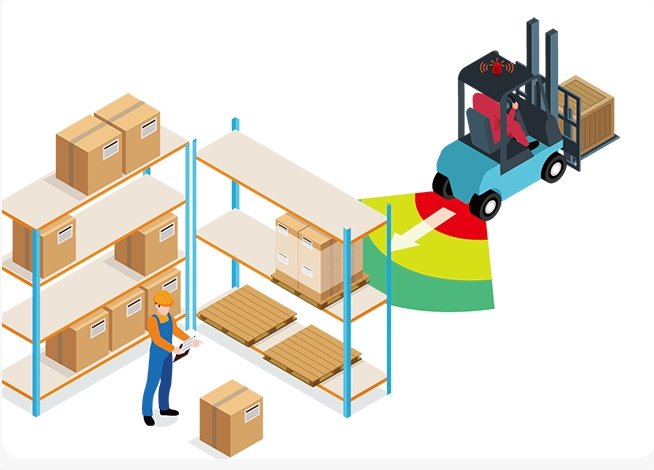
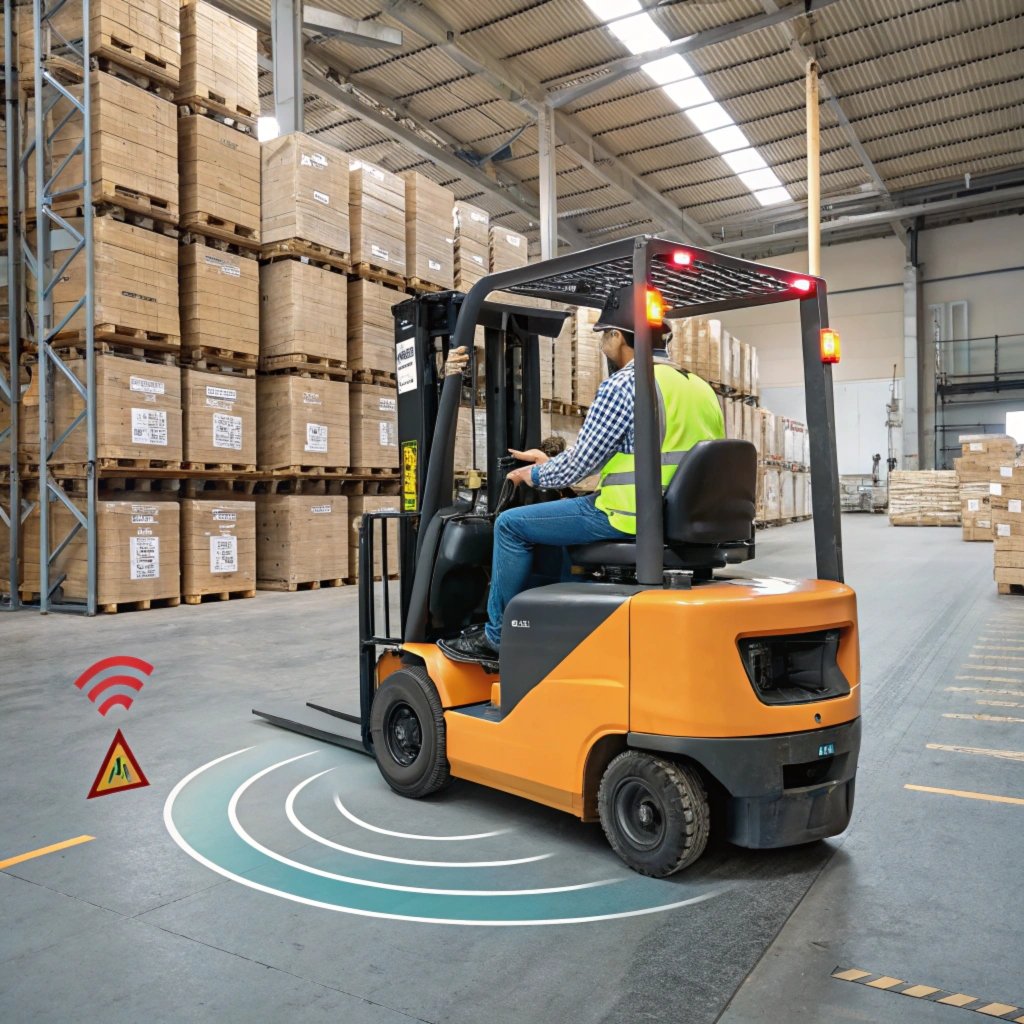
- Pedestrian detection systems alert the operator the instant a person enters a defined danger zone around the truck, regardless of whether either party was looking the right way.
- Camera systems extend the operator's field of view around loads, racking, and reversing blind spots that no mirror angle fully covers.
- Speed limiters cap travel speed automatically in pedestrian-heavy zones, directly shortening the stopping distance that your safe-distance number depends on in the first place.
- Forklift-to-forklift proximity warning covers the intersection risk between multiple trucks running the same routes, not just forklift-to-pedestrian encounters.
None of this is a substitute for a documented, site-specific distance policy — it's what makes that policy hold up under real warehouse conditions, where attention lapses and blind corners are a fact of daily operations rather than an edge case.
9. Common Mistakes Warehouses Make
- Copying a "3-4 foot" figure from a blog post into an official safety policy without checking whether it reflects actual site speeds or load heights.
- Setting one distance for the entire facility instead of different rules for high-speed lanes, dock areas, and low-traffic zones.
- Treating painted walkway lines as a complete control when higher-traffic crossings actually need a physical barrier or active alert.
- Never revisiting the number after a near-miss — a near-miss at the "approved" distance is direct evidence the distance needs to change.
- Training operators on the rule but not on why it exists — a memorized number is easier to ignore under time pressure than an understood one.
10. Frequently Asked Questions
Tap a question to expand the answer — tap again to collapse it.
No. OSHA has never published a fixed distance requirement in 29 CFR 1910.178 or any related standard. The "3-4 feet" or "5 feet" figures found on many safety sites aren't sourced from an actual OSHA regulation or interpretation letter — they're commonly repeated but unofficial. OSHA's approach is hazard-based: employers must control the risk through training, marked pathways, and safe operating practices, rather than hit one universal number.
Three main sources apply: 29 CFR 1910.178, which covers powered industrial truck operation and training; 29 CFR 1910.176(a), which requires clearly marked, unobstructed pedestrian aisles and passageways; and the General Duty Clause, which can be used to cite an employer for a foreseeable forklift-pedestrian hazard even without a distance-specific standard.
It should come from a site-specific assessment, not a borrowed number. A useful starting point is roughly load height plus 5 feet of clearance around an elevated load, and about 3 truck lengths between forklifts in general travel. From there, adjust up for higher speeds, blind corners, or poor visibility, and set separate rules for different zones rather than one facility-wide figure.
Because a single number can't account for the variables that actually determine risk — forklift class, load height, travel speed, floor surface, and visibility all change how much clearance is genuinely safe. A fixed number would either be too restrictive for low-risk areas or too permissive for high-risk ones, so OSHA requires employers to assess and control the hazard directly instead.
Yes. Pedestrian detection systems alert the operator the moment someone enters a defined danger zone, cameras remove blind spots that mirrors don't fully cover, and speed limiters automatically shorten stopping distance in pedestrian-heavy areas. These don't replace a written policy — they enforce it in situations where human attention alone isn't reliable.
Trace where the number came from. If it wasn't derived from your own site's forklift speeds, load heights, and sightlines, treat it as a placeholder rather than a validated policy. Running the six-step process in Section 6 of this guide will produce a number — or set of zone-specific numbers — that's actually defensible if it's ever questioned.
Give your safe-distance policy a layer that doesn't rely on memory
Speak with our team about pedestrian detection, camera, and speed-limiting systems built specifically for forklift fleets.
Get a Free Safety Consultation