Skip to content

Table of Contents
Understanding Forklift Geofencing: A Critical Safety Innovation
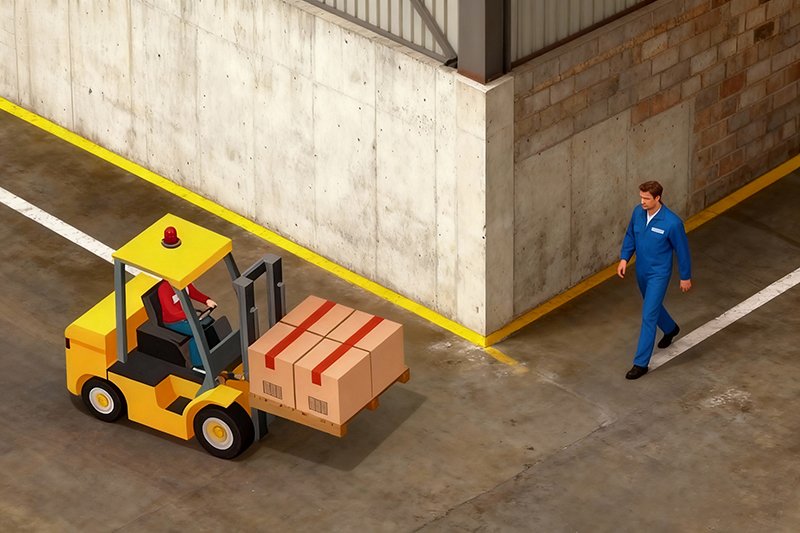
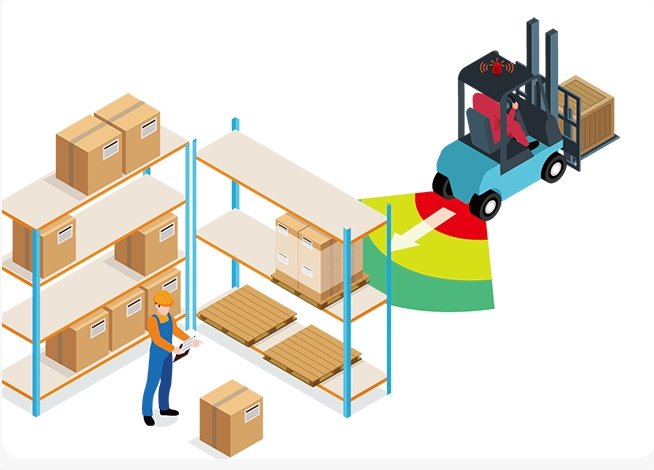
Forklift geofencing is a location-based safety system that creates virtual boundaries within warehouse and industrial environments. These invisible perimeters trigger automated alerts, speed restrictions, or equipment shutdowns when forklifts enter or exit designated zones. Think of it as an intelligent fence that doesn’t physically exist but monitors and controls forklift movement in real-time.
The primary purpose of forklift geofencing is to prevent accidents in high-risk areas such as pedestrian walkways, loading docks, chemical storage zones, or maintenance areas. When properly implemented, geofencing reduces collision incidents by up to 70% and creates a safer workflow for both operators and ground personnel.
Why Ultra-Wideband (UWB) Technology Leads the Geofencing Revolution
Ultra-Wideband technology has emerged as the gold standard for forklift geofencing, surpassing traditional GPS, RFID, and Bluetooth systems in both accuracy and reliability. UWB operates by transmitting data across a wide frequency spectrum using short-duration pulses, enabling centimeter-level positioning accuracy even in complex indoor environments.
The Technical Advantages of UWB
Precision That Matters: While GPS struggles indoors with 5-15 meter accuracy ranges, UWB delivers positioning accuracy within 10-30 centimeters. In warehouse environments where aisles may be only 3-4 meters wide, this precision difference is literally life-saving.
Penetration Through Obstacles: UWB signals can penetrate walls, metal shelving, and inventory stacks that typically block other radio frequencies. This ensures continuous tracking even in densely packed storage areas or multi-level facilities.
Real-Time Performance: UWB systems update location data 10-100 times per second, compared to 1-5 times for traditional systems. This rapid refresh rate means immediate response when a forklift approaches a restricted zone.
Interference Resistance: Unlike Wi-Fi or Bluetooth systems that share crowded frequency bands, UWB operates in dedicated spectrum space, virtually eliminating signal interference from other warehouse equipment.
Implementing a UWB Tag Based Forklift Anti-Collision System
A comprehensive UWB Tag Based Forklift Anti-Collision System consists of four integrated components working in harmony:
Hardware Infrastructure
UWB Anchors: These fixed reference points mount on warehouse walls, columns, or ceilings at 10-15 meter intervals. Each anchor continuously broadcasts timing signals that create a positioning grid across your facility. Plan for 4-8 anchors per 1,000 square meters depending on layout complexity.
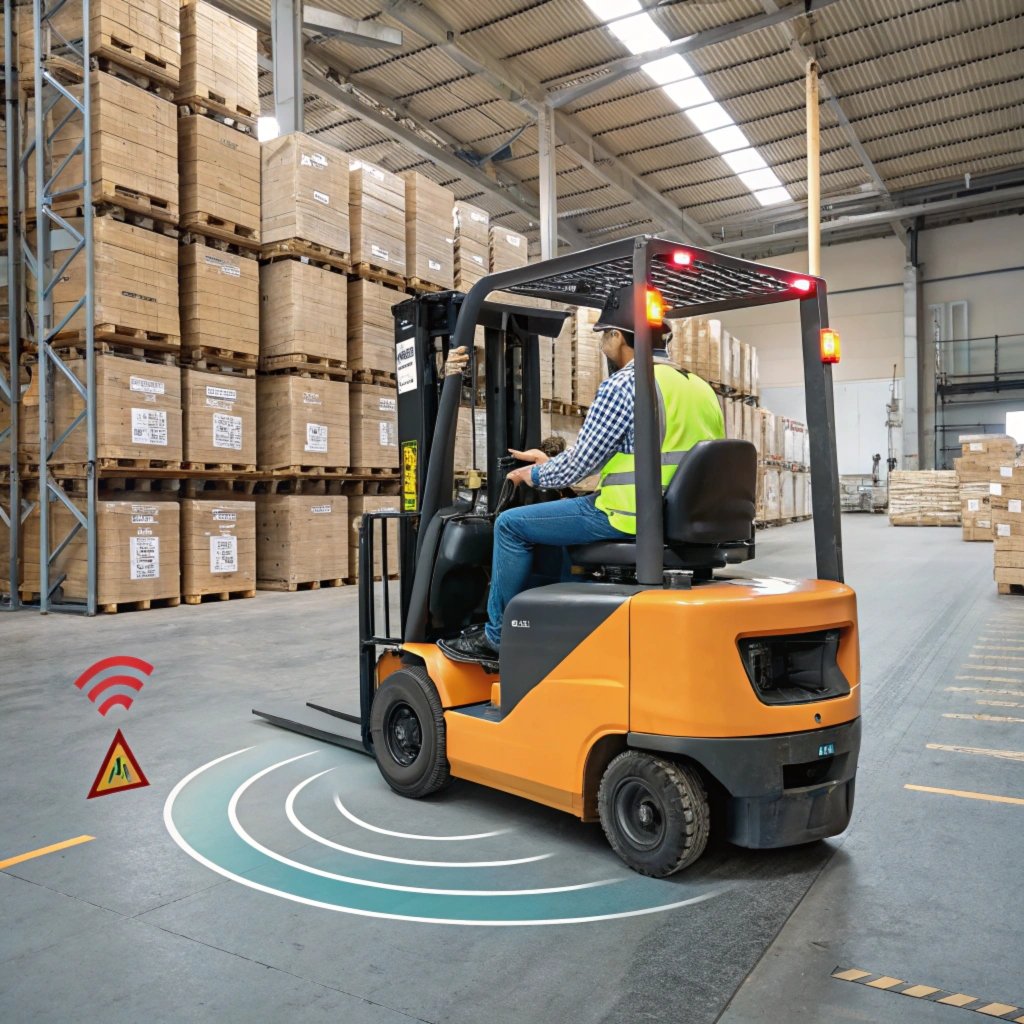
UWB Tags: Each forklift carries a compact UWB tag (typically 100-200 grams) mounted on the overhead guard. These tags communicate with anchors to triangulate precise position. Additional tags can be worn by pedestrians or attached to mobile equipment for comprehensive collision avoidance.
Alert Devices: Visual beacons (flashing lights) and audible alarms (85-95 decibel warnings) mount on forklifts and in fixed locations to provide immediate feedback when geofence violations occur.
Geofence Configuration
Modern UWB systems allow you to design multiple geofence types:
Restricted Zones: Completely off-limits areas like offices, break rooms, or hazardous material storage. Forklifts receive immediate shutdown commands upon entry.
Speed-Limited Zones: High-traffic areas where forklifts automatically reduce to 5-8 km/h, such as intersections, doorways, or blind corners.
Pedestrian Zones: Areas that trigger enhanced alerts when both forklifts and pedestrian tags are detected simultaneously.
Time-Based Zones: Flexible boundaries that activate during shift changes, lunch breaks, or maintenance windows.
Proximity Bubbles: Moving safety zones that travel with each forklift, maintaining 3-5 meter clearances between vehicles.
Software Intelligence
The UWB Tag Based Forklift Anti-Collision System brain processes millions of location data points daily through sophisticated algorithms:
Predictive Analytics: By analyzing speed, trajectory, and historical patterns, the system predicts potential collisions 3-5 seconds before they would occur, allowing proactive interventions.
Automated Reporting: Generate detailed incident logs showing near-misses, geofence violations, and operator behavior patterns. This data drives continuous safety improvements.
Heat Mapping: Visualize traffic flow throughout your facility, identifying congestion points and optimizing warehouse layouts.
Integration Capabilities: Connect with warehouse management systems (WMS), fleet management platforms, and enterprise resource planning (ERP) software for unified operations.
Implementation Best Practices
Start with Risk Assessment: Map your facility identifying high-risk zones based on incident history, traffic density, and operational hazards. Prioritize these areas for initial geofence deployment.
Pilot Program Approach: Begin with 3-5 forklifts in a single department. Gather operator feedback, refine geofence boundaries, and adjust alert sensitivity before facility-wide rollout.
Operator Training: Dedicate 2-3 hours for hands-on training covering system operation, alert response protocols, and override procedures for emergencies. Emphasize that geofencing supports rather than replaces operator judgment.
Calibration and Maintenance: Schedule quarterly anchor calibration checks and monthly tag battery replacements. Recalibrate after any facility layout changes or major equipment installations.
Progressive Enforcement: Start with warning-only mode for 30 days, allowing operators to adapt. Gradually introduce speed restrictions and then shutdown protocols as compliance improves.
Real-World Performance Metrics
Organizations implementing UWB-based forklift geofencing report measurable improvements:
- 65-75% reduction in forklift-pedestrian incidents
- 50-60% decrease in forklift-to-forklift collisions
- 40-50% reduction in product damage from zone violations
- 25-35% improvement in operator adherence to traffic patterns
- ROI achievement typically within 8-14 months through accident cost savings
Cost Considerations and ROI
Initial investment for a UWB Tag Based Forklift Anti-Collision System ranges from $15,000-$35,000 for a 50,000 square foot facility with 10 forklifts, including:
- Anchors: $500-$800 each
- Tags: $150-$300 each
- Software licensing: $2,000-$5,000 annually
- Installation and setup: $3,000-$8,000
Compare this to average forklift accident costs: property damage ($25,000-$75,000), injury claims ($50,000-$250,000), and potential fatality costs (exceeding $1 million). A single prevented serious incident typically justifies the entire system investment.
Overcoming Implementation Challenges
Challenge: Existing metal structures interfering with signals
Solution: Strategic anchor placement using 3D modeling software to optimize coverage before installation
Challenge: Operator resistance to perceived micromanagement
Solution: Transparent communication emphasizing safety benefits and involving operators in geofence boundary decisions
Challenge: Integration with legacy fleet management systems
Solution: Modern UWB systems offer API connectivity and can operate standalone if integration proves complex
Challenge: Maintaining system accuracy over time
Solution: Automated self-diagnostic features alert managers to anchor drift or tag malfunctions requiring attention
Future-Ready Technology
UWB technology continues evolving with emerging capabilities:
Autonomous Forklift Integration: UWB provides the precision positioning needed for semi-autonomous and fully autonomous forklift navigation.
Wearable Technology: Next-generation smart vests and helmets with embedded UWB tags protect pedestrians with sub-second collision warnings.
AI-Powered Optimization: Machine learning algorithms analyze geofence violation patterns and automatically suggest boundary adjustments for improved workflow.
5G Integration: Combining UWB positioning with 5G connectivity enables cloud-based processing for multi-facility monitoring from centralized control centers.
Taking the Next Step
Implementing forklift geofencing through UWB technology represents a fundamental shift from reactive to proactive safety management. The precision, reliability, and scalability of UWB Tag Based Forklift Anti-Collision Systems make them the clear choice for organizations serious about eliminating forklift accidents.
Begin your geofencing journey by conducting a thorough site assessment, engaging stakeholders from operations to safety teams, and partnering with experienced UWB solution providers who offer ongoing support. The investment in this technology isn’t just about compliance or cost savings—it’s about ensuring every employee returns home safely at the end of their shift.
Your warehouse can transform from a space where accidents happen to an environment where accidents become virtually impossible through intelligent, invisible boundaries that work tirelessly to protect your most valuable assets: your people.
More Articles
Check the following for more articles.