Skip to content
Explosive Storage Warehouse Management: The Complete Safety & Compliance Guide
A practical, field-tested guide for warehouse managers responsible for storing explosives — covering classification, magazine design, quantity-distance rules, forklift operations, and the daily habits that keep a site inspection-ready.

A well-managed explosive storage site separates magazines by compatibility group and maintains clear quantity-distance buffers between buildings.
Running an explosive storage warehouse is not like running any other warehouse. One misfiled compatibility group, one forklift that gets too close to the wrong magazine, or one gap in your inspection log can turn into a catastrophic incident — or a shutdown order. This guide pulls together the operational side of the job: how to organize your site, what your storage records actually need to show, and where most managers quietly fall behind on compliance without realizing it.
- What Counts as "Explosive Storage" — And Who Regulates It
- Explosive Classification & Compatibility Groups
- Site Layout: Quantity-Distance & Magazine Separation
- Magazine Construction & Storage Conditions
- Material Handling & Forklift Safety Inside the Storage Area
- Inventory Control & Recordkeeping
- Daily, Weekly & Annual Inspection Routine
- Security, Access Control & Theft Prevention
- Emergency Planning & Fire Response
- 5 Compliance Mistakes That Trigger Citations
- Frequently Asked Questions
What Counts as "Explosive Storage" — And Who Regulates It
Before setting policy, it helps to be precise about what your site is legally holding. "Explosives" as a storage category covers a wide range of materials — commercial blasting agents, detonators, propellants, pyrotechnics, ammunition components, and certain oxidizers — each carrying different handling rules. Most facilities in the U.S. answer to a stack of overlapping authorities rather than a single rulebook.
- ATF (Bureau of Alcohol, Tobacco, Firearms and Explosives) — federal licensing, magazine construction standards, and quantity-distance tables under 27 CFR Part 555.
- OSHA — workplace exposure and handling rules under 29 CFR 1910.109.
- NFPA 495 — the Explosive Materials Code, widely adopted as the technical baseline for siting and storage.
- DOT — governs the transport of explosives to and from your site, including placarding and segregation during loading.
- State fire marshal & local AHJ — often layer additional permit and inspection requirements on top of federal rules.
Don't manage to a single standard. Build your site procedures around the strictest applicable requirement across ATF, OSHA, NFPA 495, and your local AHJ — inspectors will cite whichever rule is more conservative, not whichever one is more convenient for you.
Explosive Classification & Compatibility Groups
The single most common root cause of explosive storage incidents isn't a faulty magazine — it's incompatible materials stored together. Every explosive is assigned a hazard division (1.1 through 1.6) and a compatibility group letter (A through S), and the compatibility group is what actually tells you which materials can share a magazine.
Primary Explosives
Extremely sensitive; requires isolated, dedicated storage — never co-located with any other group.
Propellants
Includes many boosters and propelling charges; compatible with limited groups only.
Secondary Detonating Substances
Bulk explosives, TNT, and similar — the most common bulk-storage group.
Pyrotechnic Substances
Includes illuminating, incendiary, and smoke-producing devices; distinct fire behavior from Group D.
Special Hazard Materials
White phosphorus and similarly reactive items; almost always requires standalone storage.
Very Insensitive Substances
Lowest explosion risk of the group letters, but still subject to quantity limits.
Site Layout: Quantity-Distance & Magazine Separation
Quantity-distance (Q-D) tables are the backbone of explosive site design. They set the minimum separation between a magazine and inhabited buildings, public roadways, and other magazines, scaled to the net explosive weight (NEW) stored. Two categories matter most day-to-day:
- Inhabited Building Distance (IBD) — minimum separation from occupied structures outside your site.
- Intermagazine Distance (IMD) — minimum separation between your own storage magazines, so a detonation in one doesn't propagate to another.
As your stored quantity grows, required distances grow with it — which is why an expanding operation often needs a site re-survey, not just a bigger magazine. If you've added storage capacity, changed compatibility groups on-site, or increased net explosive weight limits since your last permit was issued, your Q-D distances may no longer be compliant even if nothing about the buildings themselves has changed.
| Site Element | What It Protects | Review Trigger |
|---|---|---|
| Inhabited Building Distance | Offices, control rooms, public roads outside the site | Any NEW increase or new occupied structure nearby |
| Intermagazine Distance | Adjacent magazines from propagation | Adding, relocating, or resizing any magazine |
| Barricades / Berms | Line-of-sight blast and fragment shielding | Erosion, vegetation growth, or structural damage |
| Perimeter Fencing | Unauthorized entry & vehicle intrusion | Annual inspection; after any breach or storm |
Magazine Construction & Storage Conditions
Magazine type (typically Type 1 through Type 4 under ATF classification) dictates permissible construction, security hardware, and how much explosive material can legally be stored inside. Regardless of type, a few conditions apply across almost every facility:
- Non-sparking tools and hardware used for all work inside or near the magazine
- Grounded, explosion-proof electrical fixtures where lighting is required
- Ventilation sufficient to prevent heat and vapor buildup, especially in summer months
- Stock rotated on a strict first-in, first-out basis to avoid aging beyond shelf-life limits
- Stacking height and aisle clearance kept within the magazine's engineered load limits
- No smoking materials, open flame, or unauthorized electronics carried past the perimeter line
Temperature and humidity logs are frequently treated as optional. For heat-sensitive explosives, undocumented temperature excursions are one of the fastest ways to lose product traceability during an incident investigation — log conditions even when nothing seems unusual.
Material Handling & Forklift Safety Inside the Storage Area
Most explosive storage incidents involving vehicles don't happen during detonation events — they happen during routine material handling, when a forklift strikes a rack, a pedestrian steps into a blind spot, or a load is dropped near stored product. Because standard electrical components can generate the exact ignition source your magazine is designed to keep out, every powered piece of handling equipment operating in or near a magazine needs to be treated as part of your hazard control plan, not just your logistics plan.
Equipment requirements inside classified areas
- Only forklifts and cameras rated for the site's hazardous area classification (Class II for most dust and particulate-heavy explosive environments) should enter magazine zones — see our guide on intrinsically safe vs. explosion proof equipment for how to choose the right protection method.
- Standard, non-rated cameras and sensors should never be retrofitted onto forklifts used inside magazine areas, even temporarily.
- Speed inside storage aisles should be mechanically limited, not left to operator discipline alone — low-speed impacts are still enough to shift stacked product or damage packaging integrity.
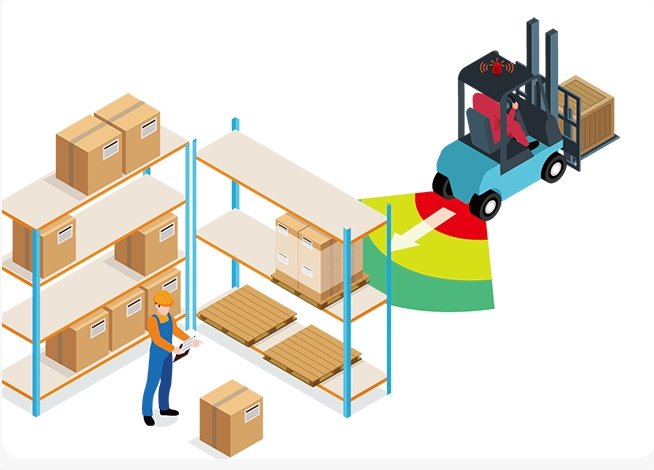
- Pedestrian detection at magazine entrances reduces the single most common trigger for handling incidents: a worker on foot entering a blind corner as a loaded forklift turns.
An explosion-proof forklift camera system gives supervisors visibility into aisle activity without introducing an unrated electrical component into the hazard zone — which matters if your site's permit conditions restrict what equipment can physically operate near stored explosives.
Auditing forklift equipment for your explosive storage site? We can help you match the right protection class to your zones.
Talk to a Safety SpecialistLoading dock & transfer point control
The transfer point between a delivery vehicle and the magazine is where explosives are most exposed — out of their storage packaging, in motion, and often handled under time pressure. Treat the dock as its own controlled zone: restrict it to trained personnel only during active transfers, keep non-essential vehicle traffic clear, and never stage incoming and outgoing lots from different compatibility groups at the same dock simultaneously.
Inventory Control & Recordkeeping
Your inventory log is the document an investigator or inspector will ask for first. A magazine's physical contents should match its paper (or digital) record at all times — not "close enough," but exact, down to lot number and net explosive weight.
| Record | What to Track | Retention |
|---|---|---|
| Daily Magazine Log | Opening/closing time, person present, quantity in/out | Per ATF/state minimum, typically 5+ years |
| Receiving Record | Lot number, compatibility group, NEW, supplier, transport manifest | Life of the lot + retention period |
| Disposition Record | Where each lot went — sold, used, destroyed, transferred | Matches receiving record retention |
| Environmental Log | Temperature, humidity, any excursions or corrective action | Site policy, commonly 1–3 years |
Reconcile physical counts against your log on a fixed schedule — weekly is standard for high-turnover sites. A discrepancy caught in week one is a paperwork correction; the same discrepancy discovered during an ATF compliance inspection is a license risk.
Daily, Weekly & Annual Inspection Routine
Inspection frequency should scale with risk, not convenience. A workable baseline most sites can build from:
- Daily: Magazine doors and locks secure, no visible damage, housekeeping clear of debris, log entries current
- Weekly: Physical inventory reconciliation, fire extinguisher pressure check, ventilation function, lightning protection continuity spot-check
- Monthly: Barricade and fencing condition, grounding system resistance test, magazine roof and drainage inspection
- Annual: Full Q-D distance re-verification, electrical system certification renewal, third-party compliance audit
Photograph inspection findings, not just checkbox forms. A dated photo of a barricade before and after erosion repair is far more persuasive to an inspector — and far more useful to you — than a written note alone.
Security, Access Control & Theft Prevention
Explosives theft is treated as a serious federal matter, and your access controls are audited as closely as your storage conditions. At minimum, most jurisdictions expect:
- Two-person integrity for magazine access — no single individual should have unsupervised entry to high-hazard storage
- Logged access with time, identity, and purpose for every entry
- Perimeter lighting and intrusion detection appropriate to the site's classification and remoteness
- A documented, tested notification chain for suspected theft or loss, including required timelines for reporting to ATF
Access control and material-handling safety overlap more than most managers expect — a forklift access control system that restricts equipment operation to authorized, trained operators closes a gap that a padlock on the magazine door alone doesn't cover.
Emergency Planning & Fire Response
A fire response plan for explosive storage is fundamentally different from a standard warehouse fire plan — in many cases, the correct response to a fire near explosives is controlled evacuation and standoff, not direct firefighting, because the risk of propagation can outweigh the value of suppression.
- Pre-established evacuation distances specific to each magazine's stored NEW, not a single site-wide radius
- Local fire department briefed in advance on which magazines can be safely approached and which require standoff-only response
- Clearly marked, unobstructed evacuation routes leading away from — not past — other magazines
- Mutual aid agreements and mass-notification systems tested at least annually
5 Compliance Mistakes That Trigger Citations
- Co-locating incompatible groups "temporarily" — overflow storage during a busy receiving period is one of the most common root causes inspectors cite.
- Letting Q-D distances go unreviewed after expansion — adding a single new structure nearby can silently invalidate an existing permit.
- Treating environmental logs as optional — missing temperature/humidity records are an easy, avoidable finding.
- Using unrated equipment "just for a quick job" inside a magazine zone — a single unrated tool or camera undermines an otherwise compliant hazard classification.
- Inconsistent access logs — gaps or shared credentials are treated as a security failure even if no material was actually lost.
Protecting Your Explosive Storage Site Starts on the Ground
From explosion-proof forklift cameras to pedestrian detection at magazine entrances, our team helps warehouse and EHS managers close the equipment gap between storage compliance and daily material handling.
Get a Free Safety ConsultationFrequently Asked Questions
How often should an explosive storage magazine be inspected?
Can different compatibility groups ever share the same magazine?
Do forklifts operating near explosive storage need special certification?
What triggers a re-survey of quantity-distance requirements?
What's the biggest recordkeeping mistake explosive storage sites make?
This guide is intended as general operational reference for warehouse and EHS managers and does not replace your site's ATF license conditions, NFPA 495 requirements, or guidance from your local Authority Having Jurisdiction. Always confirm current federal, state, and local requirements before making changes to storage, quantity, or site layout.