Skip to content

6 Common Forklift Operator Mistakes Caught on Camera — And the Technology That Prevents Them
A widely viewed forklift safety training video captures six mistakes that happen on warehouse floors every day — mistakes experienced operators make even when they know better. The video's advice is solid, but it depends entirely on the operator remembering the rule in the moment. Below, we break down each mistake with the exact video timestamp, then show how AI-based anti-collision technology closes the gap that human memory and attention can't always cover.
Quick Navigation
Why "just follow the rules" isn't enough
Every mistake below is a known rule the operator already understood. Fatigue, time pressure, and repetition still cause the same errors to happen again — because the safeguard exists only in the operator's memory.
What changes when technology backs it up
Sensors, cameras, and automatic alerts don't get tired or distracted. They enforce the same rule every single time, regardless of how the operator is feeling that shift.
Failing to Stop and Sound Horn at Aisle Exit
 Watch mistake: 00:33 – 00:59
 What happens: The operator exits an aisle without stopping or sounding the horn, giving nearby pedestrians no warning before the forklift crosses their path.
The technology solution
Forklift Arc / Blue Light
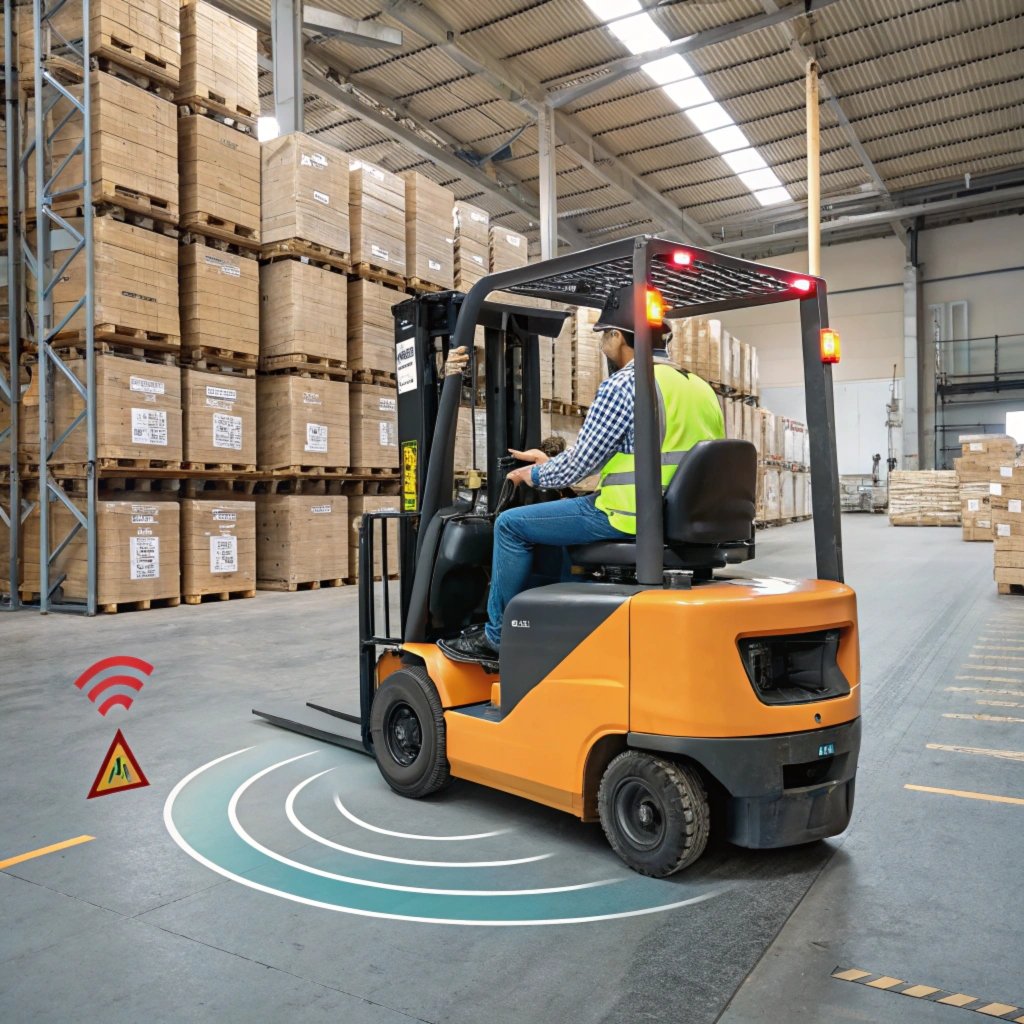
Projects a bright blue spot or arc onto the floor ahead of the truck, warning pedestrians around blind corners before the forklift itself is visible.
View product →Solar Siren Alarm
Mounted at aisle exits and intersections, it triggers an audible alert up to 120dB plus a visible flash whenever a vehicle approaches — no horn press required.
View product →Not Wearing a Seat Belt
Watch mistake: 01:37 – 01:58 What happens: The operator starts moving the forklift without buckling the seat belt, removing the single most effective protection against being thrown from the seat during a tip-over.
The technology solution
Seat Belt Warning System
Monitors the buckle status in real time and sounds an alarm — or disables ignition and travel entirely — until the belt is fastened, so compliance isn't optional.
View product →Failing to Check Surroundings Before Reversing
Watch mistake: 02:37 – 02:53 What happens: The operator reverses without checking behind or around blind spots first — one of the leading causes of pedestrian strike incidents in warehouses.
The technology solution
Radar Reversing Detection
Detects pedestrians and obstacles within roughly 3 meters behind the truck and delivers combined voice and buzzer alerts before contact is possible.
View product →Blind Spot Safety Camera
Streams a high-definition rear view with AI pedestrian recognition, so the blind spot the operator can't physically see is covered automatically.
View product →Overspeeding in the Warehouse
Watch mistake: 04:12 – 04:23 What happens: Driving too fast for aisle and floor conditions raises the risk of skidding, tipping, or losing control, especially with a raised or heavy load.
The technology solution
Forklift Speed Limiter
Provides three layers of protection: audible warning, visual warning, and a hard physical cap on top speed, so overspeeding stops being a judgment call.
View product →Driving Forward with an Obscured Load
Watch mistake: 05:28 – 05:41 What happens: The operator drives forward when a tall or bulky load blocks forward visibility, instead of traveling in reverse as trained.
The technology solution
AI Pedestrian Detection System
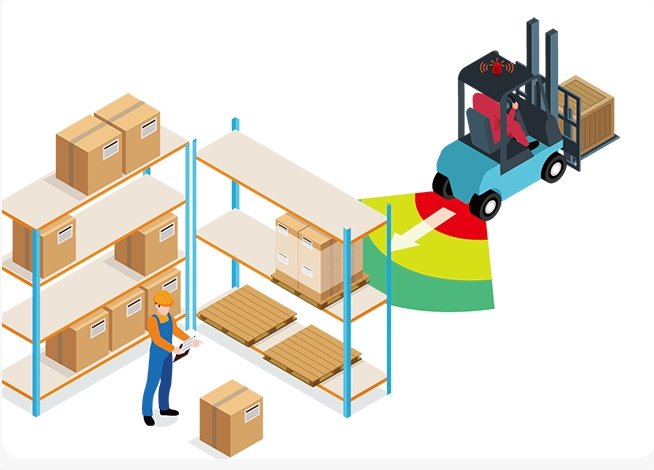
Automatically senses pedestrians in front of the truck — even when the operator's own view is blocked by the load — and triggers real-time visual, audible, or braking response.
View product →Using a Cell Phone While Driving
Watch mistake: 07:08 – 07:34 What happens: Texting or using a phone while operating the truck pulls attention away from the surroundings — a distraction risk no rule reminder can fully prevent on its own.
The technology solution
DMS Driver Monitoring System
An AI-powered camera detects distracted driving behavior — phone use, calling, smoking — and issues an immediate voice alert the moment it happens.
View product →Forklift Access Control System
Pairs operator authentication with black-box behavioral logging, so accountability doesn't depend on a supervisor happening to walk by.
View product →One Distracted Moment Shouldn't Decide the Outcome
Training and reminders reduce these mistakes — they don't eliminate them. Pairing your safety program with anti-collision, monitoring, and warning systems means the mistake gets caught even on the operator's worst shift.
Frequently Asked Questions
Tap a question to expand the answer — tap again to collapse it.
No — training stays essential for teaching the rules in the first place. Anti-collision technology is a backup layer that catches the moments when training alone isn't enough, such as fatigue or a lapse in attention.
Most of these systems are designed to retrofit onto existing forklifts regardless of brand, including electric and internal-combustion models. Confirm compatibility with your specific make and model before ordering.
It depends on your layout and risk points. A facility with blind intersections benefits most from arc lights and sirens, while one with high pedestrian traffic near the dock benefits most from pedestrian detection and driver monitoring. A walkthrough of your site is the fastest way to prioritize.
Most of these devices are designed for straightforward installation that can be completed without pulling a forklift out of service for an extended period. Exact installation time varies by product and vehicle type.