Skip to content
How Forklift Anti-Collision Systems Work
A plain-English breakdown of the sensors, alerts, and logic behind modern forklift safety technology — written for warehouse managers who need to know how it actually protects a floor.

Most people who search for "forklift anti-collision system" already believe the technology works — what they actually want to know is how it works, so they can judge whether it will hold up on their own floor. This guide walks through the full detection-to-alert cycle step by step, compares the four technologies doing the detecting, and explains how to fit an anti-collision system into a warehouse safety program that already includes training, layout, and procedures.
1. What Is a Forklift Anti-Collision System?
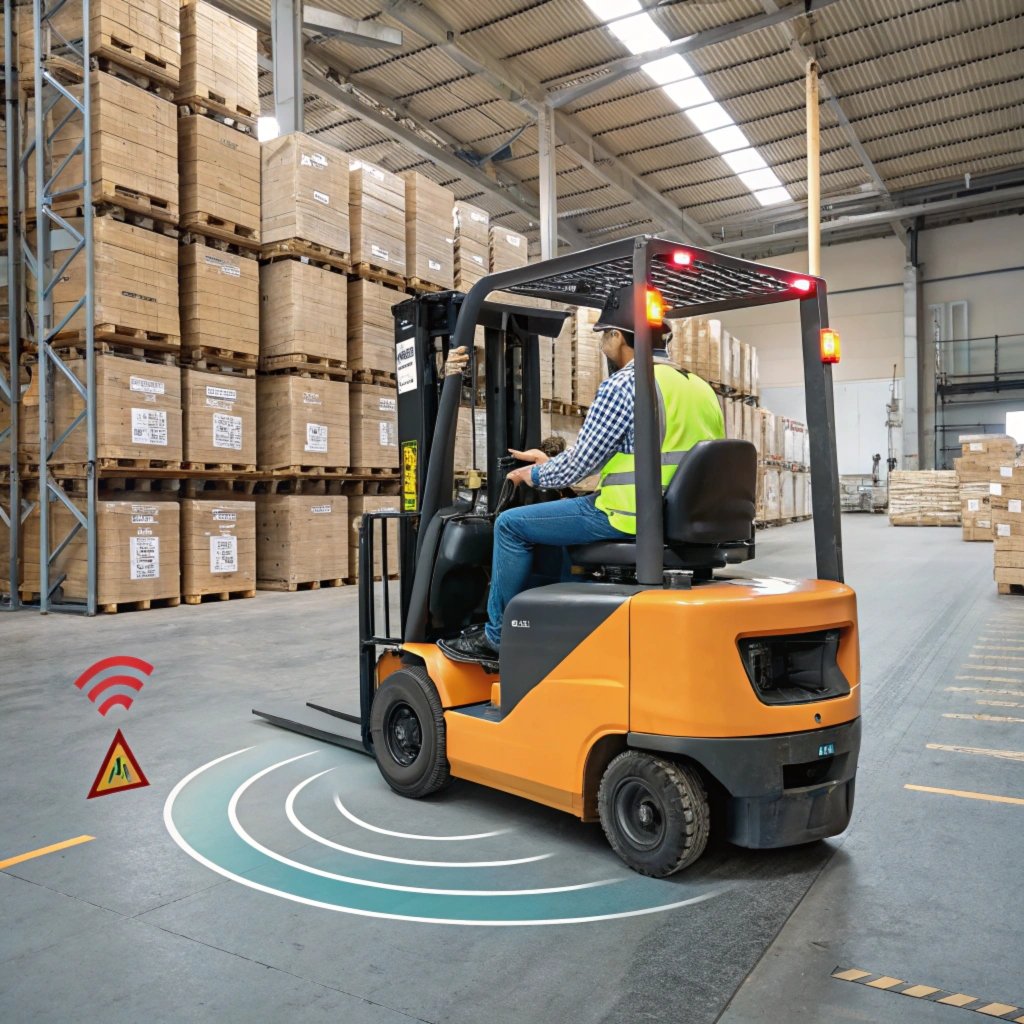
A forklift anti-collision system is a set of sensors, tags, or cameras mounted on a forklift (and sometimes worn by pedestrians) that continuously measures the distance between the truck and anything around it — other forklifts, people on foot, racking, or fixed obstacles — and warns the operator, the pedestrian, or both before the gap closes to a dangerous distance.
The core idea is simple: a forklift operator can only react to what they can see, and in a working warehouse, they can't see everything. A loaded pallet blocks the forward view. A rack end blocks the cross-aisle. A worker stepping backward out of a pick face is invisible until the last second. Anti-collision systems exist to close that gap between what an operator can physically see and what they need to know to stop in time.
An anti-collision system replaces "I hope I see them in time" with "the system tells me the instant they're close enough to matter" — and that shift is what actually prevents the accident.
2. The Detection-to-Alert Cycle: How It Actually Works
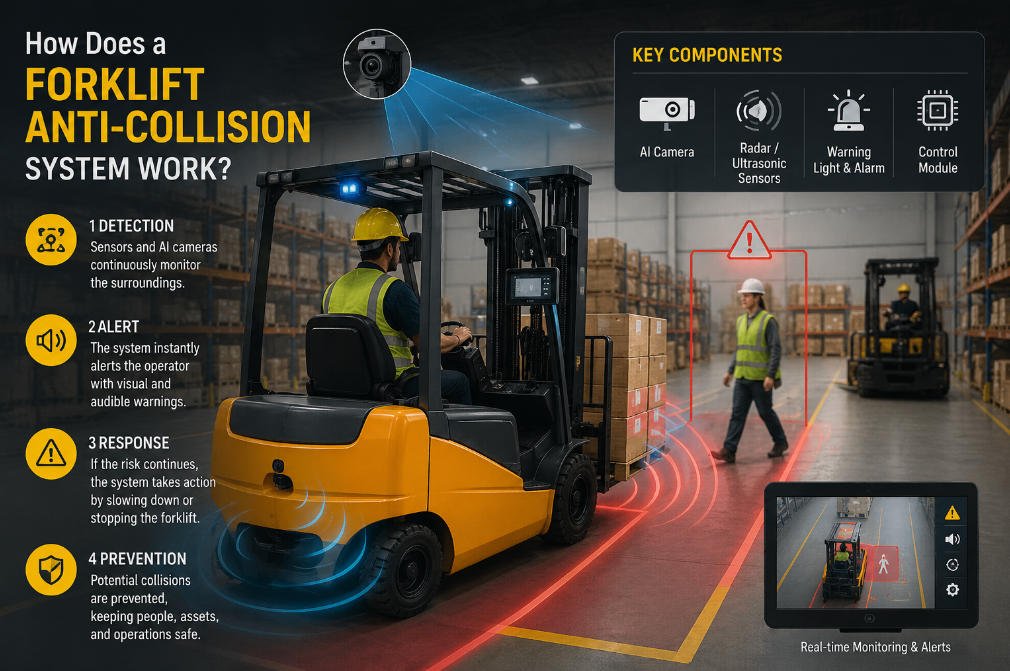
Regardless of which technology is behind it, almost every forklift anti-collision system runs the same four-stage cycle, repeated many times per second while the truck is powered on. Understanding this cycle is the fastest way to understand the whole category of product.
Sense
A sensor, tag, or camera continuously scans the space around the forklift for people, vehicles, or objects.
Measure
The system calculates distance, direction, and closing speed relative to the forklift, updated in real time.
Decide
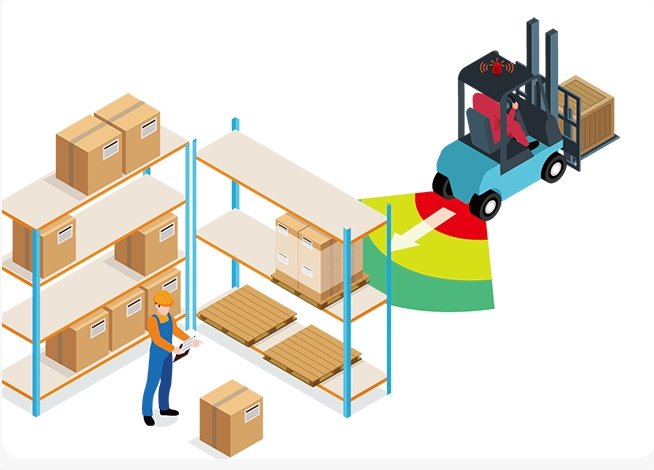
Onboard logic checks that measurement against pre-set danger and caution zones around the truck.
Alert
If a zone is breached, the system fires a warning — light, sound, vibration, or a speed/brake command.
The technical details differ by system — a UWB tag and an AI camera don't "see" the world the same way — but every commercial anti-collision system is, at its core, a loop that senses, measures, decides, and alerts, fast enough that the alert still gives the operator or pedestrian time to react. That reaction window is really the entire point: a system that detects a hazard but alerts too late is not meaningfully different from having no system at all.
3. The Four Detection Technologies Explained
There isn't one single way to build a forklift anti-collision system — there are four common approaches on the market today, and most facilities end up combining more than one. Here's what each one is actually doing under the hood.
Ultra-Wideband (UWB) Tag-Based Detection
UWB systems give a small radio tag to every forklift and, often, every pedestrian who works near forklift traffic. The tags exchange radio pulses with each other or with fixed anchor points, and the system calculates distance from the time it takes those pulses to travel back and forth — a method that's accurate to roughly 10–30 centimeters even through dust, poor lighting, or partial obstruction. Because it's tag-to-tag, a UWB-based system is particularly strong at forklift-to-forklift and forklift-to-tagged-pedestrian detection, though it can't detect an object or person who isn't wearing a tag.
AI Camera-Based Detection
Camera-based systems mount one or more cameras on the forklift and run computer-vision models that identify human shapes in the live video feed, in real time, without requiring the pedestrian to wear anything. Because it's visual, this approach is the only one of the four that reliably detects an untagged person — a visitor, a contractor, or anyone who forgot to clock in with a tag. The trade-off is that performance depends on line of sight, so a camera-based system works best when paired with well-placed camera angles rather than relying on a single forward-facing unit.
Millimeter-Wave Radar Detection
Radar-based systems send out radio waves and measure how they bounce back off nearby objects, which lets them detect people, vehicles, and solid obstacles alike — tagged or not — and keep working reliably in dust, fog, low light, or direct sun glare that can challenge a camera. A radar-based system is generally the most weather- and lighting-resilient of the four, which makes it a common choice for outdoor yards, loading docks, and covered but unheated storage.
Ultrasonic Sensor-Based Detection
Ultrasonic sensors send out high-frequency sound pulses and measure the time it takes the echo to return, similar in principle to a car's parking sensors. They're a lower-cost, shorter-range option — typically a few meters — best suited to close-quarters blind-spot warning near the rear or sides of the truck rather than long-range detection down an aisle. An ultrasonic-based system is often the entry point for sites adding their first layer of collision protection.
4. Technology Comparison: UWB vs Camera vs Radar vs Ultrasonic
No single technology wins on every criterion, which is exactly why many warehouses layer two together — commonly UWB for forklift-to-forklift detection plus a camera or radar system for untagged pedestrians. Use the table below to see where each one is strongest.
| Technology | Detects Untagged People? | Typical Range | Weather / Light Resilience | Best Fit |
|---|---|---|---|---|
| UWB Tag-Based | No (tag required) | Up to ~30–50m | Excellent | Forklift-to-forklift, tagged-pedestrian zones |
| AI Camera-Based | Yes | ~5–15m per camera | Good (light/angle dependent) | Pedestrian detection without tags, blind corners |
| Millimeter-Wave Radar | Yes | ~10–30m | Excellent | Outdoor yards, docks, dusty or low-light areas |
| Ultrasonic Sensor | Yes | ~1–5m | Good indoors | Close-range blind-spot warning, entry-level setups |
Not sure which detection technology fits your floor plan? Our team can review your layout and recommend the right mix.
Get a Free Layout Review5. Forklift-to-Forklift vs Forklift-to-Pedestrian vs Forklift-to-Object
"Anti-collision system" is really an umbrella term covering three distinct risk pairings, and a complete safety setup usually needs to address all three rather than assuming one system covers everything.
- Forklift-to-forklift. Two trucks converging on the same intersection or blind corner. UWB proximity systems handle this well because both trucks carry a tag and can warn each other directly, well before either driver has a clear sightline.
- Forklift-to-pedestrian. The highest-severity pairing, and the one pedestrian safety systems are purpose-built for. This is where camera-based detection earns its keep, since it can catch a pedestrian who isn't wearing a tag at all.
- Forklift-to-object. Racking, parked equipment, dock plates, and stationary obstacles. Radar and ultrasonic sensors are generally the better fit here, since there's no tag to detect — only a physical object to measure distance to.
6. What Happens the Instant a Risk Is Detected
Detecting a hazard is only useful if the system does something with that information fast enough to matter. Most anti-collision systems respond in layers, escalating as the distance closes rather than firing one generic alarm at a fixed range.
- Caution zone alert. At the outer boundary — often several meters out — the operator gets a low-intensity warning: a light on the dashboard, a soft tone, or a subtle in-cab indicator. This is a "be aware," not a "stop now" signal.
- Danger zone alert. As the gap tightens, the alert escalates — a louder alarm, a flashing warning light, and in pedestrian-facing setups, an external light or sound aimed at the pedestrian themselves, so both parties get the warning independently.
- Automated intervention (optional). On systems integrated with the truck's controller, crossing the innermost boundary can trigger automatic speed reduction or braking, layered on top of the audible and visual alerts rather than replacing them.
A system that alerts constantly for low-risk situations trains operators to tune it out — which defeats the purpose the first time it matters. Zone distances should be configured for the specific aisle widths and traffic patterns of your facility, not left on a generic factory default.
7. Where Anti-Collision Systems Fit Into a Warehouse Safety Program
An anti-collision system is a layer, not a complete safety program on its own. It works best sitting alongside the fundamentals that already reduce risk before a sensor ever fires:
- Operator training and certification that's refreshed on a schedule, not just at hire.
- A facility layout that separates forklift and pedestrian paths wherever it physically can.
- Documented pre-shift inspections, including a functional check of the anti-collision hardware itself.
- A near-miss reporting habit, since anti-collision systems generate useful event data that can show exactly where close calls keep happening.
Put those together, and the technology stops being a standalone gadget and becomes what it's actually meant to be: a second, independent layer of protection that catches the split-second situations training and layout alone can't fully cover.
Ready to See Which System Fits Your Warehouse?
We design and install UWB, AI camera, radar, and ultrasonic anti-collision systems for warehouses and manufacturing floors — tell us about your layout and we'll recommend the right combination.
Talk to a Forklift Safety Specialist8. How to Choose the Right System for Your Warehouse
There's no single "best" anti-collision system — only the right combination for your specific floor. A few questions narrow it down quickly:
- Do you need to detect untagged people? If visitors, contractors, or rotating staff move through your forklift zones, camera or radar detection matters more than a tag-only setup.
- Is your risk mostly forklift-to-forklift, or forklift-to-pedestrian? High-traffic intersections between multiple trucks lean toward UWB; busy pick faces with lots of foot traffic lean toward camera-based pedestrian detection.
- Indoor, outdoor, or both? Outdoor yards and unheated docks favor radar's weather resilience over camera-only setups.
- What's your rollout budget and timeline? Ultrasonic and camera kits are typically faster and cheaper to retrofit onto an existing fleet than a full tag-based UWB deployment.
Most facilities land on a layered answer — a primary technology for the majority of the floor, supplemented by a second, cheaper technology at the specific blind corners or intersections that carry the most risk.
9. Common Mistakes When Deploying Anti-Collision Technology
Treating one technology as a complete solution. A tag-only system won't catch an untagged visitor; a camera-only system won't catch a fast-closing forklift around a blind corner behind it.
Leaving zone settings on factory defaults. A caution zone tuned for a wide distribution aisle will feel wrong — either too sensitive or not sensitive enough — in a tight manufacturing floor.
Skipping the operator buy-in conversation. Operators who see the system as a nuisance will find ways to work around it; operators who understand why it's there are far more likely to trust the alerts.
Never reviewing the event data. Most systems log every near-miss alert — that data is a free early-warning report on exactly where your next incident is most likely to happen, and it's frequently ignored.
Assuming installation is "set and forget." Sensors get knocked out of alignment, tags run out of battery, and cameras get dirty — the pre-shift check should include a quick functional test of the system itself.
10. Frequently Asked Questions
Tap a question to expand the answer — tap again to collapse it.
Protect Your Operators, Pedestrians, and Bottom Line
One preventable forklift accident can cost more than years of proactive safety investment. Let's find the right anti-collision setup for your warehouse.
Get Your Free Safety Consultation