Skip to content

Forklift Turning Radius Explained: How to Calculate Aisle Width Before You Buy
Get the turning radius wrong and you'll find out the expensive way — after the racking is bolted down and the new forklift can't complete a turn. Here's how to size your aisles and your truck together, not one after the other.
📋 Table of Contents
- 1Why Turning Radius Decides Your Aisle Width
- 2Key Terms: Turning Radius vs. Aisle Width
- 3How Turning Radius Is Measured
- 4Turning Radius by Forklift Type
- 5What Changes Your Real-World Turning Radius
- 6How to Calculate Minimum Aisle Width
- 7Aisle Width Reference Table by Truck Class
- 8Common Aisle Design Mistakes
- 9Reducing Aisle Width: Narrow & VNA Trucks
- 10Tight Aisles, Bigger Blind Spots
- 11FAQs
1. Why Turning Radius Decides Your Aisle Width — Not the Other Way Around
Most warehouse projects get this backwards. The racking layout gets designed first — bays, uprights, aisle widths — and the forklift gets picked afterward to "fit." By then, the concrete is poured, the racking is ordered, and the only trucks left that can actually turn inside those aisles are the expensive narrow-aisle models nobody budgeted for.
Turning radius is the single spec that connects two decisions that are usually made by two different people: the racking designer who sets aisle width, and the fleet buyer who picks the forklift. If those two numbers don't agree, one of them has to lose — either the racking gets ripped out, or the truck gets returned.
A forklift's turning radius determines the minimum space it needs to pivot and stack a pallet in a working aisle. Aisle width isn't really a racking decision — it's a forklift decision that the racking has to accommodate.
This guide walks through how turning radius is actually measured, how it varies across forklift types, and how to turn that number into a real aisle width — before you sign a purchase order for either the racking or the truck.
2. Key Terms: Turning Radius, Aisle Width & Right-Angle Stacking
Spec sheets and racking quotes throw around several similar-sounding terms. Knowing the difference matters, because mixing them up is the single most common cause of an aisle that's too narrow.
🔄 Outside Turning Radius
- The radius of the largest circle traced by the outermost point of the truck (usually the rear counterweight corner) during a full turn.
- The number most commonly listed on a spec sheet as "turning radius."
🎯 Inside Turning Radius
- The radius of the smallest circle the innermost wheel clears during the same turn.
- Rarely used for aisle planning, but relevant for tight-corner maneuvering around fixed obstacles.
📏 Right-Angle Stacking Aisle (RASA)
- The minimum aisle width needed for the truck to enter from a cross-aisle, square up, and place or retrieve a pallet — this is the number racking designers actually need.
- Always wider than the raw turning radius alone, because it accounts for the load and pallet length too.
↔️ Working Aisle Width
- The clear distance between the faces of two opposing racking bays.
- Must be equal to or greater than the RASA for the forklift you're operating.
Suppliers sometimes quote "turning radius" without specifying whether it includes the load. A forklift can technically turn in one aisle width empty, and need a noticeably wider aisle once it's carrying a standard pallet at rated capacity. Always ask for the loaded right-angle stacking aisle figure, not just the unloaded turning radius.
3. How Turning Radius Is Actually Measured
Turning radius is measured with the steer wheels at full lock, tracing the widest arc any part of the truck sweeps through during a complete turn. On a standard counterbalance forklift, that widest point is almost always the rear corner of the counterweight — not the front wheels, which is what most people picture.
Three dimensions combine to produce the final number:
- Wheelbase — the distance between the front (drive) axle and rear (steer) axle. A longer wheelbase increases turning radius.
- Overall length to face of forks — the truck's body length, excluding forks, which factors into the swept arc.
- Steer axle angle — how sharply the rear wheels can turn; a tighter maximum steer angle reduces radius but can affect stability at speed.
Because the counterweight sits behind the rear axle, it swings outward on the opposite side of the turn — this is the "tail swing" that catches new operators and rack designers off guard. It's why a forklift can clear a doorway going straight in, then clip a rack upright while turning inside it.
4. Turning Radius by Forklift Type
Turning radius varies enormously by truck class — this is usually the biggest single factor in how narrow your aisles can go. Figures below are typical industry ranges for mid-capacity trucks (roughly 2.5–3.5 ton class); always confirm the exact number on the spec sheet of the specific model and mast height you're quoting.
| Forklift Type | Typical Outside Turning Radius | Typical Min. Working Aisle | Best Fit |
|---|---|---|---|
| IC Counterbalance | ~2,300–2,600 mm (90–102 in) | 3,600–4,300 mm (12–14 ft) | General warehousing, outdoor yards |
| Electric Counterbalance | ~2,000–2,400 mm (79–94 in) | 3,400–4,000 mm (11–13 ft) | Indoor multi-shift warehousing |
| Reach Truck | ~1,900–2,200 mm (75–87 in) | 2,700–3,100 mm (9–10 ft) | Selective racking, 3+ pallet levels |
| Order Picker | ~1,600–1,900 mm (63–75 in) | 2,400–2,700 mm (8–9 ft) | Case/piece picking aisles |
| Articulated/VNA Truck | N/A (pivot-steer, not radius-based) | 1,600–1,900 mm (5.5–6.5 ft) | Very narrow aisle, high-density storage |
The pattern is straightforward: the more specialized the truck is for indoor racking work, the tighter it turns — and the narrower the aisle can be. That tighter turn almost always trades off against travel speed, load capacity, or outdoor capability, which is why matching truck type to aisle width is a whole-fleet decision, not a single-spec lookup.
5. What Changes Your Real-World Turning Radius
The number on the spec sheet is a starting point, not the final word. Several real-world factors push the actual turning radius — and therefore the required aisle — wider than the catalog figure.
- Attachments: Fork positioners, clamps, push-pulls, and rotators extend the front of the truck and shift the load center, increasing the effective turning circle.
- Mast type: A taller or wider mast doesn't usually change the turning radius itself, but it does reduce the operator's visibility of the swept arc — increasing the risk of contact even when the truck technically fits. See how mast type affects visibility for the full breakdown.
- Load length: Long or oversized loads extend past the fork face and increase the radius needed to clear rack uprights during a turn.
- Tire type: Cushion tires generally allow a tighter turning radius than pneumatic tires of the same truck, due to a shorter wheelbase in most cushion-tire models.
- Floor condition: Uneven or sloped floors reduce effective maneuverability even when the rated turning radius hasn't changed.
Add a safety margin of at least 150–300 mm (6–12 in) beyond the calculated minimum aisle width on paper. Real trucks with real operators rarely thread the exact theoretical minimum, especially in aisles with cross-traffic or pedestrians.
6. How to Calculate Minimum Aisle Width From Turning Radius
The most widely used method for right-angle stacking aisles is the Ashley Formula, developed for warehouse layout planning. It converts a truck's turning radius, load length, and clearance allowance into a working aisle width.
Ashley Formula — Right-Angle Stacking Aisle (RASA)
RASA = TR + LL + C
TR = Truck's outside turning radius
LL = Load length (pallet depth in the direction of travel)
C = Clearance allowance, typically 250–300 mm (10–12 in)
Walking through a typical example: a mid-size electric counterbalance forklift with a 2,200 mm turning radius, carrying a standard pallet with a 1,000 mm load length in the direction of travel, and a 300 mm clearance allowance, needs a right-angle stacking aisle of roughly 3,500 mm (2,200 + 1,000 + 300).
That's the theoretical minimum. In practice, most warehouses add a further buffer for operator comfort, pedestrian traffic, and non-ideal approach angles — which is where the reference ranges in the table above come from.

Not sure your planned aisle width will actually work for the truck you're buying? Talk to our team before you finalize either one.
Ask a Safety Systems Expert →7. Aisle Width Reference Table by Truck Class
Use this as a starting planning reference when laying out racking bays — then confirm exact figures against the specific truck model and load you intend to run, since capacity, mast, and attachment choices all shift the final number.
| Truck Class | Planning Aisle Width | Relative Storage Density | Relative Truck Cost |
|---|---|---|---|
| Counterbalance (IC or Electric) | 3,400–4,300 mm (11–14 ft) | Lowest | $ |
| Reach Truck | 2,700–3,100 mm (9–10 ft) | Moderate | $$ |
| Order Picker (low/high level) | 2,400–2,700 mm (8–9 ft) | Moderate–High | $$ |
| Articulated / VNA Truck | 1,600–1,900 mm (5.5–6.5 ft) | Highest | $$$$ |
Notice the trade-off: every step down in aisle width buys you more storage density in the same building footprint, but costs more per truck and generally requires guided-wheel or wire-guidance infrastructure at the narrowest end of the range.
8. Common Aisle Design Mistakes
- Designing the racking before selecting the forklift. Aisle width should be set from the turning radius of the truck you're actually going to buy — not a generic industry average.
- Using the unloaded turning radius instead of the loaded RASA. A truck that "turns fine" empty on the showroom floor can need meaningfully more room once it's carrying a full pallet.
- Ignoring attachments at the design stage. A clamp or positioner added after the racking is built can turn a workable aisle into one the truck can no longer complete a turn in.
- Forgetting sprinkler and flue space requirements. Aisle width calculations cover the floor plane; overhead fire code clearances are a separate check that still has to pass.
- Not planning for pedestrian and cross-traffic space. A mathematically sufficient aisle for the truck alone can still be unsafe once foot traffic, other trucks, and blind corners are factored in.
9. Reducing Aisle Width: Narrow-Aisle and VNA Trucks
If the building footprint is fixed and storage density needs to go up, the practical lever is truck selection, not racking redesign. Two paths are common:
🔧 Reach & Narrow-Aisle Trucks
- Reduce required aisle width by roughly 25–35% versus a standard counterbalance truck.
- Still require some steering/turning, so aisle width is not fixed to the truck's footprint alone.
- A common upgrade path when moving from single-deep to multi-level selective racking.
📐 Articulated / VNA Trucks
- Pivot-steer or wire/rail-guided systems remove the need for a traditional turning arc entirely.
- Achieve the narrowest aisles in the industry, but usually require guidance infrastructure and a higher per-unit cost.
- Best justified when land or building cost per square meter is high enough to offset the equipment premium.
Whichever direction the fleet moves, it's worth revisiting the turning-radius math every time a truck class or mast configuration changes — a swap that looks minor on paper, like moving from a duplex to a triplex mast, can shift the effective aisle requirement enough to matter.
10. Tight Aisles Mean Bigger Blind Spots — Plan for Both
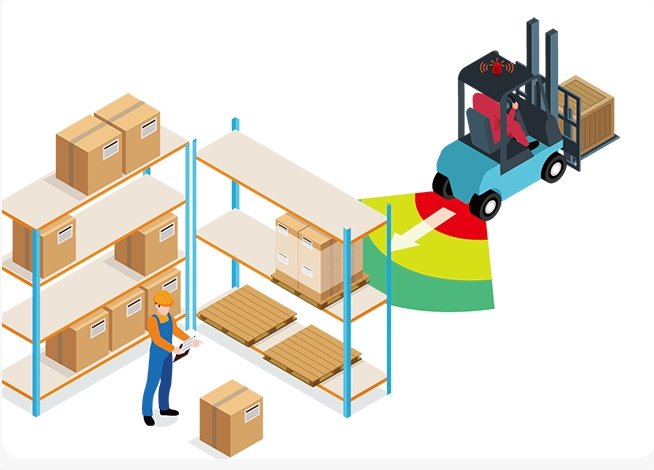
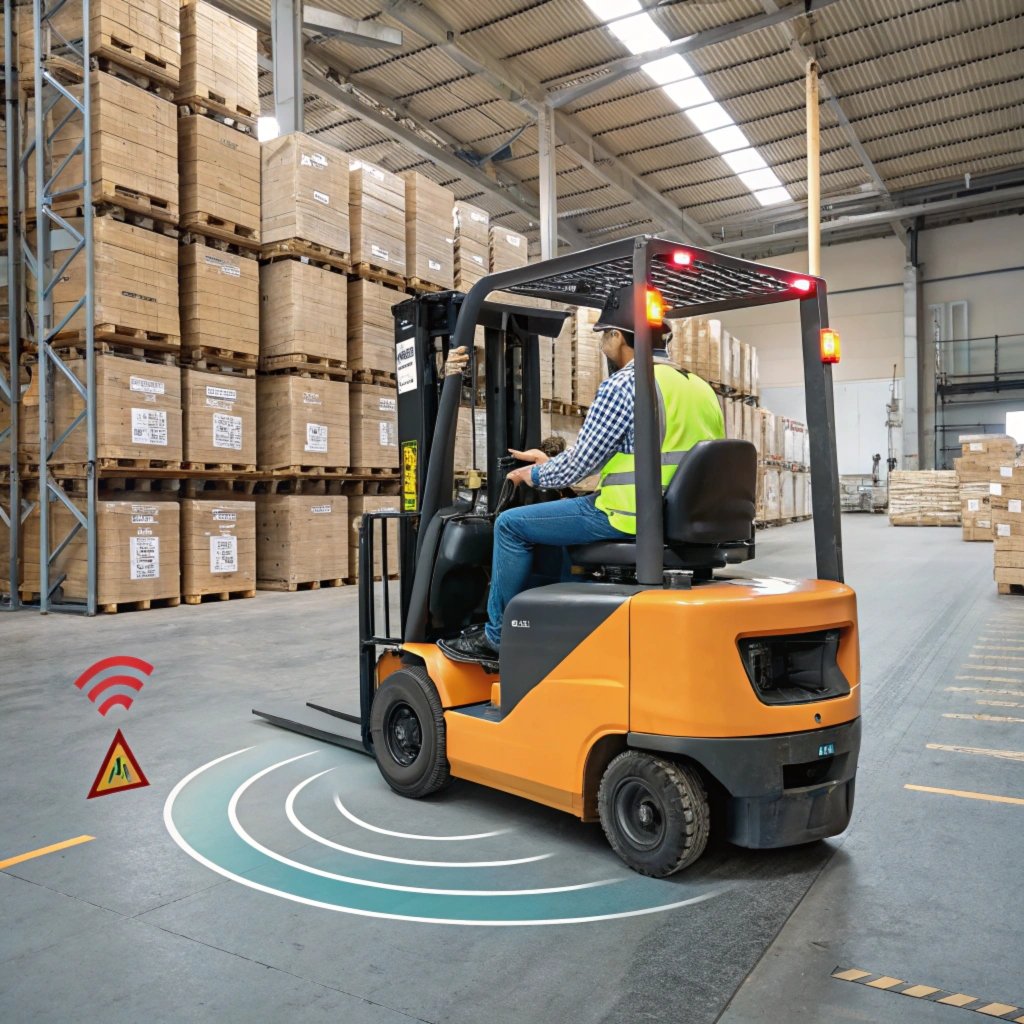
Narrower aisles solve a storage-density problem, but they create a visibility problem. The tighter the turning radius, the closer the counterweight tail swing passes to racking uprights, pedestrians, and other trucks — often in a corner the operator can't see directly, even with mirrors.
This is where aisle design and forklift safety technology intersect. A truck that fits the aisle geometrically can still be a collision risk if the operator can't see what's entering the aisle from a cross-path, or how close the tail swing is coming to a rack leg on every turn.
Tighter Aisles, Same Blind Spots — We Help You See What the Turning Radius Doesn't Show
We're not a forklift dealer or a racking designer — we build the AI camera, proximity warning, and pedestrian anti-collision systems that keep tight aisles safe once the truck is on the floor. Whatever forklift and aisle width you land on, we can help you close the visibility gap.
Get a Free Safety System Consultation11. Frequently Asked Questions
What is a good turning radius for a warehouse forklift?
It depends entirely on your aisle width, not a fixed "good" number. For standard counterbalance trucks in a 3.4–4.3 m aisle, an outside turning radius in the 2,000–2,600 mm range is typical. If your aisles are narrower, you need a truck class — reach, order picker, or articulated — with a correspondingly tighter radius, not just a smaller counterbalance model.
How do I calculate the minimum aisle width for my forklift?
Use the Ashley Formula: add the truck's outside turning radius, the load length in the direction of travel, and a clearance allowance of roughly 250–300 mm. This gives the theoretical right-angle stacking aisle; most warehouses then add a further buffer for pedestrian traffic and operator comfort.
Does a longer forklift always have a bigger turning radius?
Generally yes — wheelbase is the biggest single driver of turning radius, and overall length correlates with wheelbase on most counterbalance designs. However, mast height and attachments can also shift the effective turning circle without changing the truck's base length, so overall length alone isn't a reliable shortcut.
Should I design my racking layout before or after choosing a forklift?
Choose the forklift class first, or at minimum lock in the truck type (counterbalance, reach, VNA) before finalizing aisle widths. Racking is far more expensive and disruptive to redesign than it is to select a truck that fits an already-fixed layout — but doing it that way around usually forces you into a narrower, pricier truck class than necessary.
Why does my forklift need a wider aisle than the turning radius on the spec sheet suggests?
The spec sheet figure is usually the unloaded outside turning radius. Real aisle planning needs the right-angle stacking aisle, which adds load length and a clearance allowance on top of that base number — plus a practical safety margin for real-world operating conditions.