Skip to content

Hazardous Area Classification Explained: How to Read the Code Before It Reads You
Class, Division, Zone, Group, and Temperature Code — the labels stamped on hazardous location equipment aren't random. Here's how to decode them and apply them correctly on your site.
Walk into almost any refinery, grain terminal, paint booth, or chemical storage facility and you'll spot equipment stamped with cryptic codes: Class I, Div 1, Group C-D, T4. To an outsider, it looks like a serial number. To a safety engineer, it's a complete risk profile — telling you exactly what kind of hazard exists, how often it's present, and what equipment is allowed anywhere near it.
Hazardous area classification is the system behind that stamp. Get it right, and you prevent the single spark that could turn a routine shift into a catastrophic incident. Get it wrong, and even correctly manufactured equipment can become the ignition source nobody planned for.
What Is Hazardous Area Classification, Really?
At its core, hazardous area classification is a risk-mapping exercise. Engineers walk a facility and identify every location where flammable gases, vapors, combustible dust, or ignitable fibers could realistically accumulate in the air. Each of those zones is then assigned a classification describing:
- What kind of hazardous material is present (gas, vapor, dust, or fiber)
- How often the hazardous atmosphere is likely to occur (constant, occasional, or abnormal)
- How hot equipment surfaces are allowed to get without risking ignition
That classification then dictates everything downstream — the wiring methods, the enclosure ratings, and which pieces of equipment are even legally allowed to operate in that specific area.
The Building Blocks: Class, Division, Zone, Group
In North America, the NEC (National Electrical Code) breaks classification into three layers that stack together to form a complete rating.
Class: The Type of Hazard
- Class I — Flammable gases or vapors (refineries, chemical plants, fuel depots)
- Class II — Combustible dust (grain elevators, flour mills, metal processing)
- Class III — Easily ignitable fibers or flyings (textile mills, woodworking shops)
Division: How Often the Hazard Shows Up
- Division 1 — Hazardous conditions exist under normal operating conditions, or frequently during routine maintenance and repair
- Division 2 — Hazardous conditions are only present during abnormal situations, like a leak, spill, or equipment failure
Group: The Specific Substance
Within Class I, gases are further split into Groups A through D based on how easily they ignite (Group A being the most volatile, like acetylene, down to Group D, covering substances like propane and gasoline vapors). Class II dust hazards use Groups E, F, and G. This matters because equipment tested for Group D isn't automatically safe around a Group B gas — the ignition energy required is different.
NEC vs IEC: Two Systems, One Goal
Outside North America, most of the world uses the IEC (International Electrotechnical Commission) Zone system instead of the Class/Division model. The two systems describe the same underlying risk using different vocabulary, which is why cross-border projects often need equipment certified under both frameworks.
| Risk Level | NEC (Class/Division) | IEC (Zone System) |
|---|---|---|
| Continuous or long-duration hazard | Class I, Division 1 | Zone 0 (gas) / Zone 20 (dust) |
| Likely under normal operation | Class I, Division 1 | Zone 1 (gas) / Zone 21 (dust) |
| Only under abnormal conditions | Class I, Division 2 | Zone 2 (gas) / Zone 22 (dust) |
Reading a Temperature Code (T-Rating)
Beyond Class, Division, and Group, hazardous location equipment also carries a Temperature Code, or T-Rating. This number caps the maximum surface temperature the equipment is allowed to reach — because a hot enclosure can ignite a flammable atmosphere just as easily as a spark.
T-Ratings range from T1 (up to 450°C) down to T6 (as low as 85°C). The rule is simple: the equipment's T-Rating must always be lower than the autoignition temperature of the specific gas, vapor, or dust present at the site. A T6-rated device is required anywhere low-autoignition substances are present, even though it's technically "more restrictive" than a T1 rating.
How a Site Actually Gets Classified
Identify the hazardous materials on site
Engineers catalog every flammable gas, vapor, or combustible dust used, stored, or produced in the facility, along with its physical properties.
Map where releases could occur
Every valve, seal, vent, and storage point is assessed for the likelihood and duration of an accidental release into the surrounding air.
Assign Class, Division/Zone, and Group
Each mapped area is assigned a formal classification based on the hazard type, frequency of exposure, and ignition characteristics.
Select and install rated equipment
Only equipment certified for that exact classification — including the correct T-Rating — is approved for installation in the zone.
Classification in Motion: Mobile Equipment
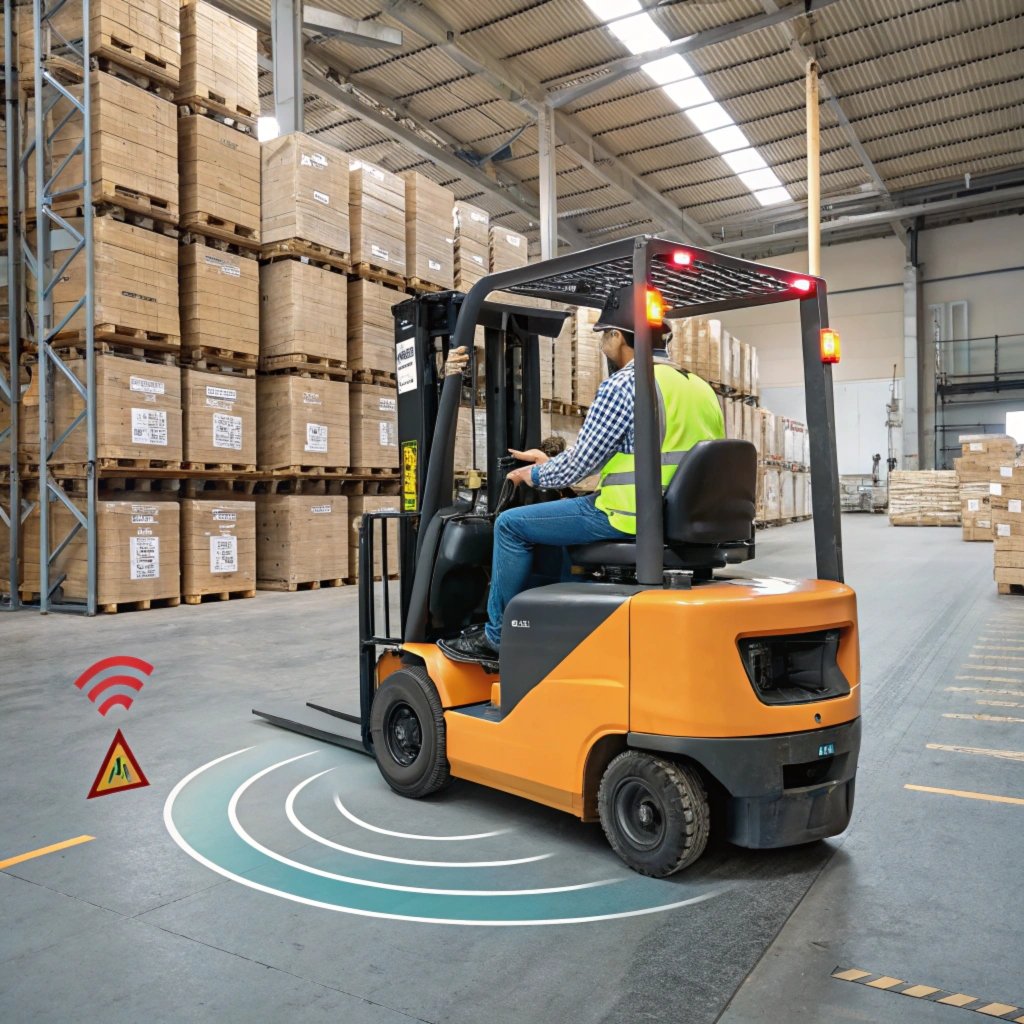
Classification isn't only about fixed infrastructure like lighting fixtures and control panels. Facilities that operate forklifts, tow tractors, or other powered industrial trucks inside classified areas face an added challenge: the vehicle itself, and everything mounted on it, has to meet the classification rating of every zone it travels through.
This is a common blind spot. A facility might carefully classify its storage bays and loading docks, then overlook the fact that a forklift's onboard camera, lighting, or sensor package also needs to meet that same rating wherever the vehicle operates. Vision and collision-avoidance systems draw enough power that they typically rely on explosion proof housings rather than intrinsically safe circuits, since IS designs are generally limited to low-power instrumentation.
A Forklift Explosion Proof Camera System is built specifically to close this gap — giving operators clear visibility and collision-avoidance support while remaining compliant with the Class and Division rating of the hazardous zones the forklift travels through, from loading docks to classified storage rooms.
Operating Forklifts in a Classified Hazardous Area?
See how a properly rated explosion proof camera system helps close a common compliance gap for mobile equipment.
Explore the Forklift Explosion Proof Camera SystemCommon Classification Mistakes to Avoid
- Treating classification as a one-time exercise. Process changes, new chemicals, or facility expansions can shift boundaries — classification drawings need periodic review, not a single sign-off.
- Assuming Division 2 is "safe enough." Division 2 still requires rated equipment; it simply reflects a lower probability of exposure, not zero risk.
- Overlooking mobile and portable equipment. Handheld tools, radios, and vehicle-mounted devices are just as subject to classification requirements as fixed installations.
- Mixing Group ratings incorrectly. Equipment approved for one Group isn't automatically safe for a more volatile substance in a different Group.
- Ignoring the Temperature Code. An otherwise correctly rated device with too high a T-Rating can still become an ignition source.
Frequently Asked Questions
Who is responsible for classifying a hazardous area?
Classification is typically performed by qualified engineers or safety professionals familiar with the specific process, materials, and applicable codes (such as NFPA 497 or IEC 60079-10) for the facility in question.
Is Zone classification the same as Division classification?
They describe similar risk levels but use different terminology and boundary logic. Zone 0/1/2 roughly correspond to Division 1 and 2, but they aren't always a direct one-to-one substitution, so equipment certifications should be checked carefully.
Does classification apply to outdoor areas?
Yes. Outdoor tank farms, loading racks, and storage yards can absolutely be classified hazardous areas if flammable materials are present, even without an enclosed building.
How often should a facility's classification be reviewed?
Best practice is to review classification drawings whenever a process, chemical, or layout change occurs, and on a routine periodic basis even without changes, to confirm the original assessment still holds.
Hazardous area classification isn't paperwork for its own sake — it's the framework that keeps every piece of equipment, from a fixed control panel to a forklift's camera system, matched to the exact risk it's operating in. Understanding how Class, Division, Zone, Group, and Temperature Code fit together gives facility managers and safety teams the confidence to select equipment correctly the first time, rather than discovering a gap after the fact.