Skip to content

Forklift Safety Management Guide for Warehouse Managers

Daily forklift safety management starts with the warehouse manager's walk of the floor — not the annual audit.
Most warehouse managers already know the rules — OSHA 1910.178, a certified operator, a pre-shift checklist. What separates a warehouse with a clean safety record from one that keeps logging near-misses usually isn't the rulebook; it's whether someone is actually managing forklift safety day to day, instead of just filing the paperwork after the fact. This guide walks through what that daily management actually looks like, from the checklist you run before the first shift to the technology that catches what a checklist can't.
1. Why Forklift Safety Is a Management Job, Not a Training Event
A forklift operator certificate proves someone passed a class on a given day. It doesn't guarantee the aisle they're driving down six months later is still clear of a blind corner, that the truck's brakes were actually checked this morning, or that the pedestrian walking toward the dock door has seen the truck coming. Those are management questions, and they get answered — or ignored — every single shift, not once a year during recertification.
That's the core shift in how effective warehouses treat forklift safety management: not as a compliance box tied to a training date, but as an operating system with daily inputs — inspections, traffic observation, near-miss reports — and a manager who's accountable for reading them and acting.
Forklift accidents are rarely caused by an operator who didn't know the rules. They're caused by a gap between the rules on paper and what's actually happening on the floor that shift — and closing that gap is a management function, not a training outcome.
2. The Real Cost of Poor Forklift Safety Management
The injury is the visible cost. It's rarely the only one, and it's usually not the biggest one over a full year of operations. A single forklift incident typically sets off a chain of secondary costs that many warehouse managers underestimate until they're building the budget case for a safety upgrade:
- Operational downtime while the area is cleared, the incident is investigated, and the equipment is inspected before it's allowed back into service.
- Damaged inventory and racking — a tip-over or collision rarely damages just the forklift.
- Regulatory exposure — a reportable incident can trigger an inspection that puts the rest of the facility under review, not just the accident site.
- Insurance premium increases that persist for years after the direct repair cost is paid.
- Turnover and morale impact — a visible incident makes every operator on that floor more anxious, which tends to increase hesitation errors rather than caution.
Weighed against the cost of the controls that prevent it — a layout fix, a training refresher, or a detection system — the case for investing in forklift safety management usually makes itself once it's laid out this way.
3. The Five Pillars of a Forklift Safety Management Program
A forklift safety program that actually holds up under a busy shift rests on five pillars working together. Remove one and the others end up carrying more weight than they were built for.
Operator Certification & Training
Documented initial certification, scheduled refreshers, and immediate retraining after any near-miss. Covered in Section 5.
Pre-Shift Equipment Inspection
A non-negotiable check before every truck moves a load, with a clear out-of-service process. Covered in Section 4.
Traffic & Facility Design
Aisle marking, blind-corner mitigation, and dock-area separation between forklift and pedestrian traffic. Covered in Section 6.
Load & Racking Oversight
Rated capacity discipline, racking inspection, and load-securement standards. Covered in Section 7.
Monitoring & Detection Technology
Systems that catch the split-second situations training and layout alone can't. Covered in Section 9.
Not sure where your warehouse actually stands?
We help warehouse managers pinpoint the blind corners and traffic patterns most likely to cause a forklift incident.
Request a Free Safety Review4. Daily Forklift Safety Checklist for Warehouse Managers
Pre-shift inspection is the operator's job. Making sure it actually happens — and happens honestly, not as a signature on autopilot — is the manager's job. A workable daily routine looks like this:
Before the first shift starts
- Confirm every powered industrial truck scheduled for the day has a completed, dated pre-operation inspection on file — not a blanket signature from the week before.
- Spot-check horns, backup alarms, and any fitted camera or pedestrian-alert systems on at least a rotating sample of trucks.
- Review the prior shift's handoff notes for any flagged hazard, near-miss, or out-of-service equipment.
- Walk the main forklift-pedestrian crossing points before traffic picks up, checking sightlines and floor markings.
During the shift
- Observe at least one high-traffic intersection or dock door for a few minutes at different points in the shift — patterns show up in observation that never show up in a report.
- Confirm any truck flagged for a defect during pre-shift has actually been pulled from service, not just noted.
- Log any near-miss reported by an operator or pedestrian the same day, with location and cause — not at the end of the week.
End of shift
- Write a short handoff note for the next shift: any equipment issue, any hazard, any near-miss that needs follow-up.
- Confirm charging/fueling areas are clear and any truck due for maintenance is actually scheduled, not just flagged.
The single most common failure point in pre-shift inspection isn't a missed step — it's a defect that gets noticed, mentioned informally, and never formally taken out of service. Build a process where flagging a truck is fast enough that skipping it isn't the path of least resistance.
5. Managing Operator Certification & Training
Most warehouses already run initial certification. Where forklift safety management actually breaks down is what happens after that first certification — training that stops at hire tends to fade right around the time complacency sets in, typically six months to a year into the job, once routes feel routine and shortcuts start looking safe because nothing's gone wrong yet.
- Site-specific orientation for every operator, including experienced hires transferring from another facility — a different warehouse's blind corners and traffic patterns aren't intuitive on day one.
- Scheduled refresher evaluation on a set cadence, not only triggered by an incident — waiting for something to go wrong before retraining keeps the whole program reactive.
- Immediate retraining after any near-miss, observed unsafe behavior, or a switch to a different truck class, attachment, or racking height.
- A written record tying each operator to their certification date, refresher history, and any retraining events — this is also what protects the warehouse if an incident is ever investigated.
6. Traffic Flow, Racking & Facility Layout
A warehouse built around pallet flow can dedicate wide, marked lanes to forklift traffic in a way most retrofitted or mixed-use facilities can't fully match — but even a tight layout gets meaningfully safer with a handful of targeted changes:
- Mark every crossing point where a forklift route meets a walkway — floor tape, hatching, or raised markers, not just at the main aisles but at every rack-end and dock-door access point.
- Identify blind corners methodically. Walk the floor from both an operator's seat height and a pedestrian's eye level, and flag every point where sightlines run under roughly 10–15 feet.
- Keep staged pallets and WIP out of turning radii. A truck making a tight turn around staged material has far less room to react to someone stepping out unexpectedly.
- Treat dock areas as a distinct risk zone. Poor lighting, trailer creep, and the transition between dock and open floor account for a disproportionate share of incidents relative to how much square footage they cover.
You don't need to redesign the whole floor at once. List every point where a forklift route crosses a walkway or another forklift route, rank them by traffic volume, and fix the top five first — that's usually where most near-misses are already concentrated.
7. Load Handling & Racking Safety Oversight
Tip-overs and dropped loads are among the most severe forklift incidents, and both usually trace back to the same management gap: a load chart that isn't actually being checked against the load in front of the operator. Managing this well means building the habit, not just posting the rule.
- Confirm load charts are legible and matched to the correct attachment on every truck, especially on fleets shared across multiple areas.
- Set a clear standard for load center and mast height that operators are expected to check, not estimate, on anything unusual.
- Inspect racking on a regular schedule for bent uprights, damaged beams, or missing safety clips — racking damage is one of the clearest visible signs that loads are being handled outside spec.
- Require reduced speed and full visibility on any run with an elevated or oversized load, and build that into the traffic layout rather than leaving it to operator judgment alone.
8. Manual vs. Technology-Assisted Safety Management
Every warehouse runs some version of manual forklift safety management — checklists, spot-checks, and manager observation. The question worth asking honestly is where that manual approach reaches its limit, and where monitoring technology picks up the slack.
| Safety Function | Manual Management Alone | Technology-Assisted Management |
|---|---|---|
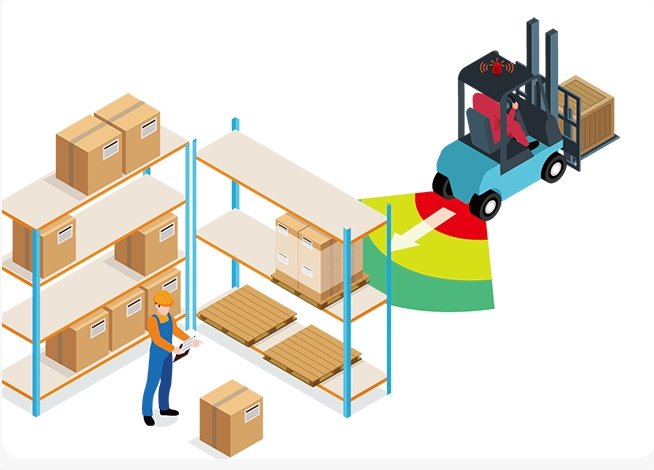
| Pedestrian detection at blind corners | Depends on mirrors and operator vigilance in the moment | Active alert the instant a pedestrian enters a blind zone |
| Forklift-to-forklift intersection risk | Relies on horn use and driver judgment | Proximity warning triggers automatically for both trucks |
| Speed in high-traffic zones | Posted limits, enforced inconsistently | Zone-based speed limiting applied automatically |
| Incident investigation | Relies on witness recollection | Recorded footage of the exact event |
| Near-miss pattern detection | Only as good as manual reporting habits | Event logs surface repeat locations automatically |
Neither column replaces the other. Manual management sets the standard and does the daily follow-through; technology closes the reaction-time gap that no amount of vigilance can fully close on its own. The strongest warehouse safety programs run both together — see our warehouse risk assessment framework for a structured way to score which gaps in your facility matter most.
9. Where Detection Technology Supports the Warehouse Manager
Training and layout changes reduce how often a dangerous moment happens. Neither one fully compensates for the split-second nature of a blind-corner encounter or a fast-approaching cross-aisle truck — and that's the specific gap detection technology is built to close, as a layer on top of a manager's daily process, not a replacement for it.

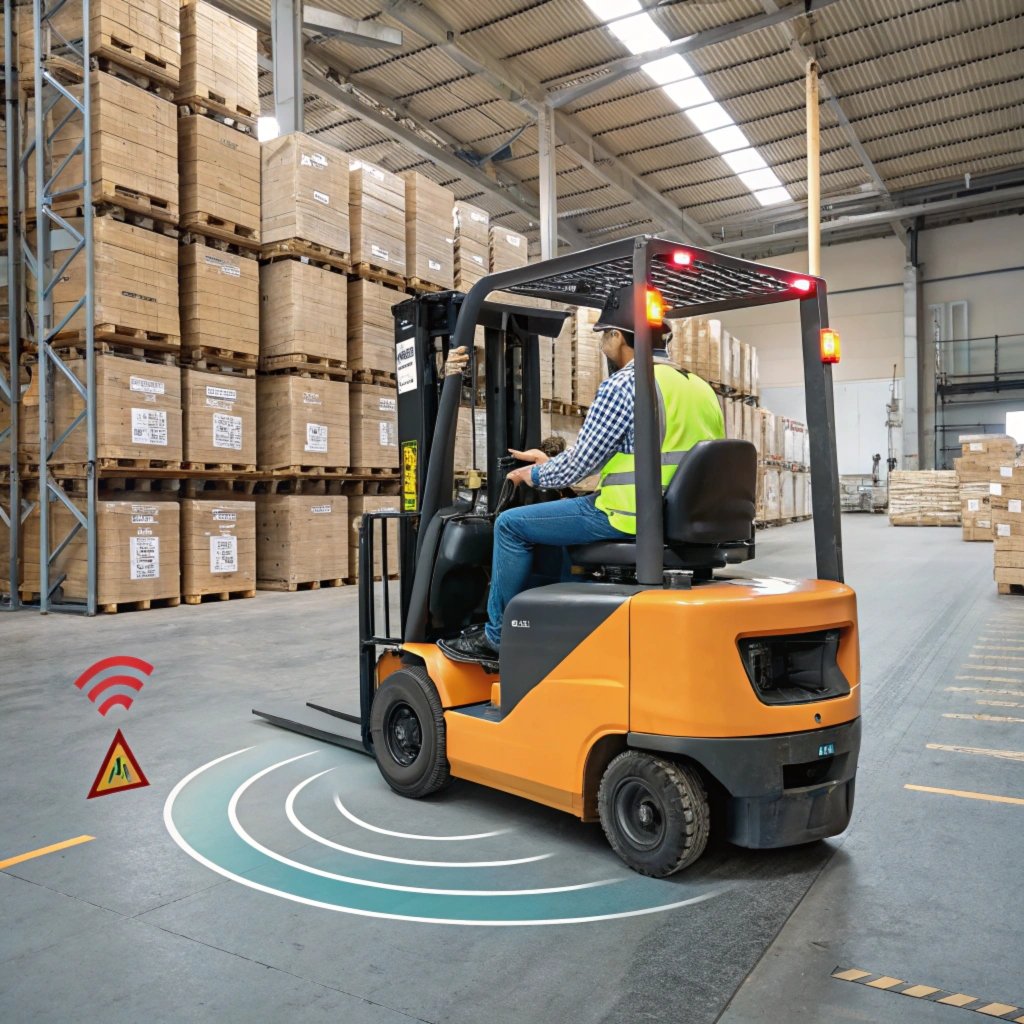
UWB tag-based detection is one of several technologies warehouses use to give operators an active proximity warning.
- Pedestrian detection alerts the operator the moment someone enters a blind zone or intersection, instead of relying on either party spotting the other first — see how forklift pedestrian safety systems apply this in practice.
- Forklift-to-forklift proximity warning reduces collisions at shared intersections and staging points where multiple trucks converge on a predictable schedule, often using UWB tag-based anti-collision systems.
- Camera systems extend the operator's field of view around racking and reversing blind spots that mirrors alone don't fully cover.
- Speed limiting keeps trucks inside a safe travel speed automatically in high-traffic zones, cutting stopping distance exactly where it matters.
- Recorded event data turns every near-miss into something a manager can actually review and act on, instead of relying on memory or an informal mention on the floor.
None of this replaces a trained, attentive operator or a manager who's actually walking the floor — but a warehouse running solid daily management alongside active detection technology is working with two independent layers of protection instead of one, which is exactly what keeps a single missed glance from becoming an injury.

Forklift-to-Forklift
UWB technology with wearable tags to flag proximity risk between trucks.

Forklift-to-Pedestrian
AI camera detection built to identify pedestrians and reduce blind-corner risk.
10. Common Forklift Safety Management Mistakes
- Treating certification as the finish line instead of the starting point of an ongoing program.
- Logging near-misses informally, or not at all — without a pattern to review, the same blind corner keeps almost causing the same incident until it finally does.
- Letting pre-shift inspection become a signature ritual rather than an actual check, especially under production pressure.
- Assuming a "quiet" quarter means a safe warehouse — the absence of a recent incident isn't the same as the absence of risk; it often just means the near-misses haven't been counted yet.
- Relying on mirrors alone at high-traffic blind corners — they help, but only when both the operator and pedestrian happen to be looking at the right moment.
- Fixing the layout once and never revisiting it as seasonal volume, new racking, or a shifted dock schedule changes the traffic pattern.
Build a Forklift Safety Program That Doesn't Depend on Luck
We design pedestrian detection, proximity warning, and speed-control systems that give warehouse managers a second layer of protection their daily checklist and training program can't provide alone.
Talk to a Forklift Safety Specialist11. Frequently Asked Questions
Tap a question to expand the answer — tap again to collapse it.
What is forklift safety management, exactly?
Forklift safety management is the ongoing system a warehouse runs to control forklift risk — operator certification and training, pre-shift inspections, traffic and facility design, incident and near-miss reporting, and monitoring technology — rather than a single training event. It is a management process, not a one-time class.
How many forklift safety checks should a warehouse manager run each day?
At minimum, a documented pre-shift inspection on every powered industrial truck before it moves a load, plus a visual walk of high-traffic intersections and dock areas. Larger operations often add a mid-shift spot check and an end-of-shift handoff note so the next shift starts with a clean equipment and hazard status.
How often should forklift operators be retrained?
Beyond initial certification, operators need refresher evaluation at least once every three years, plus immediate retraining after any accident, near-miss, observed unsafe operation, or a switch to a different truck type or attachment. Waiting for a scheduled refresher after a near-miss already happened is treating training as reactive instead of preventive.
What causes the most forklift accidents in warehouses?
Pedestrian struck-by incidents at blind corners and dock doors, tip-overs from overloaded or off-center loads, and forklift-to-forklift collisions at shared intersections account for most serious warehouse forklift incidents. Nearly all of them trace back to one of two root causes: an operator or pedestrian didn't see the other party in time, or a load exceeded the truck's rated capacity for that lift height and center.
Can technology replace forklift safety training?
No. Training and facility design reduce how often a dangerous situation occurs; detection technology like pedestrian alerts, proximity warning, and speed limiting catches the split-second situations that even a well-trained operator can't always see in time. The two work as independent layers — technology supports the safety program, it doesn't substitute for it.
What should a warehouse manager do immediately after a forklift near-miss?
Log it formally with the exact location, truck, and contributing factor rather than treating it as a non-event, then fix that specific factor — a layout change, a retraining session, or a technology gap. Near-misses are the clearest early warning a warehouse gets before a minor incident becomes a serious one.