Skip to content

OSHA Forklift Pedestrian Safety Requirements: The 2026 Compliance Guide
What OSHA actually requires for keeping forklifts and pedestrians apart — traffic separation, right-of-way, speed and horn rules, training duties, and the engineering controls that go beyond the minimum.
Roughly one in six workplace deaths involves a forklift, and pedestrians on the warehouse floor make up a large share of those incidents — most of them preventable. Employers who assume "we did the training" satisfies OSHA are usually missing half the picture: pedestrian safety under 29 CFR 1910.178 is a mix of workplace design duties, operating rules, training content, and a catch-all clause that applies even when no specific rule fits the hazard.
This guide walks through exactly what OSHA requires — not general safety advice, but the actual standard sections that inspectors cite — and where forklift anti-collision and pedestrian detection technology fits into a compliance program that holds up under scrutiny.
- 1. The Core OSHA Standard: 29 CFR 1910.178
- 2. Traffic Separation Requirements
- 3. Right-of-Way: Who Yields to Whom
- 4. Speed, Horn & Visibility Rules
- 5. Operator Training Duties Around Pedestrians
- 6. The General Duty Clause Backstop
- 7. Citations & Penalty Exposure
- 8. Engineering Controls Beyond the Minimum
- 9. Building a Compliant Pedestrian Program
- 10. FAQs
1. The Core OSHA Standard: 29 CFR 1910.178
OSHA doesn't have a single standalone "pedestrian" regulation for forklifts. Instead, pedestrian protection is woven through the Powered Industrial Trucks standard, 29 CFR 1910.178, along with the general walking-working surfaces rule at 1910.176. Together they cover four areas that matter most for pedestrian safety:
- 1910.178(m) — Operating rules: how a truck must be driven around people, loads, and blind corners.
- 1910.178(n) — Traveling rules: speed control, distance from other trucks, and reduced-visibility travel.
- 1910.178(l) — Training: operators must be evaluated on workplace-specific hazards, including pedestrian traffic patterns.
- 1910.176(a) — Housekeeping and clearance: aisles and walkways must stay marked, visible, and unobstructed.

2. Traffic Separation Requirements
The first line of defense OSHA expects is physical separation — keeping forklifts and people out of each other's path whenever the facility layout allows it. This isn't optional guidance; it's the baseline engineering control inspectors look for first.
What separation actually looks like in practice
- Marked pedestrian walkways, kept visible and free of stock, pallets, or cords (1910.176(a)).
- Physical barriers, guard rails, or bollards where forklift and foot traffic would otherwise cross.
- Designated crossing points at intersections, with mirrors or line-of-sight aids where visibility is blocked.
- Separate doorways or staggered entry points for forklifts versus walk-in staff, where the building allows it.
Where full separation isn't physically possible — a shared dock area, a cross-aisle near receiving — OSHA expects administrative controls to fill the gap: posted speed limits, mandatory horn points, and traffic flow rules that reduce the number of blind interactions.
3. Right-of-Way: Who Yields to Whom
This is the rule that surprises new operators the most: pedestrians have the right of way, in essentially every situation, and the forklift operator carries the responsibility for stopping, slowing, or rerouting — not the person on foot.
This applies at cross-aisles, near racking corners, in loading dock areas, and anywhere a pedestrian could reasonably be present but isn't yet visible. It's also the reasoning behind requiring a sounded horn at blind intersections — the operator can't yield to someone they haven't been warned might be there.
4. Speed, Horn & Visibility Rules
OSHA doesn't publish one universal numeric speed limit for every forklift — the standard requires operators to travel at a speed that allows the truck to be stopped safely given the load, floor condition, and traffic in the area. Employers are expected to set and enforce facility-specific speed limits that reflect actual conditions, not a generic number copied from another site.
| Requirement | What It Covers |
|---|---|
| Controlled speed | Slow enough to stop safely for the load, surface, grade, and visibility at any given moment. |
| Horn at blind spots | Sound the horn at cross-aisles, doorways, and any point where vision is obstructed. |
| Clear line of sight | Travel with the load trailing (downhill in reverse on ramps) if it blocks forward vision. |
| Look in direction of travel | Operator must keep a clear view of the path, not just the load. |
| Safe distance | Maintain enough distance from other trucks and pedestrians to stop safely if either stops suddenly. |
These rules read as common sense, but they're exactly what shows up on citation reports after an incident — investigators check whether the operator was traveling at a controllable speed and whether the horn was sounded at the point where the pedestrian became a hazard.
5. Operator Training Duties Around Pedestrians
Under 1910.178(l), training has to cover both truck-related topics and workplace-related topics — and pedestrian traffic is explicitly one of the workplace-related items OSHA expects to be addressed, alongside surface conditions, ramps, loading docks, and restricted areas.
- Operators must be evaluated in the actual workplace, not just on general truck operation — a certification from a previous employer doesn't transfer automatically.
- Refresher training is triggered by a near-miss, an unsafe-operation observation, a change in truck type, or a change in workplace layout — not just the standard three-year cycle.
- Employers must keep written records: operator name, training date, evaluation date, and evaluator name.
- Operators must be at least 18 years old for non-agricultural forklift work.
6. The General Duty Clause Backstop
Even where 1910.178 doesn't spell out a specific control for a particular hazard, Section 5(a)(1) of the OSH Act — the General Duty Clause — requires employers to keep the workplace free of recognized hazards likely to cause death or serious injury. Forklift-pedestrian contact is a well-documented, recognized hazard industry-wide.
That means OSHA can still cite an employer for a pedestrian-related incident even when no single subsection of 1910.178 was technically violated, as long as a reasonably available control — better lighting, a barrier, a detection system — existed and wasn't used. This is why "we followed the letter of 1910.178" isn't always a full defense after an incident.
7. Citations & Penalty Exposure
Pedestrian-related violations typically fall under 1910.178(m) or (n), or 1910.176(a) for walkway maintenance, and penalty exposure is not trivial:
| Violation Type | Maximum Penalty (2026) |
|---|---|
| Serious / Other-than-Serious | Up to $16,550 per violation |
| Failure to Abate | Up to $16,550 per day past the correction deadline |
| Willful or Repeat | Up to $165,514 per violation |
A single inspection following a pedestrian-strike incident can generate multiple citations at once — a traffic-separation citation, a training-documentation citation, and a General Duty Clause citation are not mutually exclusive, and each carries its own penalty.
8. Engineering Controls That Go Beyond the Minimum
OSHA's standard sets the floor — separation, right-of-way conduct, speed and horn discipline, and documented training. It does not require any specific technology. But it does favor employers who can show they used reasonably available engineering controls, and that's where forklift safety technology has become a standard part of serious compliance programs rather than an optional extra.
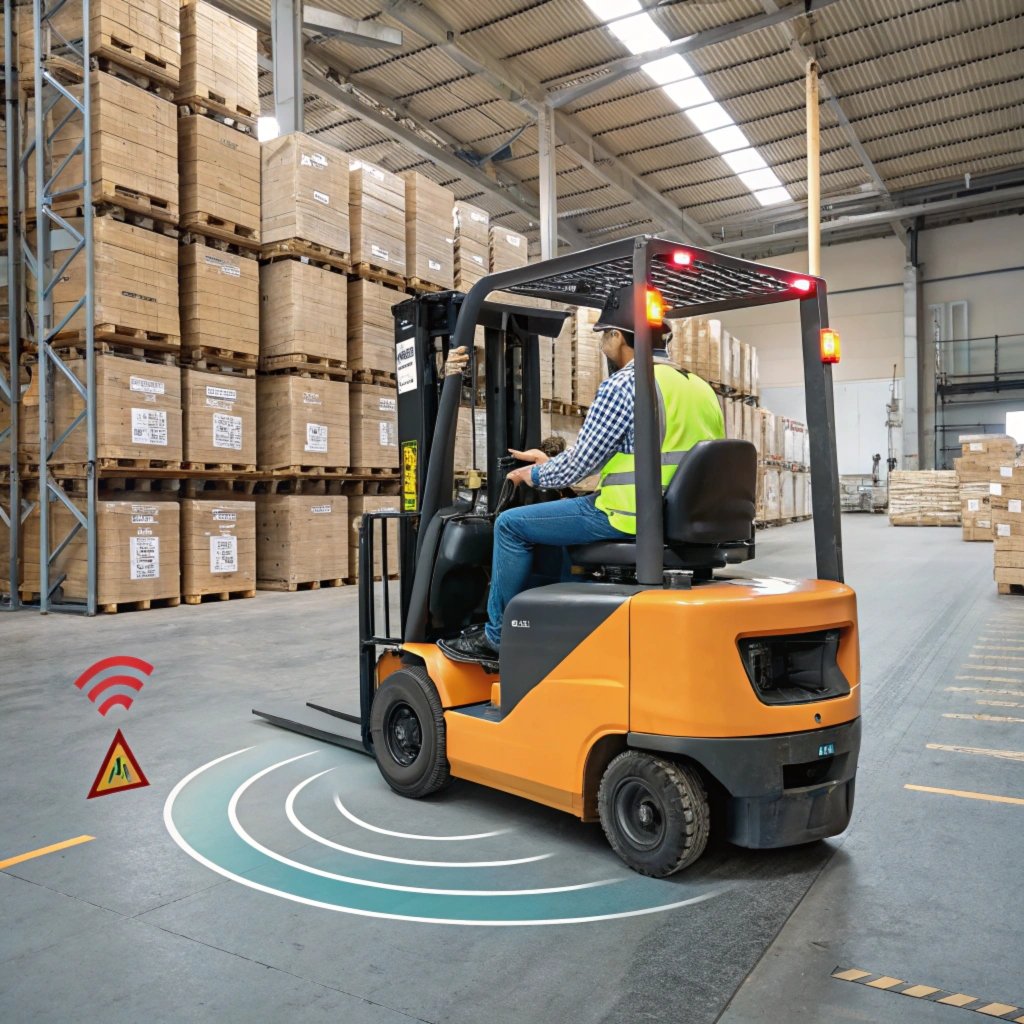
- AI pedestrian detection systems that identify a person near the truck and alert both the operator and the pedestrian in real time, as shown in the image above — closing the gap between "the operator should have seen them" and actually seeing them.
- Automatic speed reduction that slows the truck the moment a pedestrian is detected in a defined danger zone, rather than relying solely on operator reaction time.
- Blind-spot and reversing cameras that remove the guesswork at racking corners and dock doors — see our forklift camera systems overview.
- Blue and arc warning lights that project a visible signal ahead of or around the truck, giving pedestrians advance notice before the forklift itself is in view.
- Speed limiters that enforce facility-specific speed caps by zone, instead of depending purely on operator discipline — covered in our forklift speed limiter guide.
None of these replace training or marked walkways — they're a second layer that catches the moments training alone doesn't, like a pedestrian stepping around a blind rack corner just as the forklift arrives. For a closer look at how detection technology fits alongside marked traffic zones, see our pedestrian collision avoidance system page.
9. Building a Compliant Pedestrian Safety Program
A program that holds up under an OSHA inspection — and actually prevents incidents — usually has three layers working together, not just one:
| Layer | Examples |
|---|---|
| Engineering | Barriers, marked walkways, mirrors, pedestrian detection, automatic braking or speed reduction |
| Administrative | Traffic flow plans, posted speed limits, horn-point signage, documented training and evaluations |
| PPE & Awareness | Hi-vis clothing, no-phone/no-headphone zones near active forklift traffic, pedestrian awareness training |
Employers who treat pedestrian safety as a designed system across all three layers — rather than a single control like "we trained everyone" — are consistently the ones who avoid both the injury and the citation.
Turn OSHA's Pedestrian Rules Into an Active Safety System
We build the AI detection, alert, and automatic speed-reduction technology that helps operations meet — and go beyond — 1910.178's pedestrian requirements.
Talk to a Safety Specialist10. Frequently Asked Questions
Tap a question to expand the answer — tap again to collapse it.
OSHA doesn't set one fixed numeric distance for every workplace. Instead, 1910.178 requires operators to maintain a safe distance based on the truck's stopping capability at its current speed and load — which is why many facilities set their own zone-based minimum distances and back them up with automatic detection technology rather than relying on judgment alone.
The pedestrian has the right of way in essentially every situation. The forklift operator is responsible for slowing, stopping, or rerouting to avoid a person on foot — not the other way around.
Yes. The General Duty Clause (Section 5(a)(1) of the OSH Act) allows OSHA to cite an employer for a recognized hazard — like forklift-pedestrian contact — even when no single subsection of 1910.178 was technically violated, if a reasonably available control wasn't used.
OSHA's certification requirements under 1910.178(l) apply to operators, not pedestrian staff. However, a defensible safety program typically includes basic pedestrian awareness training for anyone working near active forklift traffic, since incidents involving untrained bystanders are a recurring citation trigger.
Serious or other-than-serious violations can reach up to $16,550 per violation, with the same maximum applying per day for failure to abate. Willful or repeat violations can reach up to $165,514 per violation, and a single inspection can produce multiple separate citations.
No single control satisfies 1910.178 by itself. Detection and speed-reduction technology are strong engineering controls, but OSHA still expects them to sit alongside marked walkways, documented training, and enforced operating rules — not to replace them.