Skip to content

Table of Contents
Warehouse environments where forklifts and pedestrians share the same space present significant safety challenges that require comprehensive solutions. Modern forklift pedestrian safety systems combine advanced sensor technology, warning mechanisms, and workplace protocols to prevent collisions and create safer operational zones. These integrated systems address one of the most critical hazards in industrial settings, where approximately 85 pedestrian fatalities occur annually in forklift-related incidents according to OSHA data. By implementing layered safety approaches that include detection technology, visual alerts, and proper training protocols, facilities can dramatically reduce accident rates while maintaining operational efficiency.
Video Guide: This comprehensive overview demonstrates the fundamental principles of keeping pedestrians safe around forklift operations, covering essential awareness strategies and workplace protocols.
What is forklift pedestrian safety system?
A forklift pedestrian safety system is an integrated technology solution that uses proximity sensors, warning devices, and alert mechanisms to detect when pedestrians enter dangerous zones around forklifts. These systems typically combine wearable tags or badges for workers with vehicle-mounted sensors that trigger visual, audible, or haptic warnings when pedestrians come within preset safety distances, creating an active protection layer beyond traditional safety protocols.
Video Guide: This training video provides essential insights into how modern safety systems integrate with traditional training protocols to create comprehensive pedestrian protection strategies.
Core Components and System Architecture
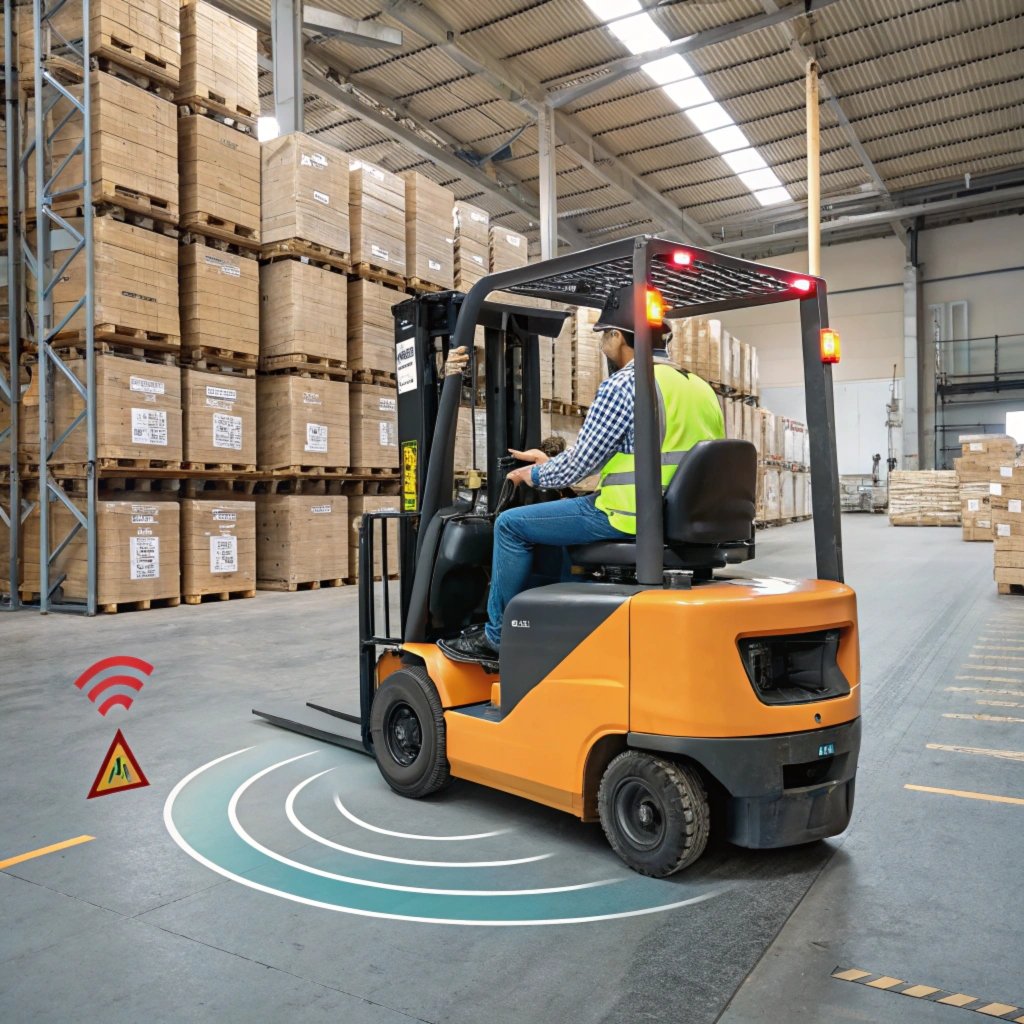
Modern forklift pedestrian safety systems operate through multiple interconnected components that work together to create protective zones. The primary elements include radio frequency identification (RFID) or ultra-wideband (UWB) technology for detection, mounted antenna systems on forklifts, wearable tags for pedestrians, and alert devices that provide immediate warnings.
The detection range is typically configurable between 3 to 30 feet, allowing facilities to customize safety zones based on their specific operational requirements. The system architecture includes:
- Vehicle-mounted detection units that continuously scan for pedestrian tags
- Wearable transponders carried by workers that emit identification signals
- Alert mechanisms including LED lights, audible alarms, and vibration warnings
- Central management software for system configuration and incident logging
- Power management systems ensuring continuous operation during shifts
Nine Chip Electron Pro Tip: When implementing our forklift pedestrian safety system, start with a facility audit to map high-traffic intersections and blind corners. We’ve found that facilities achieving the best results place additional fixed sensors at these critical points, creating overlapping detection zones that eliminate blind spots entirely.
How Does forklift pedestrian safety system Work?
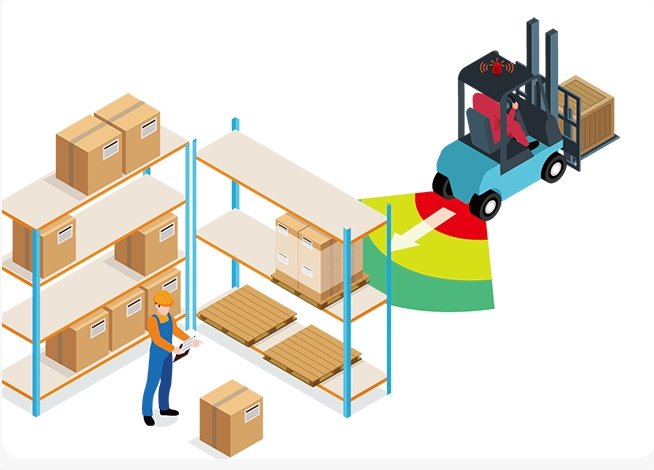
Forklift pedestrian safety systems function through continuous wireless communication between vehicle-mounted sensors and pedestrian-worn tags, calculating real-time proximity distances and triggering escalating warnings as distances decrease. The system uses triangulation algorithms to determine exact positions, activating operator alerts (visual dashboards, audible alarms) and pedestrian notifications (vibrating tags, flashing lights) when programmed safety thresholds are breached, creating a mutual awareness environment.
Video Guide: This detailed explanation walks through real-world scenarios showing how detection systems identify potential collision situations and activate appropriate warning protocols.
Operating Mechanism and Detection Protocol
The operational workflow begins the moment a forklift’s ignition activates, initializing the onboard detection system. The vehicle-mounted unit emits radio frequency signals in a 360-degree pattern, continuously searching for responsive pedestrian tags within the configured detection zone. When a tag enters this zone, bidirectional communication establishes the precise distance and relative position.
The system employs a tiered warning protocol based on proximity:
- Outer Zone (15-30 feet): Initial awareness alert—amber warning light activates on forklift dashboard
- Middle Zone (8-15 feet): Elevated caution—audible beep pattern begins, pedestrian tag vibrates
- Inner Zone (3-8 feet): Critical warning—red flashing lights activate, continuous alarm sounds, strong tag vibration
- Immediate Zone (<3 feet): Emergency protocol—all alerts maximize intensity, automatic speed reduction may engage
Advanced systems from manufacturers like Nine Chip Electron incorporate machine learning algorithms that reduce false positives by distinguishing between stationary objects and moving pedestrians, analyzing movement patterns to predict potential collision trajectories before they occur.
Nine Chip Electron Pro Tip: Configure your detection zones asymmetrically rather than using uniform circular patterns. We recommend extending the front detection zone to 25 feet while keeping side zones at 15 feet, matching actual collision risk patterns we’ve documented across thousands of installations.
What are the OSHA regulations for forklifts and pedestrians?
OSHA regulations under 29 CFR 1910.178 mandate that employers establish and enforce safe forklift operation procedures including designated pedestrian walkways, physical barriers where feasible, proper operator training, and clear traffic patterns that minimize pedestrian-forklift interaction. While OSHA doesn’t specify exact technologies, regulations require employers to implement engineering controls, administrative procedures, and personal protective measures that demonstrably reduce pedestrian exposure to forklift hazards.
Video Guide: This OSHA-focused instructional video breaks down the specific regulatory requirements for pedestrian safety in forklift environments and compliance strategies.
Regulatory Requirements and Compliance Framework
OSHA’s forklift safety standards establish comprehensive requirements that facilities must implement to protect pedestrians. The regulations emphasize a hierarchy of controls, prioritizing elimination of hazards first, followed by engineering controls, administrative controls, and finally personal protective equipment.
Key regulatory mandates include:
- Operator Certification: All forklift operators must complete formal training and evaluation per 1910.178(l)
- Traffic Control: Permanent aisles and passageways must be appropriately marked per 1910.176(a)
- Pedestrian Separation: Employers must provide safe clearances wherever forklifts and pedestrians operate
- Visibility Standards: Adequate lighting must be maintained in all operational areas
- Speed Limitations: Safe operating speeds must be established and enforced for all conditions
- Inspection Requirements: Daily pre-operation inspections must be documented
- Warning Devices: Forklifts must have operational horns and backup alarms
OSHA’s General Duty Clause (Section 5(a)(1)) further requires employers to provide workplaces “free from recognized hazards,” which courts have interpreted to include implementing available safety technologies when traditional controls prove insufficient. Facilities with documented near-miss incidents or previous accidents face heightened scrutiny regarding whether additional protective measures should be deployed.
Nine Chip Electron Pro Tip: During OSHA inspections, compliance officers increasingly ask about technology-based safety systems. Maintain detailed logs from your forklift pedestrian safety system showing near-miss prevention data—we’ve seen this documentation help multiple clients demonstrate proactive hazard mitigation during audits.
What is the minimum distance between a forklift and a pedestrian?
Industry best practices recommend maintaining a minimum distance of 10 feet between operating forklifts and pedestrians under normal conditions, though OSHA doesn’t specify an exact universal distance. The appropriate safe distance varies based on forklift speed, load characteristics, visibility conditions, and floor surface quality, with many safety professionals advocating for 15-20 feet in high-traffic areas or where forklifts carry unstable loads or operate at higher speeds.
Video Guide: This safety meeting presentation discusses practical distance requirements and explains how various operational factors influence safe spacing decisions.
Distance Determination Factors and Safety Zones
Establishing appropriate separation distances requires analyzing multiple operational variables that affect stopping distance and reaction time. A loaded forklift traveling at 8 mph requires approximately 15-20 feet to come to a complete stop under optimal conditions, but this distance increases significantly on wet floors, inclines, or when carrying elevated loads that affect stability.
Based on our internal data and market analysis, here is the breakdown:
| Operating Condition | Minimum Safe Distance | Risk Factor | Recommended Detection Zone |
|---|---|---|---|
| Standard operation, clear visibility | 10 feet | Low | 15 feet |
| High-speed aisles (>5 mph) | 15 feet | Medium | 20 feet |
| Blind corners/intersections | 20 feet | High | 25 feet |
| Elevated loads above 10 feet | 15 feet | Medium-High | 20 feet |
| Wet or slippery surfaces | 20 feet | High | 25 feet |
| Congested work areas | 12 feet | Medium | 18 feet |
| Loading dock operations | 15 feet | Medium-High | 20 feet |
The concept of “safety buffer zones” recognizes that different facility areas require different spacing protocols. High-traffic intersections, areas with limited visibility, and zones where pedestrians must work near forklift paths all demand greater separation distances than open warehouse aisles with clear sightlines.
Nine Chip Electron Pro Tip: We recommend programming your safety system with zone-specific distance parameters rather than facility-wide uniform settings. Using geofencing capabilities, configure tighter 20-foot zones around loading docks and intersections while allowing standard 12-foot zones in open warehouse areas—this approach reduces alert fatigue while maximizing protection where it matters most.
Who has the right of way, a forklift or a pedestrian?
Pedestrians always have the right of way in shared warehouse environments, and forklift operators bear the primary responsibility to yield, slow down, or stop when pedestrians are present in their path or proximity. This universal safety principle applies regardless of designated traffic patterns or walkway markings, placing the burden on the equipment operator who has greater visibility, control, and potential to cause harm to ensure safe passage for workers on foot.
Video Guide: This safety training video clarifies right-of-way protocols and demonstrates proper yielding procedures that operators must follow when encountering pedestrians.
Right-of-Way Protocols and Operational Responsibility
The pedestrian-first principle stems from fundamental safety hierarchy concepts where the party controlling the more dangerous equipment assumes greater responsibility. Forklift operators undergo specialized training and certification specifically to manage the hazards their equipment presents to others in the workplace. This training emphasizes defensive operating techniques that prioritize pedestrian safety above operational efficiency.
Practical right-of-way implementation includes several operational protocols:
- Approach Protocol: Operators must slow to walking speed when approaching intersections or areas with pedestrian activity
- Visibility Requirement: If the operator cannot see clearly around corners or obstacles, they must stop completely and sound the horn
- Yielding Obligation: When pedestrians are visible in or near the travel path, operators must stop and wait for complete clearance
- Communication Standard: Operators must make eye contact with pedestrians when possible to confirm mutual awareness
- No-Pass Zones: Operators should never attempt to pass pedestrians in narrow aisles or congested areas
- Backup Operations: When reversing, operators must ensure the path is completely clear and use spotters in congested areas
However, pedestrians also carry responsibilities within this framework. Workers must stay alert, avoid distractions like mobile phones, respect designated walkways, and never assume an operator has seen them. The right-of-way principle doesn’t eliminate pedestrian obligations to exercise reasonable caution—it establishes the primary responsibility hierarchy when conflicts arise.
Nine Chip Electron Pro Tip: Use your safety system’s data analytics to identify operators who frequently trigger proximity alerts, indicating they may not be consistently yielding to pedestrians. We’ve helped clients reduce incidents by 40% through targeted retraining programs based on system-generated operator performance reports that highlight right-of-way violations.
Key Features & Comparison
Modern forklift pedestrian safety systems vary significantly in their technological approaches, detection accuracy, and operational features. Understanding these differences helps facilities select solutions that match their specific environmental challenges and operational requirements.
Based on our internal data and market analysis, here is the breakdown:
| Feature Category | Basic RFID Systems | Advanced UWB Systems | Nine Chip Electron Solution | Impact on Safety |
|---|---|---|---|---|
| Detection Range | 10-15 feet | 15-30 feet | 5-30 feet (adjustable) | Higher range = earlier warnings |
| Position Accuracy | ±6 feet | ±1 foot | ±0.5 feet | Precision reduces false alerts |
| Update Rate | 1-2 seconds | 10-20 per second | 30 per second | Faster updates track rapid movement |
| Directional Awareness | Limited | Full 360° | Full 360° + predictive tracking | Prevents blind spot collisions |
| Environmental Interference | Moderate susceptibility | Low susceptibility | Minimal (filtered algorithms) | Reliability in metal structures |
| Battery Life (tags) | 6-12 months | 3-6 months | 12-18 months | Reduces maintenance burden |
| Zone Customization | Fixed zones only | Multiple preset zones | Unlimited custom zones + geofencing | Matches facility-specific needs |
| Integration Capability | Standalone only | Limited integration | Full fleet management integration | Comprehensive safety ecosystem |
| False Alert Rate | 15-25% | 5-10% | <3% | Operator trust and compliance |
| Scalability | Up to 50 devices | Up to 200 devices | Unlimited (cloud-based) | Grows with operations |
The technological foundation significantly impacts real-world performance. Ultra-wideband systems provide superior accuracy compared to traditional RFID approaches, particularly in complex environments with metal racking, concrete walls, and multiple reflective surfaces that can cause signal interference. However, UWB systems typically consume more power, requiring more frequent battery maintenance.
Advanced features to prioritize include:
- Directional indicators showing operators exactly where pedestrians are located relative to the vehicle
- Adjustable sensitivity allowing different warning thresholds for various facility zones
- Data logging capabilities that record near-miss events for analysis and continuous improvement
- Weather resistance rated to IP65 or higher for outdoor or wash-down environments
- Tamper detection alerting supervisors when tags are removed or disabled
- Multi-language support accommodating diverse workforces
- Wireless configuration enabling remote system adjustments without physical access
Nine Chip Electron Pro Tip: Don’t overlook the system’s false alert rate when making purchasing decisions—we’ve seen competitors’ systems with 20%+ false positive rates get disabled by frustrated operators within months. Our machine learning algorithms achieve under 3% false alerts by learning your facility’s normal traffic patterns, maintaining operator trust that keeps the system actively protecting your workforce.
Cost & Buying Factors
Investment in forklift pedestrian safety systems typically ranges from $1,500 to $4,500 per forklift for basic installations, with comprehensive facility-wide implementations including pedestrian tags, infrastructure, and integration costing between $50,000 and $250,000 depending on fleet size and facility complexity. Cost factors include the number of forklifts and pedestrians, detection technology type, required range and accuracy, integration with existing systems, and ongoing maintenance including battery replacement and software updates.
Video Guide: This overview examines the practical considerations for implementing pedestrian safety systems in active forklift worksites, including budgeting and deployment strategies.