Skip to content
The Ultimate Guide to Forklift Blue Lights: Warehouse Safety Reference for 2026
If a forklift is turning a blind corner right now in your warehouse, the person walking toward it has no idea it's coming — unless something warns them first. That's the entire job of a forklift blue light: a simple, low-cost beam of light on the floor that buys pedestrians a few extra seconds to react. This guide covers exactly how forklift blue lights work, where to mount them, how they compare to other warning devices, and how to build them into a real warehouse safety program.
1. What Is a Forklift Blue Light?
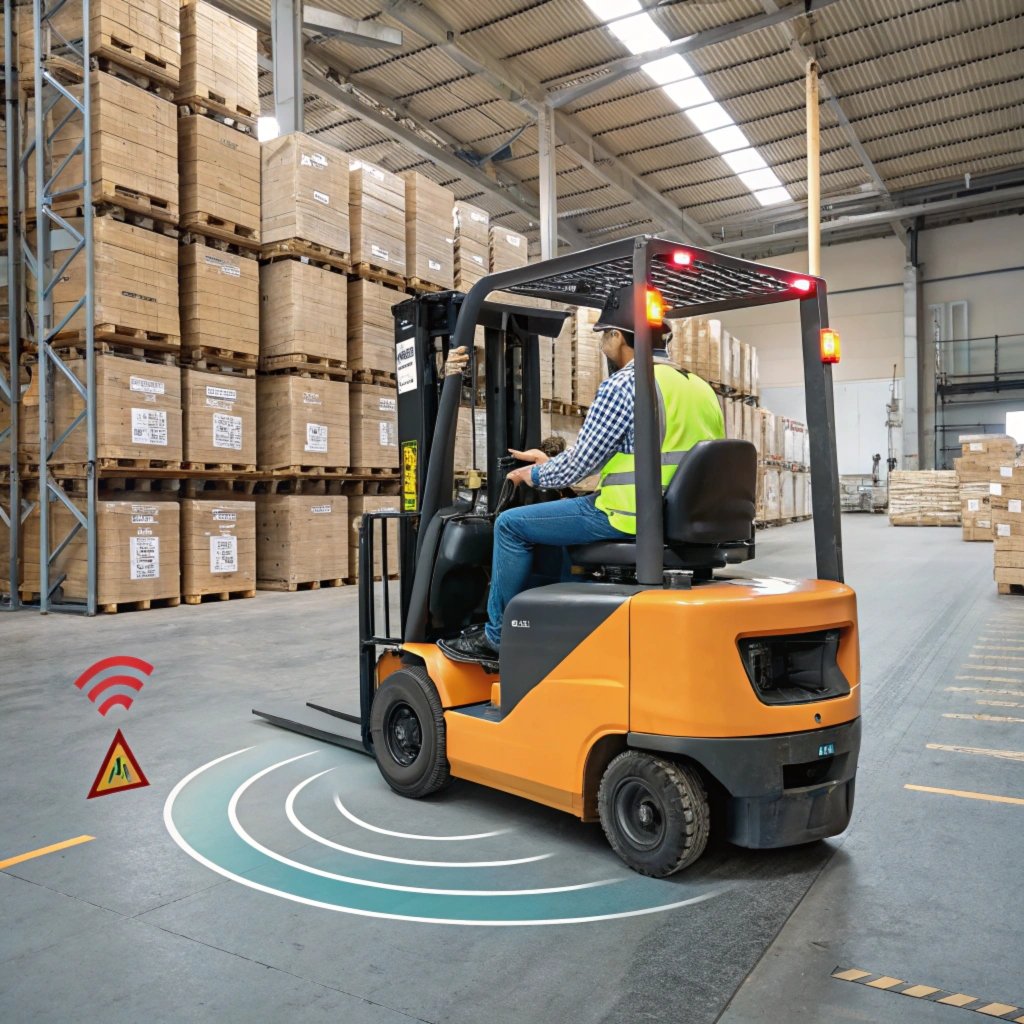
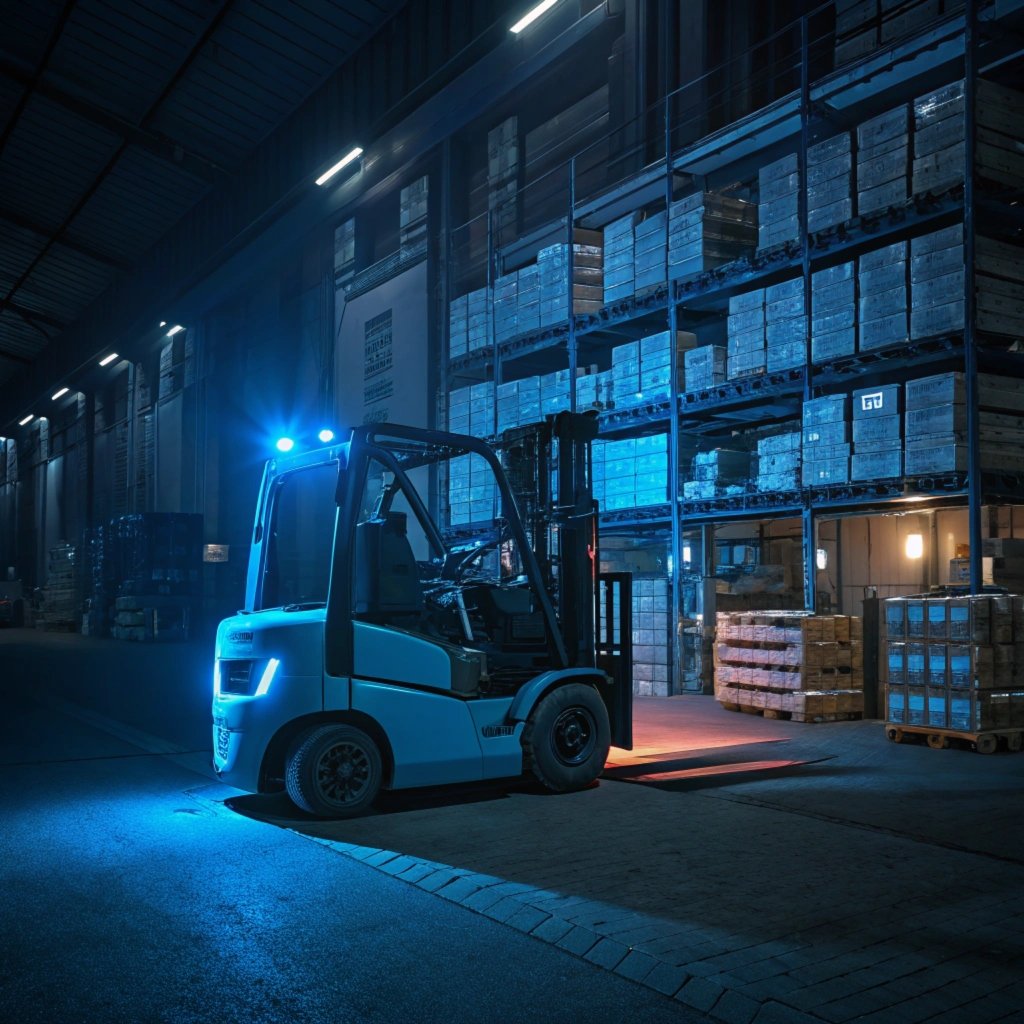
A forklift blue light is a directional LED or halogen lamp mounted on a forklift's overhead guard that projects a bright blue spot or arrow onto the warehouse floor, a few feet ahead of or behind the vehicle. It doesn't light up the forklift itself — it lights up the path in front of the forklift, so anyone approaching an intersection, doorway, or blind corner sees the blue glow on the ground before the forklift comes into view.
Blue was chosen deliberately. Warehouses are full of red and amber — stop signs, hazard tape, amber strobe beacons on other equipment. A blue beam stands out against that visual noise and is instantly recognizable as "forklift approaching," even to someone who has never worked in that facility before.
2. Why Blue Lights Matter for Warehouse Safety
Forklift-pedestrian incidents are one of the most consistently reported categories of serious warehouse injury, and a large share of them happen in the same handful of situations: a pedestrian stepping out from behind a rack, a blind 90-degree turn at the end of an aisle, or a forklift reversing out of a dock door. In every one of those cases, the core problem is the same — the forklift and the pedestrian can't see each other until it's almost too late.
A blue light doesn't fix visibility of the truck itself. It fixes the timing problem. Instead of a pedestrian and a forklift discovering each other at the same moment they're about to collide, the blue spot on the floor gives the pedestrian a visual cue a second or two earlier — often just enough time to stop walking, look up, and let the forklift pass.
- Low cost, low complexity: most kits install on a forklift's existing electrical system in under an hour.
- Works in noisy environments: unlike a horn or beeper, a visual warning doesn't get lost over machinery noise or hearing protection.
- Supports a documented safety program: many insurers and safety auditors view blue lights as a recognized, low-cost control worth noting in a facility's risk assessment.
3. How Forklift Blue Lights Work
Functionally, a blue light is straightforward: an LED or halogen bulb behind a focusing lens, wired into the forklift's 12V or 24V system, mounted at an angle that throws a defined spot or arrow shape onto the floor at a set distance from the vehicle.
Three variables determine how effective the light actually is in practice:
Mounting height
Higher mounting (on the overhead guard) throws the beam further and reduces the chance of the light being blocked by pallets or racking.
Projection distance
Most facilities aim for the beam to land 6–20 feet from the forklift — enough warning time without confusing it with a neighboring aisle.
Beam shape
A tight, defined spot or arrow is easier to notice at a glance than a wide, diffuse glow that blends into ambient lighting.
Ambient light
Brightly lit warehouses need a higher-lumen unit; the same light that's obvious in a dim dock area can wash out under skylights.
Not sure which blue light setup fits your aisle widths and lighting?
Talk to a Safety Specialist4. Types of Forklift Blue Lights
Not every blue light is built the same way. The right choice depends on your forklift's mast configuration, ceiling height, and how much of your traffic is bidirectional.
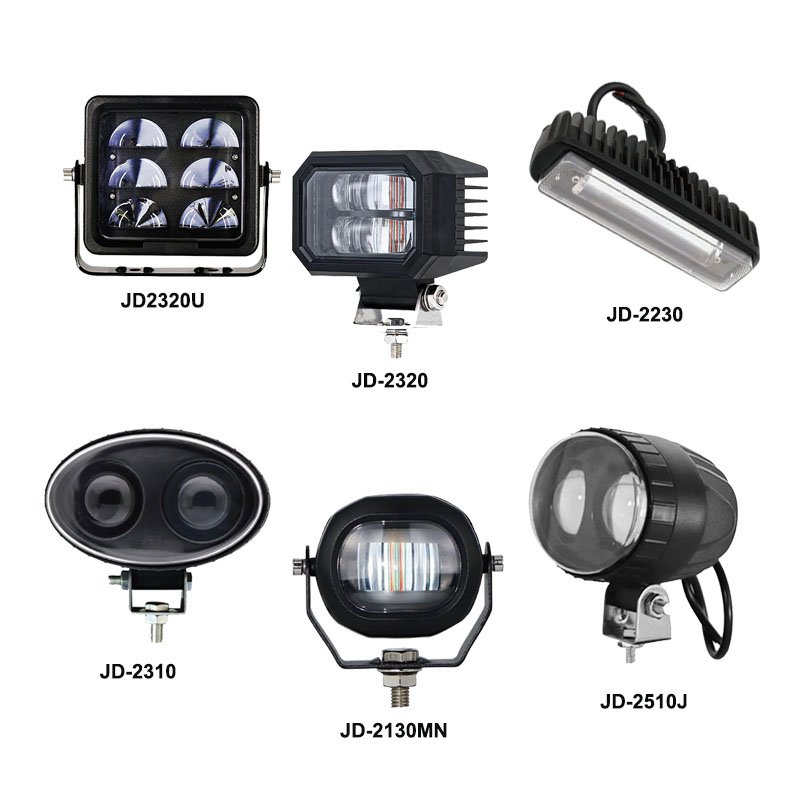
- Single-spot LED lights — one lamp projecting a single blue circle, typically mounted facing the primary direction of travel. The most common and lowest-cost option.
- Dual-beam / bidirectional kits — two lights, one facing forward and one facing the rear, since a large share of pedestrian incidents happen while the forklift is reversing.
- Arrow or line-projection lights — instead of a circle, these project a directional arrow or line, making the direction of travel unmistakable even at a glance.
- Halogen spotlights — an older but still-used option, generally brighter but with a shorter bulb life and higher heat output than LED equivalents.
You can see the visual difference between these configurations in the photo above — compare full specs for each blue light type here.
5. Blue Light vs. Other Forklift Warning Devices
A blue light is one tool among several. Here's how it stacks up against the other common forklift warning devices, so you can decide what combination makes sense for your facility.
| Device | What it warns | Best for | Limitation |
|---|---|---|---|
| Blue floor light | Pedestrians ahead, before the forklift is in view | Blind corners, doorways, rack-end intersections | Only helps if the pedestrian is looking down |
| Red zone / LED perimeter light | Pedestrians already close to the forklift | Marking a no-go zone around the vehicle body | Short range, less useful at blind corners |
| Backup alarm (audible) | Anyone within hearing range during reverse travel | Loading docks, reversing maneuvers | Easily lost in loud environments or with hearing PPE |
| Convex mirrors | The forklift operator, about blind spots | Fixed blind corners and aisle intersections | Passive — relies on the operator remembering to look |
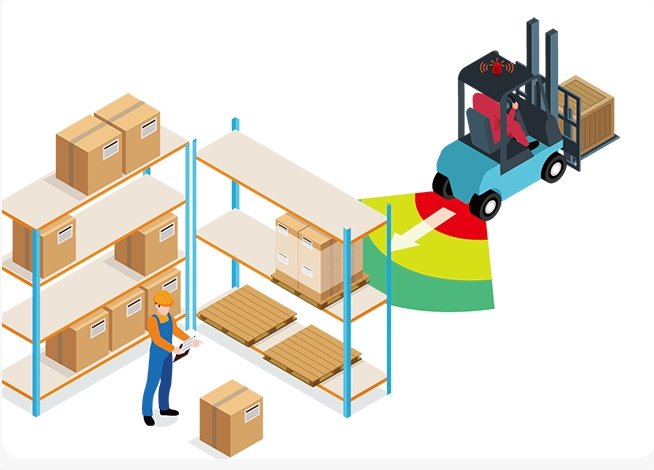
| Sensor-based anti-collision system | Both operator and pedestrian, in real time | High-traffic, mixed-fleet facilities | Higher cost and installation complexity |
The pattern here is consistent: every single-device solution has a blind spot. A blue light plus an audible alarm plus good mirror placement covers far more scenarios than any one of them alone.
6. OSHA & Safety Standards Context
OSHA's forklift standard, 29 CFR 1910.178, does not specifically name blue warning lights as a requirement. What it does require is that employers evaluate the workplace for hazards and take reasonable steps to control them — and many safety consultants, insurance risk assessors, and internal audit programs treat blue lights as exactly that kind of low-cost, recognized control for blind-corner and pedestrian risk, particularly in facilities where forklifts and foot traffic share the same aisles.
7. Where to Mount a Forklift Blue Light
Mounting position has more impact on effectiveness than almost any other factor. Get this wrong and even a bright, well-aimed light won't do its job.
- Overhead guard, forward-facing: the standard position for forward travel warning — high enough to clear pallets and throw a clean beam onto the floor ahead.
- Overhead guard, rear-facing: critical if your forklifts spend significant time reversing, since backing incidents make up a disproportionate share of forklift-pedestrian contact.
- Mast-mounted: used in some configurations for tighter beam control, though more prone to obstruction when the mast is raised.
- Avoid low chassis mounting — pallets, racking legs, and other forklifts will block the beam at floor level long before it reaches a useful distance.
8. Installation & Maintenance Best Practices
Aim it to your actual aisles
Test the beam distance against your specific aisle widths and intersection layouts, not a generic "one size fits all" angle.
Check the beam weekly
Vibration loosens brackets over time — a quick weekly visual check catches drift before it becomes a blind spot.
Clean the lens
Dust and warehouse grime dim output fast. Wipe the lens on the same schedule as other daily forklift pre-checks.
Match brightness to lighting
Re-evaluate lumen output if you change warehouse lighting, add skylights, or move equipment to a brighter zone.
9. Common Mistakes to Avoid
- Only lighting one direction of travel on forklifts that reverse frequently, leaving the highest-risk direction uncovered.
- Mounting too low, so the beam gets blocked by pallets and racking before it reaches a useful distance.
- Treating it as a complete solution instead of one layer in a broader pedestrian safety program.
- Skipping routine checks, letting a knocked or dimmed light go unnoticed for weeks.
- Ignoring operator training — a blue light warns pedestrians, but operators still need to slow down and look at intersections themselves.
Get a Free Warehouse Safety Assessment
Our team can walk your facility layout, flag your highest-risk blind corners, and recommend the right mix of blue lights, alarms, and detection for your fleet.
Request Your Free Assessment10. When a Blue Light Isn't Enough
A blue light only works if a pedestrian happens to be looking down at the right moment — it doesn't detect anyone, it doesn't sound an alert, and it doesn't slow the forklift. In high-traffic facilities, mixed-fleet operations, or areas with heavy pedestrian crossing, that passive warning often isn't enough on its own.
This is where facilities increasingly move toward sensor-based forklift anti-collision systems, which actively detect people and vehicles in real time and can alert both the pedestrian and the operator — closing the gap that a passive light leaves open. If you're evaluating whether your current blue-light setup is sufficient for your traffic levels, it's worth comparing it against a full forklift safety system for manufacturing environments.
11. Frequently Asked Questions
A blue light projected on the floor ahead of or behind a forklift is a visual warning signal. It tells pedestrians and other drivers that a forklift is approaching an intersection, doorway, or blind corner before the vehicle itself becomes visible, giving people extra time to step clear.
OSHA does not mandate blue warning lights in its general forklift standard, 29 CFR 1910.178. However, OSHA's General Duty Clause requires employers to keep the workplace free of recognized hazards, and many insurers, auditors, and site safety programs treat blue lights as a baseline control for blind-corner and pedestrian risk.
Most warehouse safety programs aim for the light to project 6 to 20 feet ahead of the forklift, giving pedestrians a few seconds of warning at typical indoor travel speeds. The exact distance depends on mounting height, aisle width, and forklift speed limits.
Blue lights are typically mounted on the overhead guard, either facing the direction of travel or angled toward the rear when the forklift is reversing, since forklifts strike pedestrians more often while backing up. Some facilities mount two lights, one on each end, for bidirectional coverage.
Many LED blue light kits are designed for straightforward installation using the forklift's existing 12V or 24V electrical system, and can be self-installed with basic tools. For fleet-wide installations or integration with a broader anti-collision system, professional installation helps ensure consistent aim, wiring safety, and compliance documentation.
A blue light is a helpful visual cue, but it only warns people who happen to be looking at the floor and does not detect pedestrians, sound an alarm, or slow the forklift down. Facilities with high pedestrian traffic typically pair blue lights with audible alarms, mirrors, and sensor-based anti-collision systems for layered protection.
Build a Complete Forklift Safety Program
Blue lights are a great first layer. See how our anti-collision sensors, alerts, and analytics complete the picture for your warehouse.
Speak With Our Team