Skip to content

Forklift Explosion Proof
Camera System
Why conventional cameras are a hidden ignition source — and how certified explosion-proof forklift camera systems transform blind-spot safety into a measurable, auditable, and legally defensible system in zones where a single spark can trigger catastrophe.
Section 01 What Is a Forklift Explosion Proof Camera System?
A forklift explosion proof camera system is a purpose-built visual monitoring solution designed to operate safely inside environments where flammable gases, combustible dust, or volatile vapours are present — locations where conventional electronics represent a genuine ignition risk.
Unlike standard reversing cameras or industrial CCTV units, explosion-proof forklift cameras are constructed with certified housings that contain any internal sparks or thermal events, preventing them from reaching the surrounding atmosphere. They are governed by international hazardous area standards (ATEX in Europe, IECEx globally, UL in North America) and must pass rigorous testing before they can legally operate in classified zones.
Think of a forklift explosion proof camera system not as an upgrade — but as essential safety infrastructure, as fundamental in a Zone 1 gas environment as a hard hat on a construction site.
An ordinary forklift backup camera that appears to work fine in a chemical warehouse is not safe — it is an uncertified ignition source operating under a false sense of security. Regulatory bodies in most jurisdictions have the authority to shut down operations and issue significant penalties for non-compliant electrical equipment in hazardous areas.
Section 02 Why Ordinary Cameras Can Cause Explosions
This is the point most facility managers underestimate. The danger is not that a standard camera will take poor footage in a warehouse — it's that it may silently trigger a catastrophic event.
Every non-explosion-proof electrical device contains at least one of three ignition mechanisms:
- ⚡ Electrical Sparks at Switching Contacts Every time a standard camera powers on, off, or adjusts — microswitches and relay contacts arc. In a Zone 1 hydrogen atmosphere (LEL as low as 4%), these arcs are sufficient to trigger ignition.
- 🌡 Surface Temperature Exceedance Standard cameras generate localised heat at processor chips, LED emitters, and power regulators. Many industrial atmospheres have ignition temperatures lower than the surface temperatures these devices routinely reach in operation.
- 🔌 Short Circuit and Arc Flash Events Forklifts operate in mechanically demanding environments. Cable abrasion, connector vibration, and water ingress cause intermittent short circuits — generating high-energy electrical arcs that can ignite surrounding atmosphere.
In a hazardous area, there is no such thing as a "safe enough" standard camera. There is only compliant equipment and non-compliant equipment. One is legal; the other is a liability waiting to detonate. — Industrial Safety Engineering Principle (IEC 60079 Framework)
The forklift explosion proof camera system solves all three failure modes simultaneously through engineered containment, thermal management, and intrinsic circuit design — detailed in Section 4.
Section 03 Understanding Hazardous Zone Classifications
Before selecting a forklift explosion proof camera, you must identify your facility's hazardous zone classification. Zone classifications determine the minimum protection level (EPL) required for any electrical equipment operating within them.
| Zone (Gas/Vapour) | Zone (Dust) | Definition | Typical Industry | Min. Camera Rating |
|---|---|---|---|---|
| Zone 0 | Zone 20 | Explosive atmosphere present continuously or for long periods | Inside fuel tanks, silo interiors | EPL Ga / Ma — Ex ia |
| Zone 1 | Zone 21 | Explosive atmosphere likely to occur in normal operation | Oil refineries, chemical plants, grain handling | EPL Gb / Mb — Ex d, Ex e, Ex ib |
| Zone 2 | Zone 22 | Explosive atmosphere unlikely but may occur in abnormal conditions | Paint shops, pharmaceutical warehouses, LPG storage periphery | EPL Gc / Mc — Ex nA or higher |
Many facility managers assume their warehouses are Zone 2 and therefore require minimal protection. A proper hazardous area study (HAZOP or risk assessment per IEC 60079-10) frequently reclassifies areas to Zone 1 — especially around loading docks, charging bays, and adjacent to process equipment. Always verify with a certified area classification engineer before specifying camera equipment.
Common Industries Requiring Forklift Explosion Proof Camera Systems
The following sectors routinely operate forklifts inside classified hazardous zones, making explosion-proof camera certification non-negotiable:
Oil and Gas: Refineries, LNG terminals, offshore supply yards, petrochemical loading facilities. Chemical Manufacturing: Solvent production, fertiliser plants, adhesive manufacturing, resin warehouses. Grain and Agriculture: Grain elevators, flour mills, animal feed facilities — combustible dust from grain is one of the most frequently underestimated explosion hazards in industrial settings. Pharmaceutical: Active pharmaceutical ingredient (API) manufacturing, solvent recovery areas, spray-drying operations. Mining: Underground operations, coal processing, mineral extraction facilities.
Section 04 Key Features of a Certified Explosion Proof Forklift Camera System
A certified system is architecturally different from a standard camera — not just a ruggedised version of one. Here are the engineering features that matter:
- 🛡 Flameproof (Ex d) Enclosure The enclosure is precision-machined to ensure that if ignition occurs internally, the explosion is contained and the flame front is quenched before it can exit through any joint. Typically manufactured from 316L stainless steel or marine-grade aluminium alloy with flame path gap tolerances to ±0.01mm.
- 🧊 Temperature Class Compliance (T-Rating) Every explosion proof camera system carries a T-class rating from T1 (surface temp ≤450°C) to T6 (≤85°C). For hydrogen atmospheres, T6-rated equipment is mandatory. The camera's entire operating temperature range must stay within the T-class under all load conditions.
- ⚙ Intrinsically Safe (Ex ia / Ex ib) Circuits Intrinsic safety limits the energy available in the electrical circuit — both in normal operation and under fault conditions — to a level that cannot ignite the specified gas group. This is the gold standard for Zone 0 and Zone 1 applications, and the most elegant protection concept since it prevents ignition by design rather than containment.
- 💧 IP66 / IP68 Ingress Protection Forklifts operate in environments subject to wash-down, high-pressure steam cleaning, and dust accumulation. A minimum IP66 rating (total dust exclusion, powerful water jets) is required; IP68 (continuous submersion) is preferred for the most demanding environments. IP67/IP68 ratings also reduce the risk of dust accumulating internally — a secondary explosion hazard.
- 📷 Wide Dynamic Range (WDR) Imaging Hazardous-area forklifts frequently transition between bright outdoor loading areas and dimly lit interior zones. A WDR sensor — typically 120dB or higher — ensures the camera adapts instantly without the driver losing visual awareness during the critical transition period.
- 🌙 Infrared Night Vision (Ex-rated LEDs) Night-shift operations represent a disproportionate share of forklift accidents. Ex-rated infrared LED illuminators extend camera visibility to 20–30 metres in complete darkness without introducing unsafe heat sources. The IR LEDs themselves must be rated for the zone.
- 🧲 Anti-Vibration Mounting and Cable Gland Seals Forklift operation generates significant mechanical vibration — particularly over uneven concrete, dock plates, or rough terrain. All cable entry points must use certified Ex d or Ex e cable glands with anti-vibration compound, and camera brackets must include vibration-damping elements to maintain image stability and preserve enclosure integrity.
Section 05 ATEX, IECEx and UL Certifications Explained
Certification is not optional — it is the legal mechanism that defines whether your forklift explosion proof camera system is compliant with national and international workplace safety law. Here is what each mark means:
Always request the original certificate document — not just a manufacturer's claim. The certificate must specify: the exact gas group (IIA, IIB, IIC), temperature class (T1–T6), zone suitability (Zone 0/1/2), and the issuing Notified Body reference number. Uncertified or improperly specified equipment has no place in a classified area, regardless of price or appearance.
Gas Group Classification and Why It Matters
Explosion proof cameras must be specified for the correct gas group. Equipment rated for Group IIA (propane) is not safe in a Group IIC (hydrogen) environment. The groups, from least to most hazardous, are: IIA (propane, ethane, butane), IIB (ethylene, town gas), and IIC (hydrogen, acetylene, carbon disulfide). Most premium forklift explosion proof camera systems carry a Group IIC rating — ensuring they are safe across all industrial gas environments without the need for separate specification by gas type.
Section 06 Safety Benefits: From Reactive Incident Response to Active Prevention
The operational safety impact of a forklift explosion proof camera system goes well beyond "the driver can see better." Properly deployed, these systems fundamentally change the safety architecture of hazardous-area forklift operations.
Blind Spot Elimination
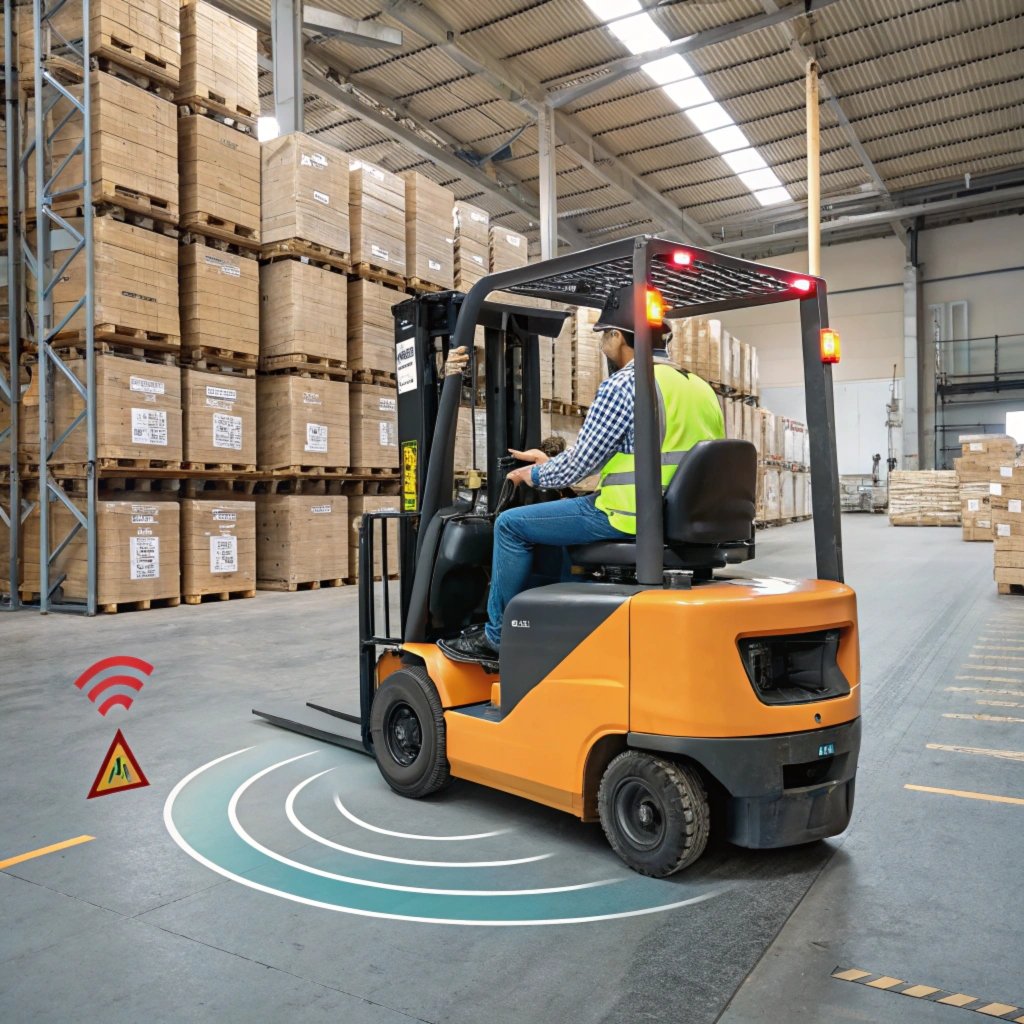
Rear-facing, side-facing, and overhead cameras cover the three primary forklift blind zones: directly behind the vehicle, beside the mast at height, and in the downward direction when carrying tall loads. In a hazardous chemical plant where a vehicle collision could rupture a pipe or dislodge a pressure fitting, eliminating these blind spots is not merely a pedestrian-safety issue — it is an explosion-prevention measure.
Pedestrian Detection with AI Analytics
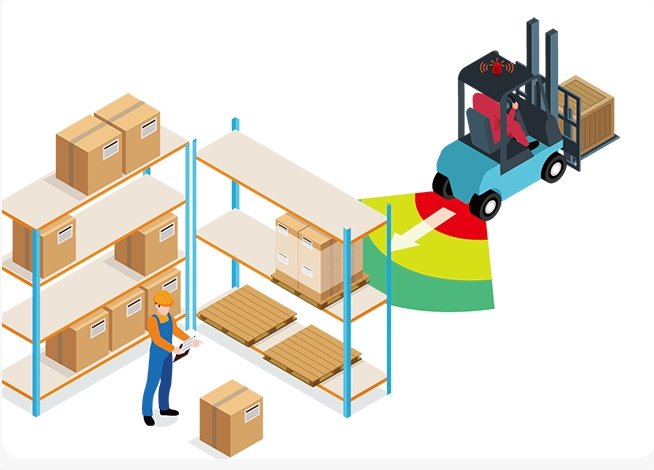
Advanced explosion proof forklift camera systems now integrate AI-powered pedestrian detection directly into the vehicle display unit. The system can alert the driver — and simultaneously log the near-miss event — when a person enters the defined danger zone around the vehicle. In a crowded chemical warehouse where workers may not hear a reversing alarm over process noise, visual and vibrotactile driver alerts based on camera-AI detection can prevent fatalities.
Real-Time Monitoring and Evidence Recording
Beyond the driver's display, explosion proof camera feeds can be transmitted — via intrinsically safe or fibre-optic signal paths — to a central control room for real-time monitoring. Continuous recording with timestamped footage provides audit-quality evidence for incident investigation, regulatory compliance demonstration, and insurance purposes. The footage often proves decisive in determining liability after incidents.
Night Shift and Low-Light Operations
Industrial facilities running 24-hour operations are statistically more accident-prone on night shifts — compounding poor visibility with operator fatigue. Explosion proof cameras with IR illumination and WDR imaging maintain full situational awareness regardless of ambient light conditions, effectively decoupling accident risk from time-of-day.
The shift from reactive safety (investigate after an incident) to predictive safety (detect and prevent before an incident occurs) is the defining value proposition of a modern forklift explosion proof camera system. In hazardous areas, the cost of a single uncontrolled incident typically exceeds the entire lifetime investment in prevention technology by a factor of 10–100.
Section 07 The Hidden Cost of Not Installing an Explosion Proof Camera System
When facilities managers evaluate forklift explosion proof camera systems purely as a capital expenditure, they systematically undercount the cost of the alternative. The "decision not to spend" is itself a financial exposure — one that typically dwarfs the system investment by orders of magnitude.
Direct Costs of an Incident in a Hazardous Area
Worker compensation and medical costs for serious injuries in industrial environments frequently reach six to seven figures in jurisdictions with comprehensive workers' compensation frameworks. Where fatalities occur, civil litigation and criminal prosecution costs can dwarf initial compensation claims. Production shutdown following a serious incident in a classified zone — including mandatory regulatory investigation, area decontamination, equipment replacement, and re-certification — typically runs from weeks to months, with daily production loss costs in chemical and refinery environments routinely exceeding £100,000–£500,000 per day. Equipment and structural damage in an explosion event can render an entire processing area unrecoverable, with reconstruction costs running to many millions.
Regulatory Penalties and Legal Exposure
In most jurisdictions, operating uncertified electrical equipment in a classified hazardous area is a strict-liability offence. Regulatory bodies including the Health and Safety Executive (UK), OSHA (US), and their national equivalents have the authority to issue unlimited fines for serious breaches, and company directors face personal criminal liability where negligence is established. Regulatory investigation following a preventable incident will routinely examine the specification records of every electrical device in the vicinity — a non-certified camera found at the scene of an explosion is an extremely difficult fact to defend.
Insurance Implications
Industrial insurance policies typically contain hazardous-area equipment compliance warranties. A claim arising from an incident where non-certified equipment is found to have been a contributing factor may be partially or wholly repudiated — transforming an insured loss into an uninsured one.
Section 08 From Forklift to Intelligent Safety Node: The Smart Facility Vision
A forklift explosion proof camera system is increasingly the entry point to a broader intelligent facility platform. Once a certified, network-connected camera is installed on each vehicle, the forklift transforms from a simple material-handling machine into a mobile data node — contributing real-time operational intelligence across a range of integrated systems.
Fleet Telematics Integration
Camera event data — near-misses, hard braking, zone boundary crossings — integrates with fleet management platforms to build a comprehensive operational picture per vehicle, per driver, and per shift. This data drives predictive maintenance scheduling, route optimisation, and operational efficiency improvements that extend well beyond the original safety justification.
Driver Behaviour Scoring and Training
AI-powered analysis of camera footage can generate objective driver behaviour scores — identifying patterns of speeding, sharp turns, excessive load heights, and proximity violations. These scores feed into targeted training programmes, transforming subjective safety culture conversations into measurable, data-driven performance management.
AI Collision Avoidance Systems
The camera feed from a forklift explosion proof camera system provides the visual input for AI-powered collision avoidance systems that can apply automatic braking or speed limiting when an imminent collision is detected. In hazardous areas, where the consequences of vehicle collisions extend beyond property damage into potential ignition events, these systems represent the most sophisticated layer of the modern forklift safety architecture.
Digital Permit-to-Work Integration
Camera systems that record vehicle positions and timestamps can be integrated with digital permit-to-work platforms — providing automated verification that vehicles are not entering restricted zones during active maintenance operations, and creating an auditable record of zone compliance throughout each shift.
Section 09 Buying Guide: How to Choose the Right Forklift Explosion Proof Camera System
Selecting the right system requires working through a structured specification process. Cutting corners at any stage creates compliance gaps that will surface — at the worst possible moment.
Conduct or commission a formal hazardous area classification study
Establish the zone designation (Zone 0/1/2 or 20/21/22), gas group (IIA/IIB/IIC or IIIA/IIIB/IIIC for dust), and required temperature class (T1–T6) for every area where forklifts operate. This is the non-negotiable first step.
Specify the protection concept required
Zone 1 typically requires Ex d (flameproof) or Ex ib (intrinsic safety) cameras. Zone 2 permits Ex nA (non-sparking). Confirm which protection concept is acceptable under your site's area classification documentation before approaching vendors.
Verify certifications against your jurisdiction
Confirm whether your country requires ATEX, IECEx, or national equivalent certification. Request original certificates and verify the issuing Notified Body is accredited. Cross-reference the certificate scope against your zone and gas group.
Evaluate optical performance for your environment
Assess resolution (minimum 1080p for incident evidence quality), WDR capability, IR range, and lens field of view for your specific forklift type and operating environment. Consider multiple camera positions per vehicle for full coverage.
Assess system integration and data connectivity
Determine whether the system needs to integrate with existing fleet management, CCTV, or safety management platforms. Confirm the signal transmission method (wired to display, wireless via Ex-rated transmitter, fibre optic) and its certification status.
Plan installation with a certified Ex electrical contractor
The camera system itself must be installed by competent persons trained in Ex electrical installation (CompEx or equivalent qualification). Improper installation of a certified camera can negate its certification. Retain all installation documentation for compliance records.
Section 10 Frequently Asked Questions
Ready to Specify Your System?
A correctly specified forklift explosion proof camera system is one of the highest-ROI safety investments available to hazardous area facility managers. Combine zone classification data, certification requirements, and optical specifications — then partner with a certified Ex equipment supplier.
Consult a Certified Specialist
Forklift Explosion Proof Camera System from Nine Chip Electron