Skip to content
Why the Forklift Speed Limiter Needs to Follow the R89 Standard
Overspeed is one of the most common root causes of forklift collisions with racking, pedestrians, and other vehicles. A forklift speed limiter that merely “slows the truck down” is not enough. When the device is built and tested to the R89 standard, operators, safety managers, and fleet buyers gain measurable accuracy, reliability, and accountability that directly reduce accident risk.
📋 Table of Contents
- 1. Why Forklift Speed Control Matters for Accident Prevention
- 2. What Is the R89 Standard?
- 3. Why Forklift Speed Limiters Should Follow R89
- 4. Real Risks of Non-Compliant Speed Control
- 5. What Buyers Should Look For
- 6. How an R89-Aligned Speed Limiter Works in Practice
- 7. Implementation Tips for Warehouse Safety
- 8. FAQs
1. Why Forklift Speed Control Matters for Accident Prevention
OSHA and most national regulators do not set a single universal speed limit for powered industrial trucks. Instead they require employers to operate forklifts at a speed that allows the truck to stop safely under the conditions present. In practice that means lower speeds near pedestrians, at intersections, in narrow aisles, and around racking.
Industry guidance commonly recommends:
- Approximately 8 mph (13 km/h) or less in general warehouse travel
- 3 mph (5 km/h) or lower in high pedestrian or congested zones
- Even slower speeds on turns, ramps, and dock areas
When these limits rely only on operator judgment or simple mechanical restrictors, compliance drifts. A properly engineered forklift speed limiter removes that variability by enforcing a maximum speed the truck cannot exceed, regardless of throttle input.

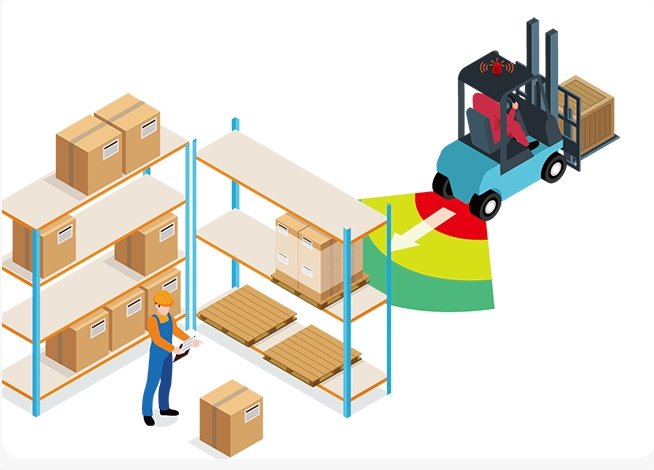
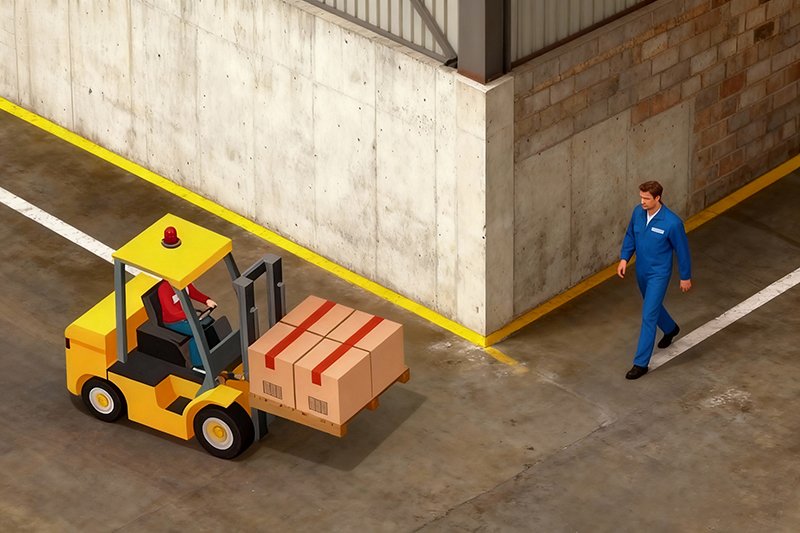
Overspeed leaves almost no reaction time when a pedestrian steps into the path of a forklift.

Impact damage to racking and product is a frequent and expensive consequence of uncontrolled speed.
2. What Is the R89 Standard?
UN Regulation No. 89 (commonly called R89 or ECE R89) is a United Nations Economic Commission for Europe regulation that sets uniform technical requirements for speed limitation devices (SLDs) and adjustable speed limitation devices (ASLDs). It was developed primarily for road vehicles in categories such as heavy goods vehicles and buses, but its performance criteria — accuracy, durability, electromagnetic immunity, and installation integrity — are widely recognized as a rigorous benchmark for any speed-limiting system.
Core expectations under R89 include:
- The vehicle must not exceed the set speed by more than a defined tolerance under normal operating conditions
- The device must not interfere with the service braking system
- Performance must remain stable across load changes, gradients, and normal wear
- The system must resist interference from magnetic or electric fields
- Type-approval involves independent testing by a recognized authority
For forklift applications, following the principles and test methods of R89 means the speed limiter is designed and verified against the same disciplined framework used for critical road-vehicle safety equipment rather than relying on informal internal claims.
3. Why Forklift Speed Limiters Should Follow R89
3.1 Accuracy That Operators and Auditors Can Trust
A limiter that allows the truck to creep several km/h above the programmed limit defeats the purpose. R89-aligned devices are required to hold the set speed within tight tolerances. That consistency is essential when different zones of a warehouse have different permitted speeds and when incident investigations later examine whether the control system performed as intended.
3.2 Reliability Under Real Warehouse Conditions
Warehouses involve vibration, temperature swings, dust, moisture, and electromagnetic noise from other equipment. R89 includes requirements for electromagnetic compatibility and stable performance. A device that drifts or fails under these conditions creates a false sense of security.
3.3 Clear Accountability and Audit Trail
Many modern R89-oriented forklift speed limiters incorporate data logging, event recording, and remote parameter management. When an incident occurs, the ability to show that the truck was mechanically limited to a defined speed strengthens both internal safety culture and external compliance posture.
3.4 Compatibility With Broader Safety Systems
Speed control rarely works in isolation. The most effective warehouses combine an R89-aligned forklift speed limiter with pedestrian detection, zone-based speed reduction, access control, and impact monitoring. Devices built to a recognized standard integrate more cleanly and behave predictably alongside these systems.
4. Real Risks of Non-Compliant or Poorly Designed Speed Control
Not every device marketed as a “speed limiter” delivers the same level of control. Common shortcomings include:
- Large tolerance bands that allow the truck to exceed the intended limit by a meaningful margin
- Sensitivity to load, ramp angle, or battery voltage that causes inconsistent limiting
- Interference with normal acceleration or hydraulic performance that operators then try to bypass
- Lack of tamper resistance or easy override by unauthorized personnel
- No recording of overspeed attempts or parameter changes
These gaps turn the device into a paper control rather than an engineering control. In the event of an accident the organization may still face questions about whether the chosen technology was reasonably effective.
5. What Buyers Should Look For
When evaluating a forklift speed limiter, use the following practical checklist:
| Evaluation Point | Why It Matters |
|---|---|
| Documented alignment with R89 principles or equivalent testing | Provides independent performance benchmark rather than self-declaration |
| Adjustable set speeds (and preferably multi-zone capability) | Allows different limits for aisles, pedestrian areas, docks, and outdoor yards |
| Minimal impact on normal acceleration and hydraulic power | Operators are less likely to resist or attempt to defeat the system |
| Tamper resistance and access control (e.g., IC card or password) | Prevents unauthorized raising of the speed limit |
| Event logging / black-box function | Supports investigation, training, and continuous improvement |
| Compatibility with existing forklift models and voltages | Simplifies fleet-wide rollout without major modifications |
| Clear installation and calibration procedure | Reduces risk of incorrect setup that undermines accuracy |

A modern forklift speed limiter unit designed for reliable, standards-aligned performance across mixed fleets.
6. How an R89-Aligned Speed Limiter Works in Practice
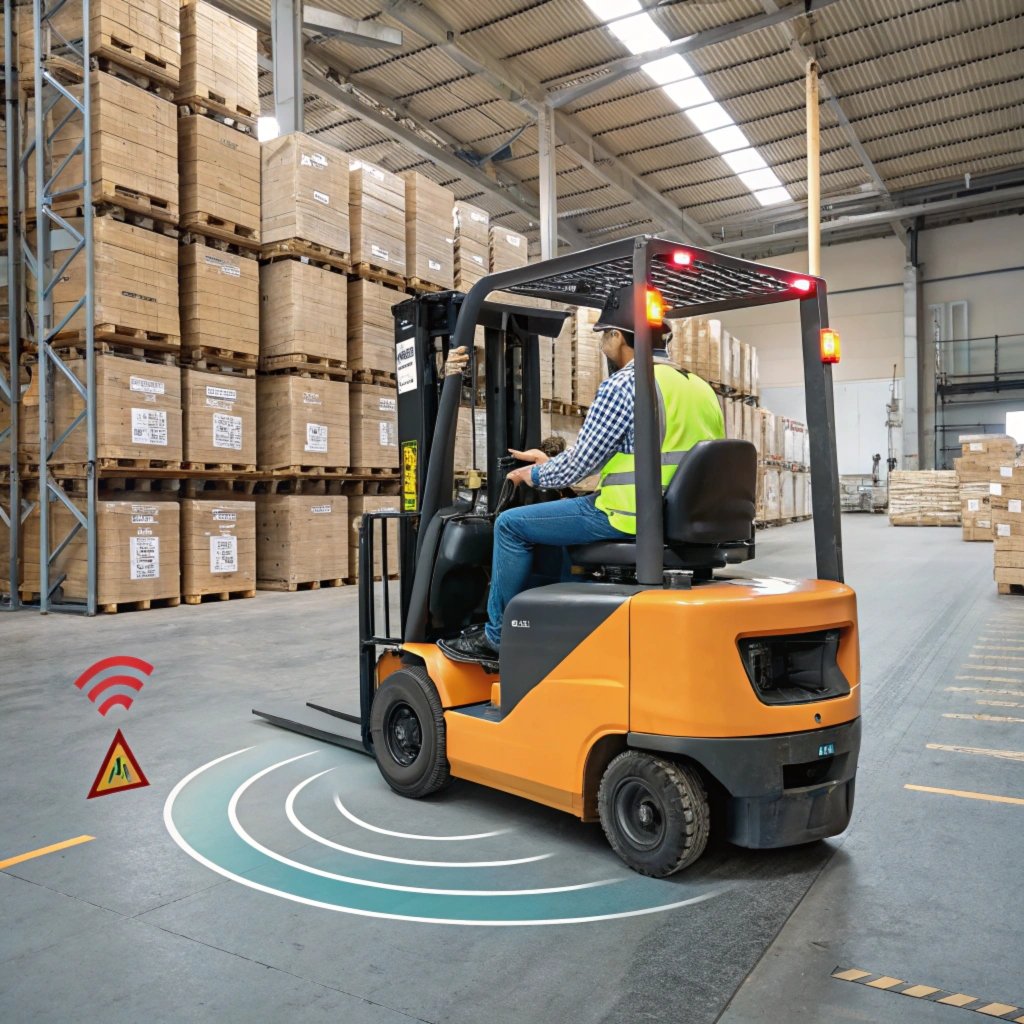
Most electronic systems monitor actual travel speed (via sensor or vehicle signal) and compare it with the programmed limit. When the limit is approached or reached, the system reduces engine or motor power demand so the truck cannot accelerate further. Progressive warning stages (visual, then audible) are often provided before full limiting takes effect.
Better systems also support:
- Different speed profiles for different areas of the site
- Integration with access-control cards so only authorized operators can run the truck
- Remote adjustment of limits by safety or maintenance personnel
- Recording of overspeed events and parameter changes
Because the control acts on power demand rather than the service brakes, it avoids the safety and wear issues that would arise from constant brake intervention.
7. Implementation Tips for Warehouse Safety
Installing a high-quality speed limiter is only part of the solution. To maximize accident reduction:
- Map speed zones based on pedestrian density, aisle width, visibility, and racking proximity. Assign lower limits where risk is highest.
- Combine with other controls — pedestrian detection, mirrors or cameras, physical barriers, and clear walkways — rather than relying on speed alone.
- Train operators on why the limits exist and how the system behaves so they do not view it as an obstacle to productivity.
- Calibrate and verify after installation and after any major maintenance or software change.
- Review logged data periodically. Patterns of repeated near-limit events can highlight layout or process problems that need attention.
- Include the limiter in management of change procedures so future equipment modifications do not inadvertently disable or degrade the system.
Ready to Strengthen Your Forklift Safety System?
As a forklift safety system provider we help warehouses implement accurate, reliable speed control that aligns with recognized performance standards. Talk with our team about how an R89-oriented forklift speed limiter can fit your fleet and risk profile.
Request a Safety Consultation8. FAQs
Is R89 mandatory for forklifts?
R89 was developed primarily for certain categories of road vehicles. It is not a universal legal mandate for every forklift worldwide. However, following its performance and testing principles gives buyers and safety managers a clear, internationally recognized benchmark for accuracy and reliability — which is why many high-quality forklift speed limiters are designed and verified against those same criteria.
Will a speed limiter reduce productivity?
When limits are set realistically for each zone and the system does not unnecessarily restrict acceleration or hydraulic performance, most operations see little or no overall productivity loss. The reduction in collisions, racking damage, product loss, and downtime usually more than offsets any minor time difference on individual moves.
Can one limiter serve both indoor and outdoor forklifts?
Many modern systems support multiple programmable speeds and can be configured for different environments. Confirm voltage compatibility, environmental rating, and whether the unit supports the specific throttle or drive system of your trucks (mechanical cable, drive-by-wire, hand/thumb control, etc.).
How is the set speed chosen?
Start from a site-specific risk assessment. Consider pedestrian interaction, aisle geometry, floor condition, load types, and any existing company or insurer requirements. Common practice is a higher limit for open travel areas and a significantly lower limit in pedestrian-dense or high-congestion zones. The forklift speed limiter then enforces those chosen values consistently.
What happens if someone tries to override the system?
Quality units include tamper-resistant design, access control (card or password), and logging of parameter changes or attempted overrides. These features support both technical integrity and management accountability.
Should a speed limiter be the only safety measure?
No. Speed control is one engineering layer. Pair it with operator training, traffic management, pedestrian separation or detection systems, good housekeeping, and regular equipment inspection for the strongest overall protection.
A forklift speed limiter built to follow the discipline of the R89 standard turns a policy speed limit into a reliable physical control. For warehouses serious about preventing collisions with pedestrians, racking, and other equipment, that difference in design and verification is worth insisting on.