Skip to content

How to Design a High-Performance Forklift Operation Route in the Warehouse
The fastest warehouses aren't the ones with the fastest forklifts — they're the ones where trucks never have to slow down for a blind corner, a jammed intersection, or a pedestrian who shouldn't have been in that aisle in the first place. Here's how to design a route that's fast because it's safe, not despite it.

A well-designed forklift route sets one-way flow, aisle sizing, and intersection rules before a single truck ever moves — not after the near misses start.
Most warehouses don't design their forklift routes — they inherit them. Racking goes up where it fits, aisles get whatever width was left over, and the "route" is really just whatever path drivers have worked out for themselves over time. That works fine right up until throughput increases, a new SKU mix changes travel patterns, or two trucks meet at a blind corner neither one saw coming.
A high-performance route is designed on purpose: traffic flow direction, aisle width matched to the equipment using it, intersections that don't rely on luck, and zoning that keeps your highest-frequency travel as short and predictable as possible. This guide walks through exactly how to build one, step by step.
1. Why Route Design Affects Both Speed and Safety
Every stop, detour, and near miss in a forklift's travel path costs time — not just the seconds lost to the incident itself, but the accumulated delay of drivers instinctively slowing at every blind corner because they've learned they have to. A route designed around clear sightlines, consistent right-of-way, and predictable traffic direction lets operators move at a confident, consistent pace, because they're not constantly guessing what's coming from the other direction.
That's the core idea behind high-performance route design: speed and safety aren't competing goals here. A route that's genuinely safer is almost always the faster one too, because uncertainty — not distance — is what actually slows a fleet down.
2. One-Way vs Two-Way Traffic Flow
The first major decision in any route design is traffic direction. One-way aisles eliminate head-on encounters entirely and generally allow narrower aisle widths, which frees up floor space for additional storage. Two-way aisles offer more routing flexibility — a truck doesn't have to travel the long way around to reverse direction — but they require wider clearances and carry a higher chance of two trucks meeting mid-aisle.
Most high-throughput facilities use a hybrid: one-way flow through dense storage aisles where space is tightest and traffic is heaviest, with wider two-way corridors at the perimeter or main cross-aisles where flexibility matters more than density.
3. Sizing Aisles to the Equipment, Not the Other Way Around
Aisle width should be set by the turning radius and load dimensions of the specific trucks operating in that zone — not a single blanket number applied warehouse-wide. A standard counterbalance truck typically needs a wider aisle than a narrow-aisle reach truck or an order picker, so mixing equipment types across the same aisle plan usually means designing for the widest vehicle that will ever use it.
- Match aisle width to the widest regular user, not the average truck, including any seasonal or rental equipment brought in during peak periods.
- Add extra clearance at rack ends and intersections, where trucks are turning rather than traveling straight, and where sightlines are already reduced.
- Reassess aisle sizing whenever equipment changes — a fleet upgrade to trucks with a different turning radius can quietly turn a previously adequate aisle into a tight one.
4. Designing Safer Intersections
Intersections — where aisles cross, or where an aisle meets a main corridor — are where the majority of forklift-to-forklift incidents cluster, because they're the one point in a route where two vehicles' paths can genuinely converge without warning.
- Install convex mirrors at blind corners formed by racking, so an approaching operator gets some visual warning even without a direct sightline.
- Set and enforce consistent right-of-way rules — main aisle traffic yields less than cross-traffic, for example — so operators aren't negotiating priority on the fly at every crossing.
- Mark intersection approach zones with floor markings that cue a mandatory slow-down well before the actual crossing point, not right at it.
- Avoid placing intersections directly behind racking corners wherever the floor plan allows — even a small offset improves the sightline dramatically.
5. Zoning the Warehouse by Travel Frequency
A high-performance route puts your most frequently traveled paths — fast-moving SKUs, primary put-away and pick routes, dock-to-storage runs — on the shortest, most direct, least obstructed path available. Slower-moving or bulk storage can sit further from the main flow without hurting overall throughput, since those trips happen far less often.
- Map travel frequency by zone, not just by square footage, using pick and put-away data rather than assumptions about which areas "feel" busy.
- Keep your highest-frequency zone closest to receiving and shipping, minimizing the average travel distance for the trips that happen most often.
- Revisit zoning when SKU velocity shifts, such as after a seasonal demand change — a route optimized for last year's traffic pattern can become inefficient without anyone changing the physical layout.
6. Separating Pedestrian and Forklift Paths
Every point where a pedestrian walkway crosses a forklift route is a risk point, and the goal of route design isn't to eliminate crossings entirely — that's rarely possible — but to minimize how many exist and control the ones that remain.
- Route pedestrian walkways around the perimeter of forklift traffic wherever the floor plan allows, rather than running them through active aisles.
- Consolidate necessary crossings into a small number of marked points, rather than leaving pedestrians to cross an aisle wherever seems convenient.
- Treat crossing points as their own mini-intersections, with the same speed-reduction and visibility standards applied to forklift-to-forklift intersections.
Pedestrian crossings are a common gap in route design
Camera-based detection at crossing points catches pedestrians a route plan alone can't guarantee will stay clear.
See how AI camera detection covers crossing zones →7. Signage, Markings, and Speed Zoning
A route design only works if operators can actually read it on the floor, not just on a planning document. Floor markings for direction of travel, posted speed limits by zone, and clear signage at intersections turn a route plan into something operators follow automatically, without needing to memorize a policy.
- Set differentiated speed limits by zone, not one blanket facility-wide number — main corridors, dense aisles, and pedestrian-crossing zones each warrant a different cap.
- Use consistent color coding for travel direction, pedestrian paths, and restricted zones so the meaning is instantly recognizable across the whole facility.
- Keep markings maintained, since faded floor paint quietly erodes route discipline over time even when the original design was solid.
8. Route Design Choices Compared
| Design Factor | Option A | Option B | Best Fit |
|---|---|---|---|
| Traffic direction | One-way aisles | Two-way aisles | One-way for dense/high-traffic; two-way for flexible perimeter routes |
| Aisle width basis | Fixed facility-wide standard | Sized per equipment class | Per-equipment sizing avoids over- or under-building clearance |
| Pedestrian routing | Shared aisle with forklifts | Perimeter path, marked crossings | Perimeter routing minimizes total crossing exposure |
| Speed limits | Single facility-wide limit | Zone-based limits | Zone-based matches risk level to the specific area |
| Intersection control | Markings and mirrors only | Markings plus automatic braking/alerts | Combined approach for the highest-traffic blind intersections |
9. A Step-by-Step Process for Designing Your Route
- Map current travel patterns. Before redesigning anything, document where forklifts actually travel today, including informal shortcuts operators have developed on their own — those often reveal where the existing plan doesn't match real operations.
- Pull pick and put-away frequency data. Identify which zones see the heaviest traffic so the highest-frequency paths can be prioritized for the shortest, clearest routing.
- Set traffic direction per aisle. Decide one-way versus two-way for each aisle and corridor based on traffic density and available width, not a single blanket rule.
- Design intersections deliberately. Identify every point where paths cross, assign right-of-way rules, and add mirrors, markings, or technology-based alerts where sightlines are limited.
- Separate pedestrian paths. Route walkways around forklift traffic and consolidate any necessary crossings into a small number of clearly marked points.
- Apply zone-based speed limits. Set differentiated limits for corridors, dense aisles, and crossing zones based on actual risk rather than a single facility-wide number.
- Mark and test the route. Apply floor markings and signage, then walk and drive the new route with actual operators before declaring it final — plans that look right on paper sometimes reveal gaps once trucks are actually moving through them.
- Review with real traffic and near-miss data. After rollout, track near misses and travel-time data by zone to confirm the design is performing as intended, and adjust the specific segments that aren't.
Build a Layered Safety System Around Your Actual Risk
We design and install both AI camera and UWB forklift safety systems, matched to the specific blind spots and traffic patterns in your facility — not a one-size-fits-all package.
Talk to a Forklift Safety Specialist10. Where Technology Fits Into Route Performance
Route design sets the plan; technology helps enforce it and tells you when the plan needs adjusting. A few examples that show up repeatedly in high-performance routes:
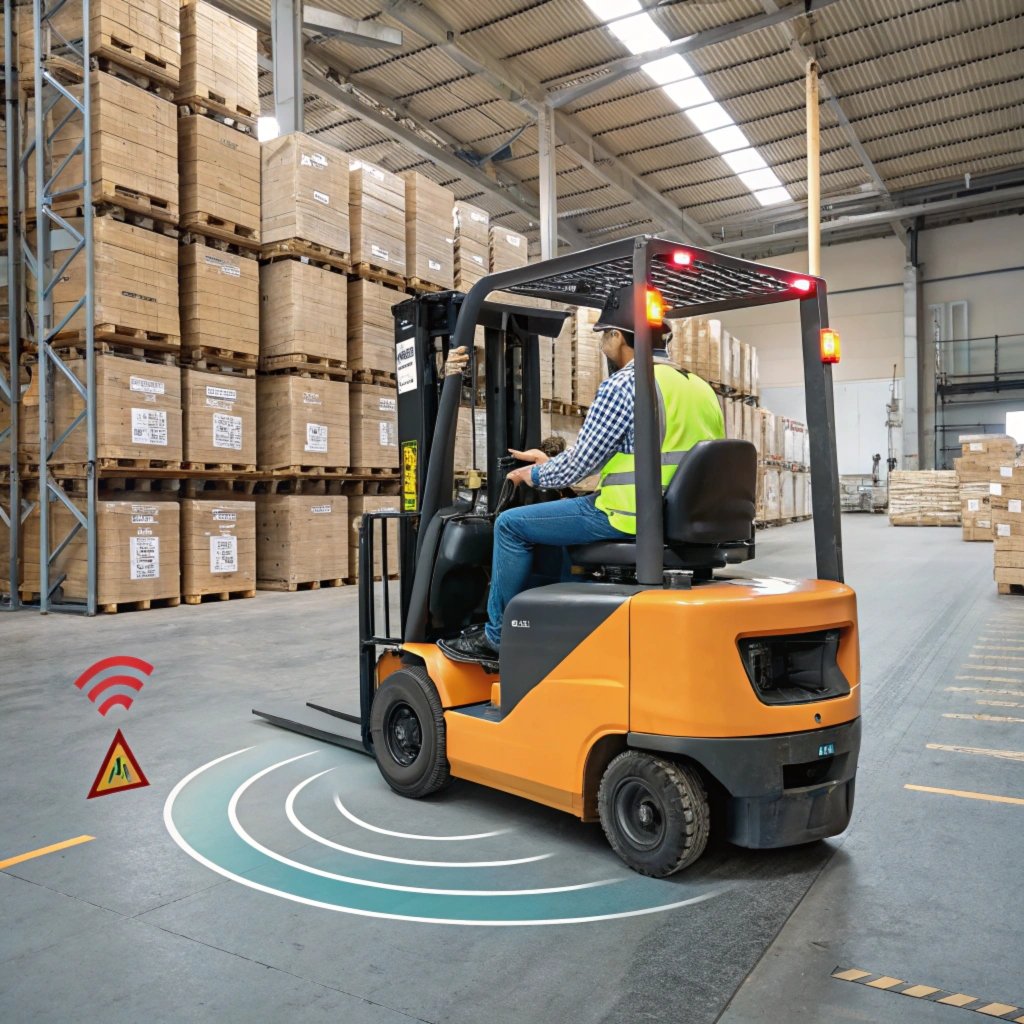
- Zone-based speed limiting automatically caps truck speed in specific corridors or aisles, enforcing the speed zoning your route design calls for without depending entirely on operator discipline.
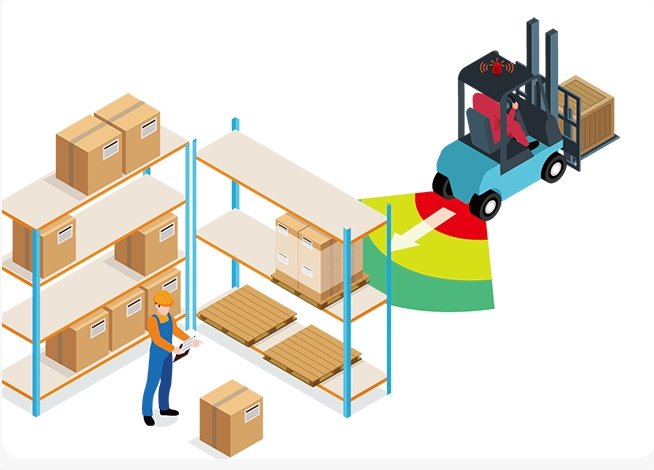
- Proximity and geofencing systems trigger automatic alerts or speed reduction at intersections and crossing points, adding a layer of protection at exactly the spots route design alone can't fully cover — see our guide on UWB geofencing for forklifts for how virtual zones work.
- Camera-based detection covers pedestrian crossing points and dock approaches where untagged foot traffic is common, backing up the physical separation your route design already builds in.
- Traffic and near-miss data collected from these systems gives you an evidence-based way to revisit the route periodically, rather than only redesigning after an actual incident forces the question.
11. Frequently Asked Questions
Tap a question to expand the answer.
What is a forklift operation route in a warehouse?
Should warehouse aisles be one-way or two-way for forklifts?
How wide should a forklift aisle be?
How do you reduce forklift and pedestrian crossing points?
What causes most intersection collisions in warehouse forklift routes?
Can technology improve forklift route performance and safety?
Get Your Route Design Reviewed by a Forklift Safety Specialist
Tell us about your current layout and traffic pattern, and we'll help identify where route design and safety technology can cut both travel time and risk.
Get a Free Fleet Safety Assessment